• Home
  • Practice Focus
    • Facial Plastic/Reconstructive
    • Head and Neck
    • Laryngology
    • Otology/Neurotology
    • Pediatric
    • Rhinology
    • Sleep Medicine
    • How I Do It
    • TRIO Best Practices
  • Business of Medicine
    • Health Policy
    • Legal Matters
    • Practice Management
    • Technology
    • AI
  • Literature Reviews
    • Facial Plastic/Reconstructive
    • Head and Neck
    • Laryngology
    • Otology/Neurotology
    • Pediatric
    • Rhinology
    • Sleep Medicine
  • Career
    • Medical Education
    • Professional Development
    • Resident Focus
  • ENT Perspectives
    • ENT Expressions
    • Everyday Ethics
    • From TRIO
    • The Great Debate
    • Letter From the Editor
    • Rx: Wellness
    • The Voice
    • Viewpoint
    • SUO Corner
  • TRIO Resources
    • Triological Society
    • The Laryngoscope
    • Laryngoscope Investigative Otolaryngology
    • TRIO Combined Sections Meetings
    • COSM
    • Related Otolaryngology Events

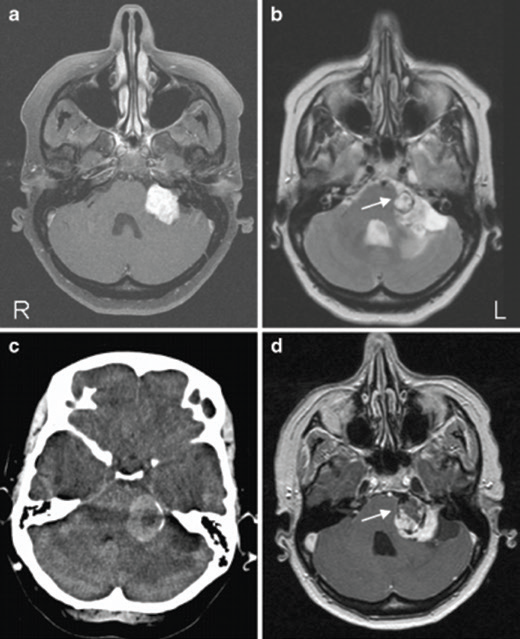
Caption: A) Axial T1-weighted MRI with gadolinium contrast enhancement showing left-sided vestibular schwannoma (VS). B) Axial T2-weighted MRI of the posterior fossa showing round lesion inside the VS (arrow) with surrounding hemosiderin deposits. C) Axial CT image through the posterior fossa showing a hyperdens area due to intratumoral hemorrhage in the VS. D) Axial T1-weighted postcontrast MRI showing hemorrhage (hypo-intense area) inside lesion (arrow). The VS enhances homogeneous and contrast-sparing occurs at the location of the hematoma (R right, L left).

August 9, 2016

Caption: A) Axial T1-weighted MRI with gadolinium contrast enhancement showing left-sided vestibular schwannoma (VS). B) Axial T2-weighted MRI of the posterior fossa showing round lesion inside the VS (arrow) with surrounding hemosiderin deposits. C) Axial CT image through the posterior fossa showing a hyperdens area due to intratumoral hemorrhage in the VS. D) Axial T1-weighted postcontrast MRI showing hemorrhage (hypo-intense area) inside lesion (arrow). The VS enhances homogeneous and contrast-sparing occurs at the location of the hematoma (R right, L left).

Caption: A) Axial T1-weighted MRI with gadolinium contrast enhancement showing left-sided vestibular schwannoma (VS). B) Axial T2-weighted MRI of the posterior fossa showing round lesion inside the VS (arrow) with surrounding hemosiderin deposits. C) Axial CT image through the posterior fossa showing a hyperdens area due to intratumoral hemorrhage in the VS. D) Axial T1-weighted postcontrast MRI showing hemorrhage (hypo-intense area) inside lesion (arrow). The VS enhances homogeneous and contrast-sparing occurs at the location of the hematoma (R right, L left).

ENTtoday - https://www.enttoday.org/article/disagreement-exists-regarding-cost-effectiveness-necessity-initial-gdt1w-mri/ent_0816_pg6a/

Caption: A) Axial T1-weighted MRI with gadolinium contrast enhancement showing left-sided vestibular schwannoma (VS). B) Axial T2-weighted MRI of the posterior fossa showing round lesion inside the VS (arrow) with surrounding hemosiderin deposits. C) Axial CT image through the posterior fossa showing a hyperdens area due to intratumoral hemorrhage in the VS. D) Axial T1-weighted postcontrast MRI showing hemorrhage (hypo-intense area) inside lesion (arrow). The VS enhances homogeneous and contrast-sparing occurs at the location of the hematoma (R right, L left).