Part II of Preserving Hearing Health of Military Service Members
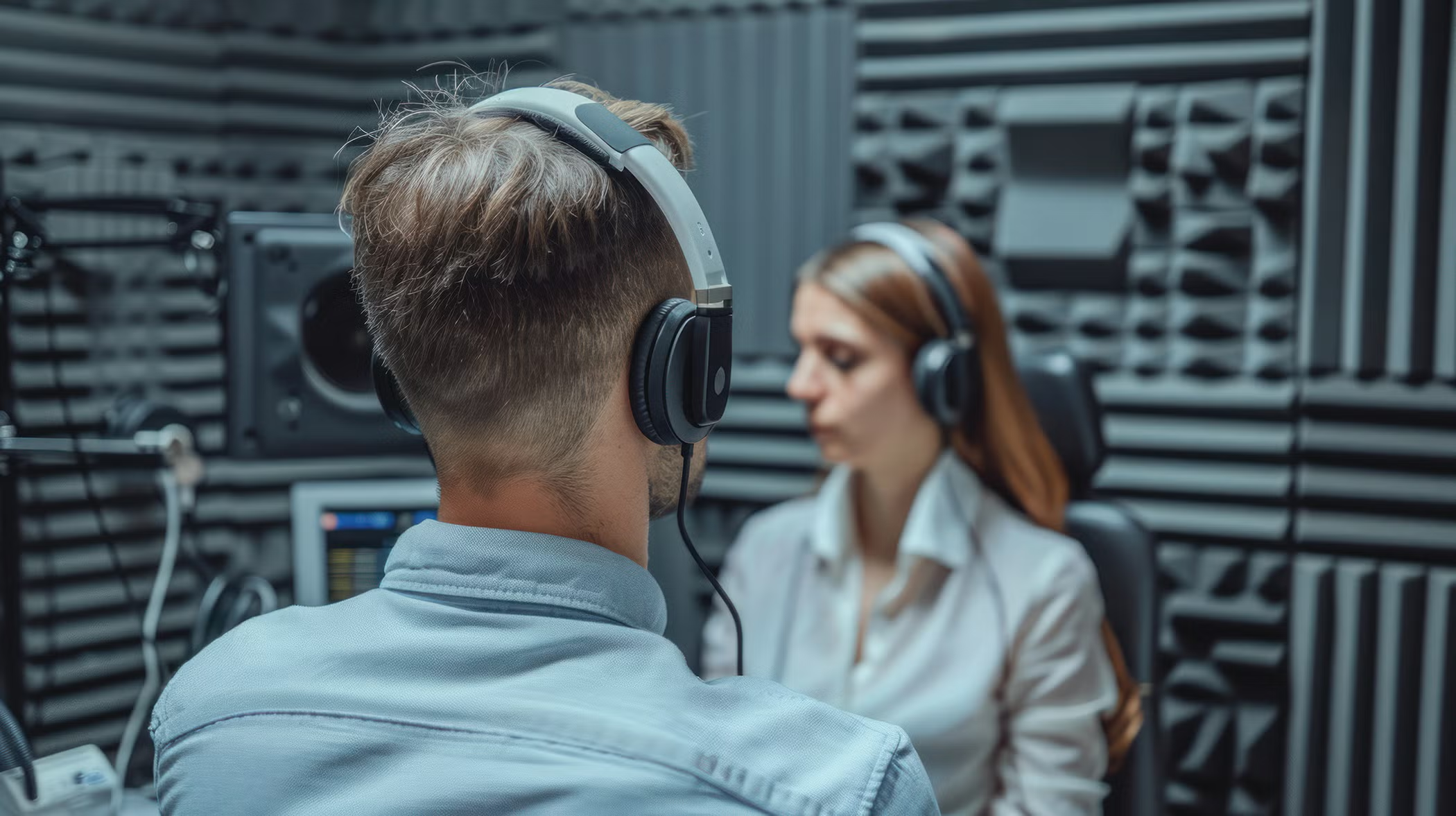 Noise-exposed service members in the U.S. military are required to complete an annual hearing test to identify any noise-related changes in the audiogram and to ensure they are able to hear well enough to perform their duties. “Service members have to complete these hearing tests to be considered fully deployable. Until recently, this meant that they had to travel once per year to the location of a hearing conservation clinic equipped with a sound-treated audio booth,” said Devon M. Kulinski, AuD, a research audiologist in the National Military Audiology and Speech Center (NMASC) at Walter Reed National Military Medical Center in Bethesda, Md.
In 2020, COVID-19 infection control measures made multi-person sound booths unusable for maintaining active-duty readiness. To address the testing backlog, researchers evaluated boothless audiometry as an alternative to traditional booth testing, Dr. Kulinski said. More than 10,000 service members underwent testing, and annual hearing shifts were compared to standard booth results. Findings showed the boothless system was as reliable as traditional microprocessor testing (Mil Med. doi:10.1093/milmed/usad224). “Boothless audiometry is now considered a viable option for annual military hearing monitoring,” he said.
Boothless audiometry has also expanded opportunities for military hearing conservation programs. Dr. Kulinski noted that these tablet-based systems can automate questionnaire data collection, potentially deliver interactive training, and conduct hearing protection fit-testing, which is a new requirement for some noise-exposed service members. “Although there remain issues with data transfer into existing hearing database systems, the feedback received from service members and audiologists has been overwhelmingly positive. Boothless audiometers are unlikely to completely replace standard audiometers in the near future, but it is likely that they will continue to play an increasingly prominent role in the military hearing conservation programs,” he said.
Interdisciplinary Collaboration
The development of the WAHTS (Wireless Automated Hearing Test System) boothless audiometer is a “great example” of interdisciplinary research that has led to breakthroughs in hearing health for military personnel, said Odile Clavier, PhD, principal engineer and partner at Creare, a small research and development firm in Hanover, N.H. WAHTS was originally funded through a Small Business Innovation Research (SBIR) grant awarded to Creare in collaboration with Deanna Meinke, PhD, CCC-A, professor emerita at the University of Northern Colorado in Greeley and co-director of the Dangerous Decibels project, and the late Sigfrid Soli, PhD, a hearing scientist at the House Ear Institute, now the House Institute Foundation, in Los Angeles. NMASC researchers started piloting the WAHTS technology, and the Department of Defense (DoD) continued to support the technology’s development and integration until Creare was able to spin off a new company that could sell the FDA-registered version to both government and commercial markets,” Dr. Clavier said.
In parallel with the WAHTS development, Creare received funding from the DoD to support the NMASC in developing an open-source, tablet-based software called TabSINT to facilitate hearing studies across the DoD. TabSINT made it possible for Douglas S. Brungart, PhD, chief scientist at the NMASC, and his team to conduct studies with thousands of active-duty subjects focused on hearing health, Dr. Clavier said. “Studies included, for example, the development of a new evidence-based hearing test based on operational performance—the Military Operational Hearing Test; the relationship between exposure to low-level blast and difficulty hearing speech in background noise; and deploying boothless audiometry during the COVID-19 pandemic,” she said.
Scientists at MIT Lincoln Laboratory (MITLL) developed a noise dosimeter capable of measuring both low-level blast noise, which is undetectable by commercially available dosimeters, and continuous ambient noise. MITLL partnered with Creare to customize the prototype, and Creare later received a new SBIR grant from the Defense Health Agency to produce this device, Dr. Clavier said. Working with MITLL and NMASC to test this device, Creare is starting low-rate production so early adopters in the DoD can begin using it. “There is significant interest within the Special Forces community because of the connection between repeated exposure to low-level blast and brain injury as well as hearing injury,” she noted.
A variety of studies have focused on understanding the threat of repeated low-level blast exposure during routine training with high-caliber weapon systems. “These studies require an extensive data collection effort on military training ranges involving researchers with expertise in hearing, cognition, neuroscience, engineering, and blast physics,” Dr. Kulinski said. “Research to date has highlighted hearing as a sensitive endpoint, including a dose-response model for predicting transient results for a given level of exposure and a standardized test battery and procedure for performing these types of prospective human subject studies (J Acoust Soc Am. doi:10.1121/10.0036149; Mil Med. doi:10.1093/milmed/usad299).”
“Still, much work is needed to improve our prediction of the long-term effects that are likely to result from repeated exposures, and the factors that might influence the risk that a given service member may experience hearing damage from a given noise event,” he said.
Long-Term Studies
Large-scale studies like the Noise Outcomes in Servicemembers Epidemiology (NOISE) study originally focused on collecting normative data (https://www.noisestudy.org). Since the development of the Military Operational Hearing Test—an auditory fitness-for-duty test adopted by the Army as the standard test for evaluating the functional performance of soldiers with hearing loss—research expanded to other aspects of hearing loss, according to Dr. Kulinski. A major contribution involved the collection of large-scale normative data from questionnaires and clinical tools for evaluating service members with hearing issues. For instance, results from the Tinnitus and Hearing Survey, administered to nearly 22,600 service members with varying degrees of hearing loss, help clinicians determine when self-reported hearing difficulties in individuals with normal or near-normal thresholds warrant clinical intervention (Trends Hear. doi:10.1177/23312165231198374), he said.
Kelly Reavis, PhD, MPH, MS, CCC-A, a research investigator at the National Center for Rehabilitative Auditory Research, VA Portland Health Care System, U.S. Department of Veterans Affairs, and an assistant professor of epidemiology at OHSU-PSU School of Public Health at Oregon Health and Science University in Portland, noted that in their ongoing NOISE Study, “we have observed that veterans exposed to military noise, blasts, or traumatic brain injuries exhibit a higher prevalence of both hearing loss and tinnitus.”
“Our analyses also demonstrate that hearing loss and tinnitus independently and adversely affect quality of life. Longitudinally, transition analyses of tinnitus states over five years indicate a slight overall increase in the progression from no tinnitus to constant tinnitus, with those experiencing occasional or intermittent tinnitus showing the highest probability of transition over time,” Dr. Reavis said. “These findings highlight the dynamic nature of tinnitus and its close association with military exposures linked to hearing loss, underscoring the importance of continued hearing health monitoring and early intervention among veterans.”
“Epidemiologic studies help identify which exposures and populations are at highest risk, guiding prevention priorities and early intervention strategies,” Dr. Reavis said. “Findings from epidemiologic research, including the NOISE Study, help inform the development of the first-ever VA/DoD Clinical Practice Guideline for Tinnitus. More broadly, epidemiologic data ensure that policies and clinical practices evolve based on real-world evidence to improve hearing health and quality of life for service members and veterans.”
Challenges and Gaps
Despite progress, the rate of hearing loss in the military remains high.
The 2023 Hearing Health Surveillance Data Review for Military Hearing Conservation reported 12% of all service members had a hearing loss, and 6.9% experienced a permanent threshold shift, Dr. Kulinski said.
In the hierarchy of exposure control for hearing conservation programs, the use of hearing protection devices is referred to as a “last resort” when you “cannot engineer your way out of, reduce time, or increase distance from noise-hazardous sources,” he said. The hearing conservation program has adopted best practice recommendations in the use of a quantitative assessment of hearing protection device fit via hearing protector fit-testing systems, but “if someone finds the protective solution cumbersome, uncomfortable, or impeding on the situational awareness needed to complete the mission, it is likely that the solution will not be used consistently in the field.”
The biggest challenge in diagnosing and treating auditory processing disorders in the military is that the current DoD hearing surveillance programs are almost entirely based on pure tone audiometric thresholds, Dr. Kulinski said.
“The reliance entirely on changes in hearing thresholds is problematic, because there is mounting evidence that service members who regularly experience hearing changes after noise and blast exposure are developing increased hearing difficulties even when the audiogram remains in the normal range (Ear Hear. doi:10.1097/ AUD.0000000000001067; Hear Res. doi:10.1016/j.heares.2025.109183). In some cases, these problems are severe enough to warrant fitting patients who have normal hearing thresholds with a low-gain hearing aid (Healthcare. doi:10.3390/healthcare12050578),” Dr. Kulinski said. “More research is needed to fully understand the role that temporary threshold shifts play in producing hearing difficulties in normal hearing listeners and why some listeners seem to be more susceptible to these temporary hearing changes than others.”
Dr. Clavier explained that many service members, some with extensive training and experience, report difficulty with “understanding speech in background noise—a common task when conducting any military training activity—yet exhibit normal hearing thresholds. These individuals are often told that nothing is wrong because they meet the standards for normal hearing according to their audiogram, yet they experience impaired communication.”
The DoD has curtailed funding for hearing research, Dr. Clavier said, “In order to make a significant reduction in the prevalence and severity of hearing loss, the DoD will need to allocate substantial resources for research and implementation of new hearing conservation measures, including better testing, hearing protector fit-testing, and better monitoring and protection of individuals exposed to repeated low-level blasts.”
As service members transition to veteran status, delays in detection and treatment may occur.
Dr. Reavis said, “The focus of hearing health transitions from population-based prevention and surveillance during active duty to individualized treatment and rehabilitation for veterans, where services are typically driven by veterans’ reported symptoms rather than routine monitoring. During military service, most service members participate in hearing conservation programs that include regular audiometric surveillance. However, this monitoring typically ends at separation because it is part of occupational exposure surveillance that does not translate to general healthcare practices, potentially leading to delays in detection and treatment.”
“As veterans age, tinnitus, hearing loss, and communication difficulties often intersect with mental health conditions, sleep problems, and cognitive demands, amplifying their overall functional impact,” Dr. Reavis said. “This underscores the importance of a sustainable hearing health monitoring program within the VA, coordinated handoffs between military and VA systems, and integrated approaches that support the well-being of veterans post-service.”
Katie Robinson is a freelance medical writer based in New York.
Leave a Reply