• Home
  • Practice Focus
    • Facial Plastic/Reconstructive
    • Head and Neck
    • Laryngology
    • Otology/Neurotology
    • Pediatric
    • Rhinology
    • Sleep Medicine
    • How I Do It
    • TRIO Best Practices
  • Business of Medicine
    • Health Policy
    • Legal Matters
    • Practice Management
    • Technology
    • AI
  • Literature Reviews
    • Facial Plastic/Reconstructive
    • Head and Neck
    • Laryngology
    • Otology/Neurotology
    • Pediatric
    • Rhinology
    • Sleep Medicine
  • Career
    • Medical Education
    • Professional Development
    • Resident Focus
  • ENT Perspectives
    • ENT Expressions
    • Everyday Ethics
    • From TRIO
    • The Great Debate
    • Letter From the Editor
    • Rx: Wellness
    • The Voice
    • Viewpoint
    • SUO Corner
  • TRIO Resources
    • Triological Society
    • The Laryngoscope
    • Laryngoscope Investigative Otolaryngology
    • TRIO Combined Sections Meetings
    • COSM
    • Related Otolaryngology Events

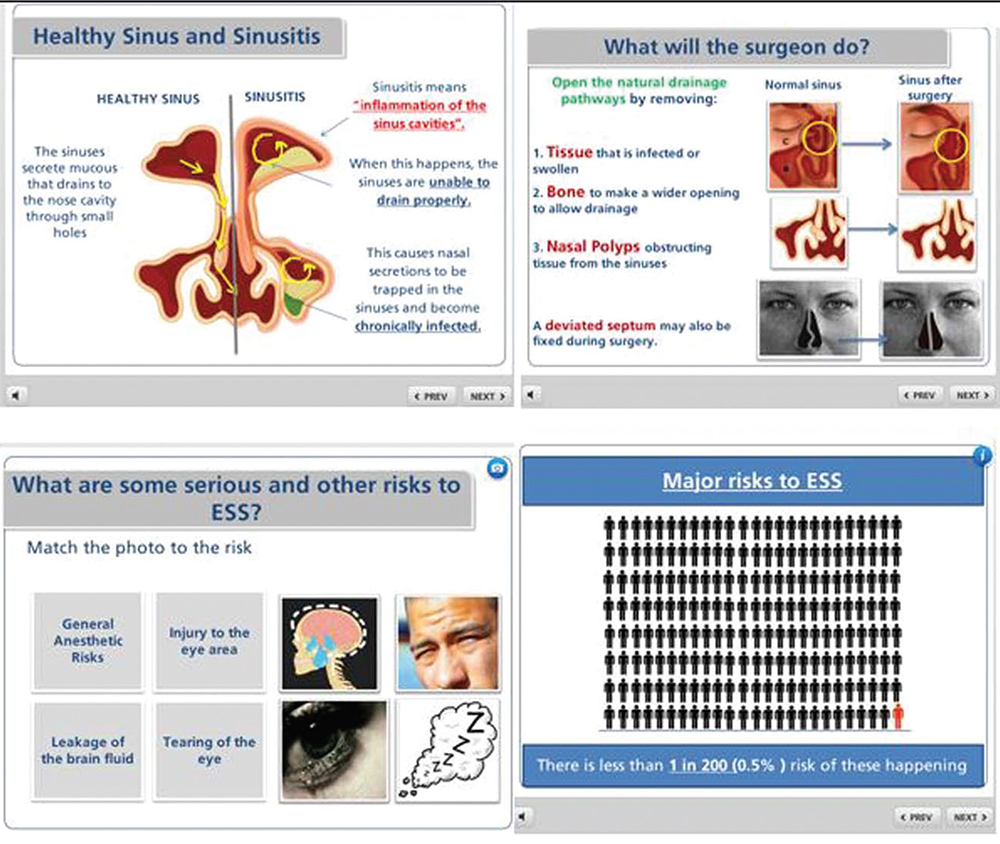
Figure 1. Screenshots of Dr. Sowerby’s multimedia module for patient consent. Audio voice-over, images, and relevant figures were synchronized to convey clinical information. Animations were used to describe visual phenomena. To optimize patient comprehension, the module contained information at the eighth grade level and incorporated large fonts, bulleting, bolding, and underlining, as well as graphic displays using pictographs of risks and benefits. The module was designed to be interactive to let the patient control the information flow rate. Credit: The Laryngoscope. ©The American Laryngological, Rhinological and Otological Society, Inc.

January 20, 2017

Figure 1. Screenshots of Dr. Sowerby’s multimedia module for patient consent. Audio voice-over, images, and relevant figures were synchronized to convey clinical information. Animations were used to describe visual phenomena. To optimize patient comprehension, the module contained information at the eighth grade level and incorporated large fonts, bulleting, bolding, and underlining, as well as graphic displays using pictographs of risks and benefits. The module was designed to be interactive to let the patient control the information flow rate. Credit: The Laryngoscope. ©The American Laryngological, Rhinological and Otological Society, Inc.

Figure 1. Screenshots of Dr. Sowerby’s multimedia module for patient consent. Audio voice-over, images, and relevant figures were synchronized to convey clinical information. Animations were used to describe visual phenomena. To optimize patient comprehension, the module contained information at the eighth grade level and incorporated large fonts, bulleting, bolding, and underlining, as well as graphic displays using pictographs of risks and benefits. The module was designed to be interactive to let the patient control the information flow rate.

Credit: The Laryngoscope. ©The American Laryngological, Rhinological and Otological Society, Inc.

ENTtoday - https://www.enttoday.org/article/how-informed-are-your-patients-2/ent_0117_pg16b/

Figure 1. Screenshots of Dr. Sowerby’s multimedia module for patient consent. Audio voice-over, images, and relevant figures were synchronized to convey clinical information. Animations were used to describe visual phenomena. To optimize patient comprehension, the module contained information at the eighth grade level and incorporated large fonts, bulleting, bolding, and underlining, as well as graphic displays using pictographs of risks and benefits. The module was designed to be interactive to let the patient control the information flow rate. Credit: The Laryngoscope. ©The American Laryngological, Rhinological and Otological Society, Inc.