• Home
  • Practice Focus
    • Facial Plastic/Reconstructive
    • Head and Neck
    • Laryngology
    • Otology/Neurotology
    • Pediatric
    • Rhinology
    • Sleep Medicine
    • How I Do It
    • TRIO Best Practices
  • Business of Medicine
    • Health Policy
    • Legal Matters
    • Practice Management
    • Technology
    • AI
  • Literature Reviews
    • Facial Plastic/Reconstructive
    • Head and Neck
    • Laryngology
    • Otology/Neurotology
    • Pediatric
    • Rhinology
    • Sleep Medicine
  • Career
    • Medical Education
    • Professional Development
    • Resident Focus
  • ENT Perspectives
    • ENT Expressions
    • Everyday Ethics
    • From TRIO
    • The Great Debate
    • Letter From the Editor
    • Rx: Wellness
    • The Voice
    • Viewpoint
    • SUO Corner
  • TRIO Resources
    • Triological Society
    • The Laryngoscope
    • Laryngoscope Investigative Otolaryngology
    • TRIO Combined Sections Meetings
    • COSM
    • Related Otolaryngology Events

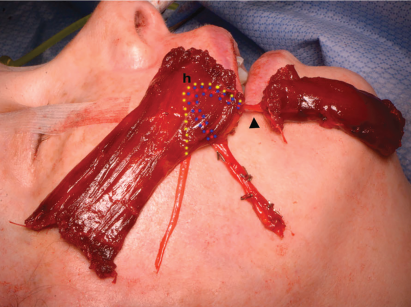
Fig. 1. Intraoperative photograph of harvested ipsilateral flap demonstrating orientation of upper and lower lip paddles following 180° in-plane rotation. In this iteration, the nerve and vascular pedicle are reflected deep to the flap for coaptation with the ipsilateral nerve-to-masseter muscle and anastomosis with the facial vessels. The approximate location of the hilum (h) and course of the neurovascular pedicle (dotted lines: yellow—nerve-to-gracilis muscle, blue—venae comitans, red—artery) on the deep aspect of the flap is demonstrated, together with the continuation of the neurovascular pedicle (arrowhead) to the lower lip paddle.

April 20, 2021

Fig. 1. Intraoperative photograph of harvested ipsilateral flap demonstrating orientation of upper and lower lip paddles following 180° in-plane rotation. In this iteration, the nerve and vascular pedicle are reflected deep to the flap for coaptation with the ipsilateral nerve-to-masseter muscle and anastomosis with the facial vessels. The approximate location of the hilum (h) and course of the neurovascular pedicle (dotted lines: yellow—nerve-to-gracilis muscle, blue—venae comitans, red—artery) on the deep aspect of the flap is demonstrated, together with the continuation of the neurovascular pedicle (arrowhead) to the lower lip paddle.

Fig. 1. Intraoperative photograph of harvested ipsilateral flap demonstrating orientation of upper and lower lip paddles following 180° in-plane rotation. In this iteration, the nerve and vascular pedicle are reflected deep to the flap for coaptation with the ipsilateral nerve-to-masseter muscle and anastomosis with the facial vessels. The approximate location of the hilum (h) and course of the neurovascular pedicle (dotted lines: yellow—nerve-to-gracilis muscle, blue—venae comitans, red—artery) on the deep aspect of the flap is demonstrated, together with the continuation of the neurovascular pedicle (arrowhead) to the lower lip paddle.

ENTtoday - https://www.enttoday.org/article/how-to-dual-vector-gracilis-muscle-transfer-for-smile-reanimation-with-lower-lip-depression/ent_0421_pg8a/

Fig. 1. Intraoperative photograph of harvested ipsilateral flap demonstrating orientation of upper and lower lip paddles following 180° in-plane rotation. In this iteration, the nerve and vascular pedicle are reflected deep to the flap for coaptation with the ipsilateral nerve-to-masseter muscle and anastomosis with the facial vessels. The approximate location of the hilum (h) and course of the neurovascular pedicle (dotted lines: yellow—nerve-to-gracilis muscle, blue—venae comitans, red—artery) on the deep aspect of the flap is demonstrated, together with the continuation of the neurovascular pedicle (arrowhead) to the lower lip paddle.