INTRODUCTION
Airway foreign body aspiration is a serious issue in pediatrics. Although organic foreign bodies are more common, aspirating magnetic objects can cause severe morbidity, especially with multiple small magnets. Given the increasing incidence of pediatric magnetic-related foreign bodies, we present a unique case of retrieving a distal tertiary bronchi magnetic foreign body in an older pediatric patient using a flexible, ferromagnetic grasping instrument.
CASE REPORT
A 13-year-old female presented to the emergency department with a report of accidentally inhaling the backing of her magnetic nose ring. She endorsed chest discomfort but otherwise denied difficulty or noisy breathing. On arrival, her vital signs and oxygen saturation were normal. Chest X-ray (lateral and anteroposterior) demonstrated a 3mm×4mm metallic foreign body in the right lower lobe, 0.5cm from the diaphragm on expiratory film. The decision was made to proceed with operative intervention given the location of the body.
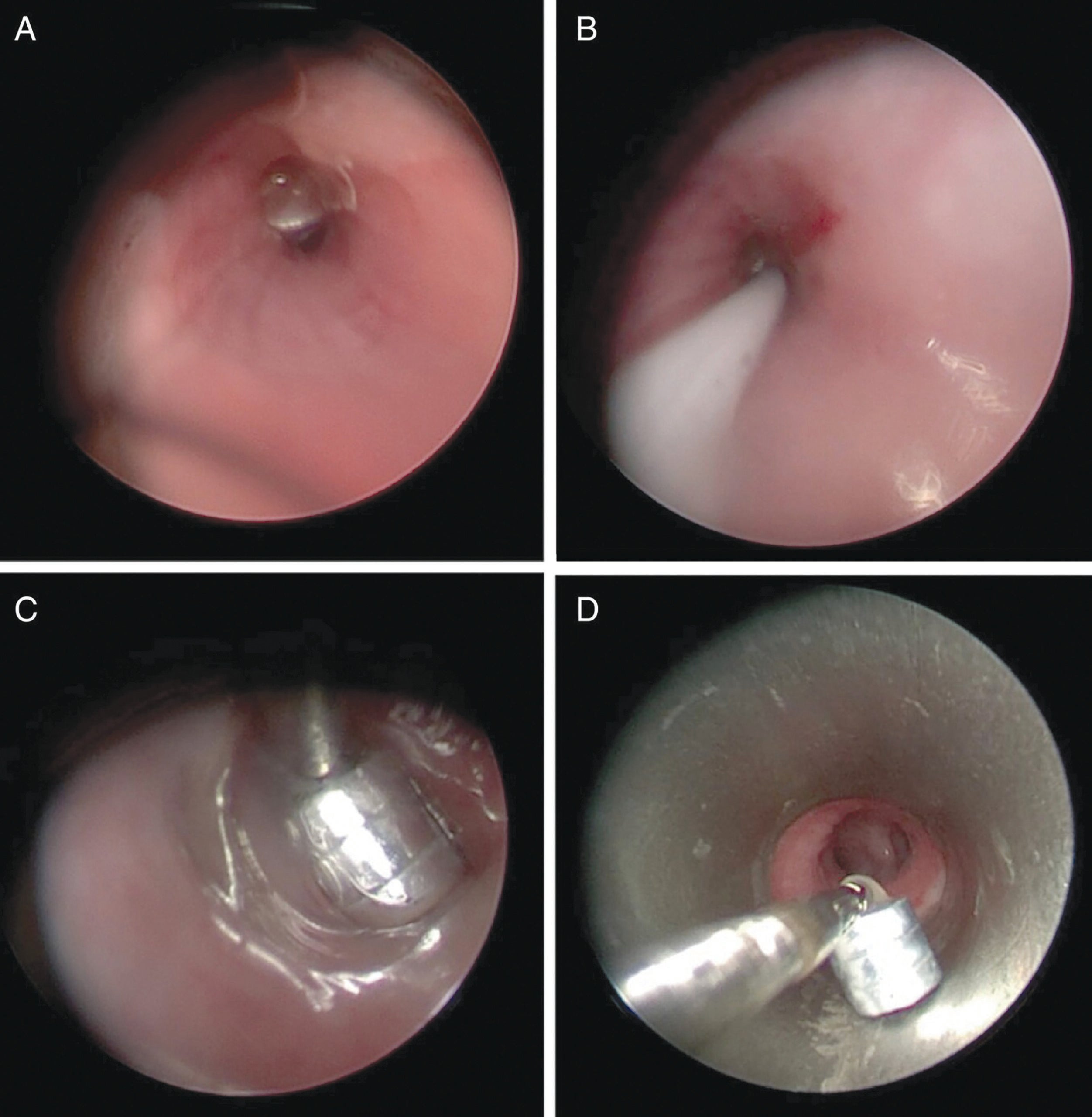
Figure 1. (A) Metallic foreign body visualized in the tertiary bronchus on rigid bronchoscopy, beyond the reach of traditional optical instruments. (B) Trial of passing a Fogarty catheter distal to the object was unsuccessful, given the relatively small size of the tertiary bronchus and foreign body obstruction. (C) Ferromagnetic pulmonary rat tooth biopsy forceps advanced into the rigid bronchoscopy and underwent magnetization near the magnetic field of the foreign body. (D) Magnetic foreign body successfully removed with rigid bronchoscopy.
After induction of general anesthesia, direct laryngoscopy was completed without evidence of a foreign body in the oropharynx or hypopharynx. A 6.0 rigid bronchoscope was inserted into the trachea and advanced into the distal trachea and segmental bronchi bilaterally. On the right, a small metallic foreign body was visualized in the distal tertiary bronchus. Traditional optical instruments, including endoscopic graspers, were unsuccessful due to the distal location of the foreign body. Attempts to pass a salivary wire basket and a ureteral stone retrieval basket to engage the foreign body were unsuccessful. An attempt to pass a 2 French Fogarty embolectomy catheter distally failed because the diameter of the catheter was too large to bypass the foreign body.
After inspection of the pulmonary flexible bronchoscopy instruments, we identified ferromagnetic flexible rat tooth biopsy forceps. These were then advanced into the tertiary bronchus distally, and the small magnetic field of the nose ring was able to attract and adhere to the ferromagnetic instrument, allowing for safe removal through the rigid bronchoscopy (Figure 1). The foreign body was noted to be three small attached magnetic nose ring backings. Repeat bronchoscopy demonstrated no further foreign bodies or airway injuries. The patient recovered uneventfully and was discharged postoperatively without complications.
CONCLUSION
We describe a unique case of an older pediatric patient who aspirated multiple small magnets used in magnetic jewelry, posing challenges for traditional removal methods due to their distal location in the tertiary bronchi and small size. Ferromagnetic flexible bronchoscopic instruments were utilized for their safe retrieval.
Leave a Reply