• Home
  • Practice Focus
    • Facial Plastic/Reconstructive
    • Head and Neck
    • Laryngology
    • Otology/Neurotology
    • Pediatric
    • Rhinology
    • Sleep Medicine
    • How I Do It
    • TRIO Best Practices
  • Business of Medicine
    • Health Policy
    • Legal Matters
    • Practice Management
    • Technology
    • AI
  • Literature Reviews
    • Facial Plastic/Reconstructive
    • Head and Neck
    • Laryngology
    • Otology/Neurotology
    • Pediatric
    • Rhinology
    • Sleep Medicine
  • Career
    • Medical Education
    • Professional Development
    • Resident Focus
  • ENT Perspectives
    • ENT Expressions
    • Everyday Ethics
    • From TRIO
    • The Great Debate
    • Letter From the Editor
    • Rx: Wellness
    • The Voice
    • Viewpoint
    • SUO Corner
  • TRIO Resources
    • Triological Society
    • The Laryngoscope
    • Laryngoscope Investigative Otolaryngology
    • TRIO Combined Sections Meetings
    • COSM
    • Related Otolaryngology Events

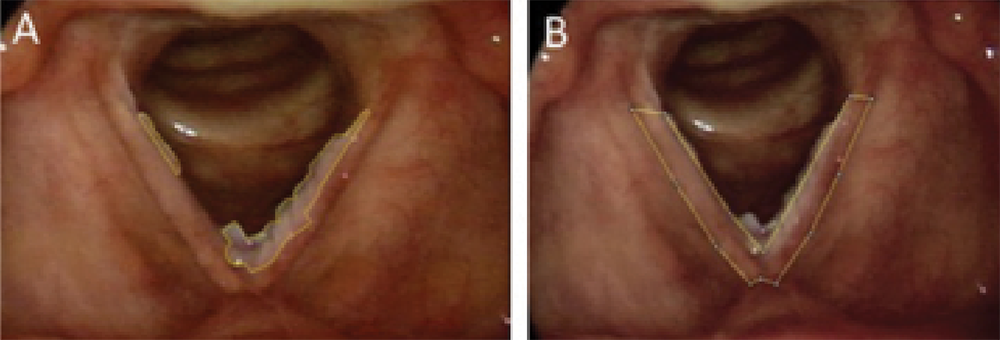
Figure 2. Determination of % lesion regression. (A) Average lesion area (three measurements) = 1,831 pixels. (B) Average full VF area (three measurements) = 6,924 pixels. Percent VF covered by the lesion was determined by (A/B) × 100% = (1,831/6,924) × 100% = 26.4% of the VF covered by lesion. This % was then compared with the postoperative picture % to determine regression. Credit: Copyright 2017 The American Laryngological, Rhinological and Otological Society, Inc.

July 11, 2017

Figure 2. Determination of % lesion regression. (A) Average lesion area (three measurements) = 1,831 pixels. (B) Average full VF area (three measurements) = 6,924 pixels. Percent VF covered by the lesion was determined by (A/B) × 100% = (1,831/6,924) × 100% = 26.4% of the VF covered by lesion. This % was then compared with the postoperative picture % to determine regression. Credit: Copyright 2017 The American Laryngological, Rhinological and Otological Society, Inc.

Figure 2. Determination of % lesion regression. (A) Average lesion area (three measurements) = 1,831 pixels. (B) Average full VF area (three measurements) = 6,924 pixels. Percent VF covered by the lesion was determined by
(A/B) × 100% = (1,831/6,924) × 100% = 26.4% of the VF covered by lesion. This % was then compared with the postoperative picture % to determine regression.
Credit: Copyright 2017 The American Laryngological, Rhinological and Otological Society, Inc.

ENTtoday - https://www.enttoday.org/article/office-ktp-pdl-treatment-vf-leukoplakia-effective-disease-control/ent_0717_pg13a/

Figure 2. Determination of % lesion regression. (A) Average lesion area (three measurements) = 1,831 pixels. (B) Average full VF area (three measurements) = 6,924 pixels. Percent VF covered by the lesion was determined by (A/B) × 100% = (1,831/6,924) × 100% = 26.4% of the VF covered by lesion. This % was then compared with the postoperative picture % to determine regression. Credit: Copyright 2017 The American Laryngological, Rhinological and Otological Society, Inc.