
• Home
  • Practice Focus
    • Facial Plastic/Reconstructive
    • Head and Neck
    • Laryngology
    • Otology/Neurotology
    • Pediatric
    • Rhinology
    • Sleep Medicine
    • How I Do It
    • TRIO Best Practices
  • Business of Medicine
    • Health Policy
    • Legal Matters
    • Practice Management
    • Technology
    • AI
    • History of Otolaryngology
  • Literature Reviews
    • Facial Plastic/Reconstructive
    • Head and Neck
    • Laryngology
    • Otology/Neurotology
    • Pediatric
    • Rhinology
    • Sleep Medicine
  • Career
    • Medical Education
    • Professional Development
    • Resident Focus
  • ENT Perspectives
    • ENT Expressions
    • Everyday Ethics
    • From TRIO
    • The Great Debate
    • Letter From the Editor
    • Rx: Wellness
    • The Voice
    • Viewpoint
    • SUO Corner
  • TRIO Resources
    • Triological Society
    • The Laryngoscope
    • Laryngoscope Investigative Otolaryngology
    • TRIO Combined Sections Meetings
    • COSM
    • Related Otolaryngology Events
  • Search

What Are the Predictors of Success with Hypoglossal Nerve Stimulation?

by Amrita Bhat, BS, Jolie L. Chang, MD, and Megan L. Durr, MD • January 8, 2025

  • Tweet
  • Email a link to a friend (Opens in new window) Email
Print-Friendly Version

TRIO Best PracticeTRIO Best Practice articles are brief, structured reviews designed to provide the busy clinician with a handy outline and reference for day-to-day clinical decision making. The ENTtoday summaries below include the Background and Best Practice sections of the original article. To view the complete Laryngoscope articles free of charge, visit Laryngoscope.com.

You Might Also Like

  • Is the Apnea/Hypopnea Index the Best Measure of Obstructive Sleep Apnea?
  • New Developments Regarding Hypoglossal Nerve Stimulation for Obstructive Sleep Apnea
  • Prescription Medications May Do Little to Encourage CPAP Use
  • Tirzepatide Makes a Big Splash, but What Else is on the Horizon for OSA? 
Explore This Issue
January 2025

BACKGROUND

Obstructive sleep apnea (OSA) affects up to 4% of the adult population. Continuous positive airway pressure (CPAP) is considered the first line in terms of therapy, but adherence is variable. For those who cannot tolerate CPAP, several surgical and nonsurgical treatment options are available, including mandibular advancement devices, weight loss, positional therapy, soft tissue surgery, maxillomandibular advancement, and hypoglossal nerve stimulation (HNS).

HNS was approved by the U.S. Food and Drug Administration in 2014 as a treatment option for patients with moderate to severe OSA who cannot tolerate CPAP. This review summarizes relevant literature assessing factors that predict HNS success, specifically with the Inspire Medical Systems (Minneapolis, Minn.) device unless otherwise noted, including therapeutic response and device adherence.

BEST PRACTICE

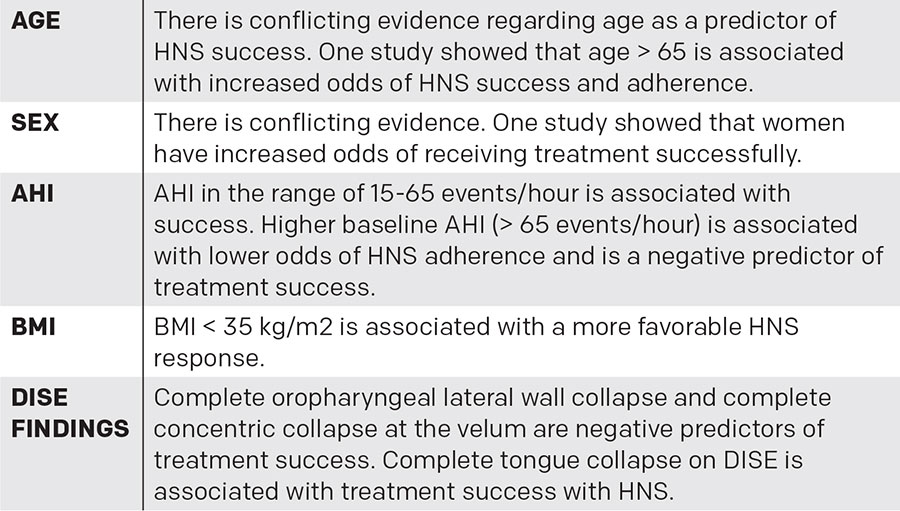
The apnea–hypopnea index (AHI) in the 15-65 events/hour range, BMI < 35 kg/m2, female sex, and complete tongue base collapse on drug-induced sleep endoscopy (DISE) are predictors of successful outcomes with HNS, whereas velum concentric circular collapse (CCC) and complete oropharyngeal lateral wall collapse on DISE are negative predictors of success. Data are conflicting for age and sex, but single studies have shown that female sex and age > 65 years may have increased odds of success. Carefully selected patients with AHI > 65 events/hour, BMI > 35 kg/m2, and velum CCC may respond well to HNS treatment but may not experience success rates to the same degree as those who do not have these characteristics. 

Conclusion
Filed Under: Practice Focus, Sleep Medicine, Sleep Medicine, TRIO Best Practices Tagged With: CPAP intolerance, Hypoglossal Nerve StimulationIssue: January 2025

You Might Also Like:

  • Is the Apnea/Hypopnea Index the Best Measure of Obstructive Sleep Apnea?
  • New Developments Regarding Hypoglossal Nerve Stimulation for Obstructive Sleep Apnea
  • Prescription Medications May Do Little to Encourage CPAP Use
  • Tirzepatide Makes a Big Splash, but What Else is on the Horizon for OSA? 

The Triological SocietyENTtoday is a publication of The Triological Society.

Polls

Have you used AI to submit documentation to insurance companies in response to a denial?

View Results

Loading ...
  • Polls Archive

Top Articles for Residents

  • Is the SLOR in Otolaryngology Residency Applications Contributing to Rural Disparities?
  • Applications Open for Resident Members of the ENTtoday Editorial Board: Deadline Extended
  • A Resident’s View of AI in Otolaryngology
  • Call for Resident Bowl Questions
  • Resident Pearls: Pediatric Otolaryngologists Share Tips for Safer, Smarter Tonsillectomies
  • Popular this Week
  • Most Popular
  • Most Recent
    • Some Laryngopharyngeal Reflux Resists PPI Treatment
    • Vocal Cord Leukoplakia Management Trends Include Advanced Surgical Techniques, Voice Preservation
    • Empty Nose Syndrome: Physiological, Psychological, or Perhaps a Little of Both?
    • The Dramatic Rise in Tongue Tie and Lip Tie Treatment
    • What Is the Extent of Neck Dissection in Medullary Thyroid Carcinoma?
    • The Dramatic Rise in Tongue Tie and Lip Tie Treatment
    • Rating Laryngopharyngeal Reflux Severity: How Do Two Common Instruments Compare?
    • Is Middle Ear Pressure Affected by Continuous Positive Airway Pressure Use?
    • Otolaryngologists Are Still Debating the Effectiveness of Tongue Tie Treatment
    • Complications for When Physicians Change a Maiden Name
    • The Battle of the Bots Comes to Prior Authorization
    • How to Avoid These 10 Difficult Airway Pitfalls
    • Getting Comfortable Being Uncomfortable
    • Comparative Study of TMRT for Chronic Otitis Media
    • Early and Sustained Improvements in Sense of Smell with Tezepelumab Treatment in Patients with CRSwNP (WAYPOINT)

Follow Us

  • Contact Us
  • About Us
  • Advertise
  • The Triological Society
  • The Laryngoscope
  • Laryngoscope Investigative Otolaryngology
  • Privacy Policy
  • Terms of Use
  • Cookies

Wiley

Copyright © 2026 by John Wiley & Sons, Inc. All rights reserved, including rights for text and data mining and training of artificial technologies or similar technologies. ISSN 1559-4939