
• Home
  • Practice Focus
    • Facial Plastic/Reconstructive
    • Head and Neck
    • Laryngology
    • Otology/Neurotology
    • Pediatric
    • Rhinology
    • Sleep Medicine
    • How I Do It
    • TRIO Best Practices
  • Business of Medicine
    • Health Policy
    • Legal Matters
    • Practice Management
    • Tech Talk
    • AI
  • Literature Reviews
    • Facial Plastic/Reconstructive
    • Head and Neck
    • Laryngology
    • Otology/Neurotology
    • Pediatric
    • Rhinology
    • Sleep Medicine
  • Career
    • Medical Education
    • Professional Development
    • Resident Focus
  • ENT Perspectives
    • ENT Expressions
    • Everyday Ethics
    • From TRIO
    • The Great Debate
    • Letter From the Editor
    • Rx: Wellness
    • The Voice
    • Viewpoint
  • TRIO Resources
    • Triological Society
    • The Laryngoscope
    • Laryngoscope Investigative Otolaryngology
    • TRIO Combined Sections Meetings
    • COSM
    • Related Otolaryngology Events
  • Search

What Is the Best Test for Diagnosing and Monitoring Treatment Response in Malignant Otitis Externa?

by Joshua J. Sturm, MD, PhD; Sagit Stern Shavit, MD; and Anil K. Lalwani, MD • November 16, 2020

  • Tweet
  • Click to email a link to a friend (Opens in new window) Email
Print-Friendly Version

TRIO Best PracticeTRIO Best Practice articles are brief, structured reviews designed to provide the busy clinician with a handy outline and reference for day-to-day clinical decision making. The ENTtoday summaries below include the Background and Best Practice sections of the original article. To view the complete Laryngoscope article free of charge, visit Laryngoscope.

You Might Also Like

  • Treatment Termination Criteria for Necrotizing (Malignant) Otitis Externa
  • Age Is Only Independent Risk Factor in Malignant Otitis Externa Patient Admission-Level Outcomes
  • What Is the Best Imaging Modality for Diagnosing a Large Vestibular Aqueduct?
  • What is the Role of Tympanostomy Tubes in the Treatment of Recurrent Acute Otitis Media?
Explore This Issue
November 2020

Background

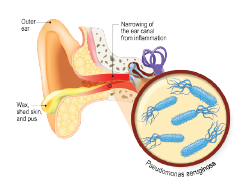
Malignant otitis externa (MOE), or skull base osteomyelitis, is an aggressive infection that predominantly affects elderly, diabetic, or immunocompromised patients, and is associated with high disease-specific mortality. MOE is suspected in the setting of external otitis associated with granulation tissue and pain; biopsy is obtained to rule out malignancy. CT and/or MRI imaging is useful to delineate bony and soft tissue involvement, respectively. MOE diagnosis is supported by a positive methylene diphosphonate (MDP)-technetium-99 m (Tc99m) bone scan and Gallium-67 (Ga67) scan. Sequential Ga67 scans have been traditionally used to assess antibiotic therapy response. More recently, concern has been raised regarding the accuracy and cost-effectiveness of the current imaging paradigm for diagnosis and treatment response assessment in MOE.

Best Practice
© DesignuaA / shutterstock.com

© DesignuaA / shutterstock.com

Tc99m and Ga67 nuclear studies have historically been used to diagnose and monitor MOE disease progression, respectively. However, the sensitivity and specificity of these studies is more limited than once imagined. Furthermore, they provide little anatomic detail, entail high costs and radiation exposure, and are not widely available. By contrast, CT and MRI are widely available and afford excellent anatomic resolution but are neither sufficiently sensitive nor specific as standalone modalities. 18F-FDG-PET/CT is a promising hybrid imaging modality for diagnosing and assessing treatment response in MOE. Future prospective trials comparing 18F-FDG-PET to traditional nuclear imaging paradigms in the management of MOE are necessary.

Filed Under: Otology/Neurotology, TRIO Best Practices Tagged With: clinical care, diagnosisIssue: November 2020

You Might Also Like:

  • Treatment Termination Criteria for Necrotizing (Malignant) Otitis Externa
  • Age Is Only Independent Risk Factor in Malignant Otitis Externa Patient Admission-Level Outcomes
  • What Is the Best Imaging Modality for Diagnosing a Large Vestibular Aqueduct?
  • What is the Role of Tympanostomy Tubes in the Treatment of Recurrent Acute Otitis Media?

The Triological SocietyENTtoday is a publication of The Triological Society.

Polls

Has experience as a patient influenced your professional development or demeanor?

View Results

Loading ... Loading ...
  • Polls Archive

Top Articles for Residents

  • A Resident’s View of AI in Otolaryngology
  • Call for Resident Bowl Questions
  • Resident Pearls: Pediatric Otolaryngologists Share Tips for Safer, Smarter Tonsillectomies
  • A Letter to My Younger Self: Making Deliberate Changes Can Help Improve the Sense of Belonging
  • ENTtoday Welcomes Resident Editorial Board Members
  • Popular this Week
  • Most Popular
  • Most Recent
    • The Path to Department Chair: Arriving and Thriving

    • Office Laryngoscopy Is Not Aerosol Generating When Evaluated by Optical Particle Sizer

    • Top 10 LARY and LIO Articles of 2024

    • Rewriting the Rules of Rhinosinusitis

    • How Audiologists and Researchers Are Shaping Military Hearing Health Practices

    • The Dramatic Rise in Tongue Tie and Lip Tie Treatment

    • Rating Laryngopharyngeal Reflux Severity: How Do Two Common Instruments Compare?

    • Is Middle Ear Pressure Affected by Continuous Positive Airway Pressure Use?

    • Otolaryngologists Are Still Debating the Effectiveness of Tongue Tie Treatment

    • Keeping Watch for Skin Cancers on the Head and Neck

    • Why So Loud? Rethinking the Volume of Our Everyday Experiences
    • How Audiologists and Researchers Are Shaping Military Hearing Health Practices
    • A Case for Endoscopic Surgery: How Personal Experience Influenced Pursuit of a New Skill
    • The Path to Department Chair: Arriving and Thriving
    • Rewriting the Rules of Rhinosinusitis

Follow Us

  • Contact Us
  • About Us
  • Advertise
  • The Triological Society
  • The Laryngoscope
  • Laryngoscope Investigative Otolaryngology
  • Privacy Policy
  • Terms of Use
  • Cookies

Wiley

Copyright © 2026 by John Wiley & Sons, Inc. All rights reserved, including rights for text and data mining and training of artificial technologies or similar technologies. ISSN 1559-4939