• Home
  • Practice Focus
    • Facial Plastic/Reconstructive
    • Head and Neck
    • Laryngology
    • Otology/Neurotology
    • Pediatric
    • Rhinology
    • Sleep Medicine
    • How I Do It
    • TRIO Best Practices
  • Business of Medicine
    • Health Policy
    • Legal Matters
    • Practice Management
    • Tech Talk
    • AI
  • Literature Reviews
    • Facial Plastic/Reconstructive
    • Head and Neck
    • Laryngology
    • Otology/Neurotology
    • Pediatric
    • Rhinology
    • Sleep Medicine
  • Career
    • Medical Education
    • Professional Development
    • Resident Focus
  • ENT Perspectives
    • ENT Expressions
    • Everyday Ethics
    • From TRIO
    • The Great Debate
    • Letter From the Editor
    • Rx: Wellness
    • The Voice
    • Viewpoint
  • TRIO Resources
    • Triological Society
    • The Laryngoscope
    • Laryngoscope Investigative Otolaryngology
    • TRIO Combined Sections Meetings
    • COSM
    • Related Otolaryngology Events
  • Search

A Case for Endoscopic Surgery: How Personal Experience Influenced Pursuit of a New Skill

by Benjamin Wycherly, MD • January 9, 2026

  • Tweet
  • Click to email a link to a friend (Opens in new window) Email
Print-Friendly Version

As a child, I had several ventilation tubes inserted into my left ear, including a long-term tube. I remember having to move from an exam room to a procedure room, lying on a flat, cushioned examination table, and having my ear suctioned. I hated it. When the ventilation tube was eventually removed, I needed a tympanoplasty. After the surgery, my auricle felt numb, I couldn’t hear, and it hurt. I still bear a large (4 cm) horizontal scar over my left ear (temporalis fascia) with a bump where the hair doesn’t grow. Even at the time (late 1980s), it seemed like an awfully large incision. My left ear had a tendency to feel clogged, and it was always harder to equalize.

You Might Also Like

  • A Closer Look at Endoscopic Ear Surgery
  • Endoscopic Approach Reduces the Need for ‘Second-Look’ Mastoid Surgery
  • Endoscopic Ear Surgery: Advancements and Adoption Challenges 
  • The Great Debate: MRI Versus Second-Look Surgery for Cholesteatoma
Explore This Issue
January 2026


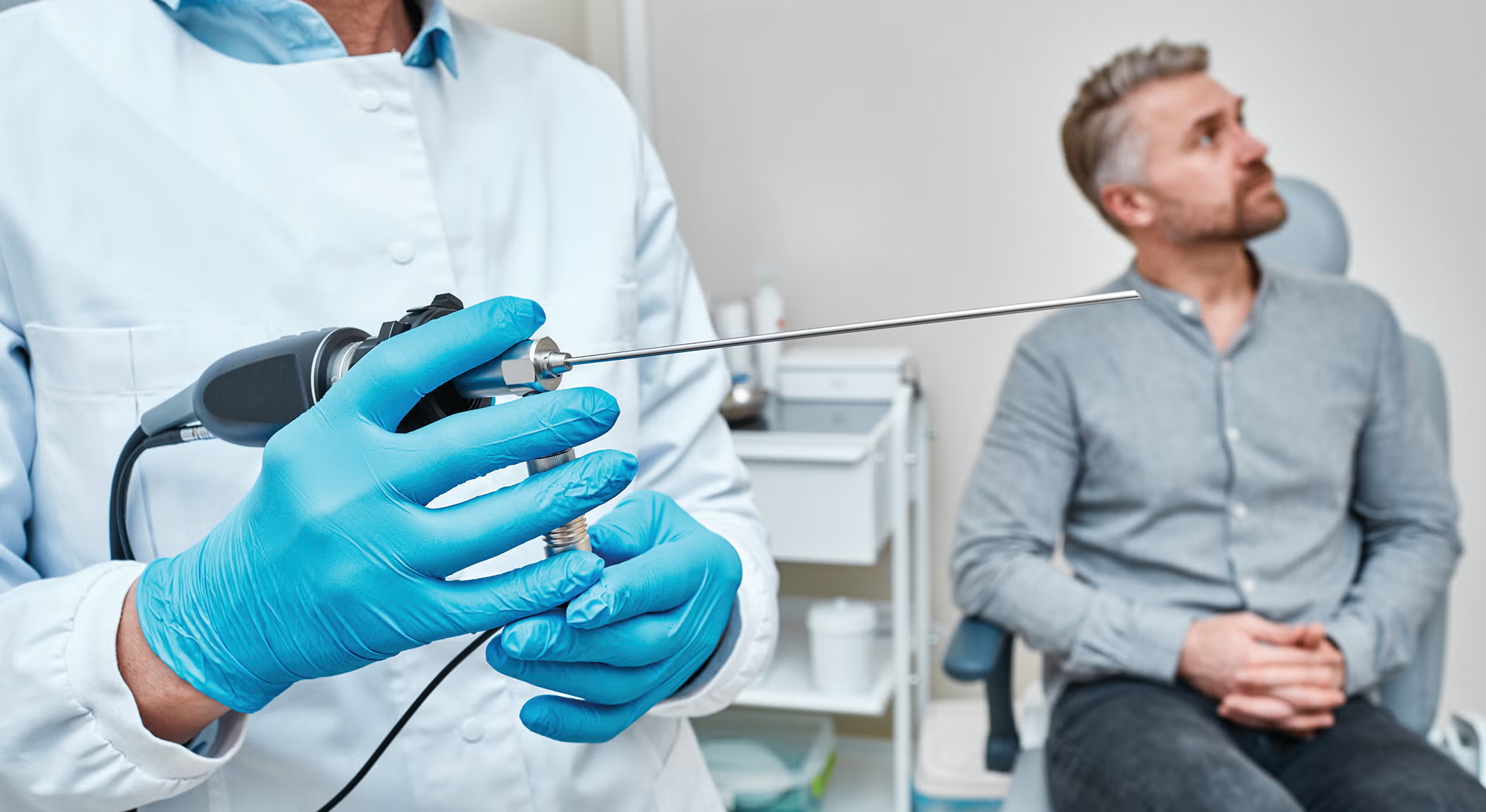
In 2015, after returning home from a trip, my left ear clogged during descent and remained so for several days. I knew something was off. At the end of the day, back at work, seeing patients, I put an endoscope in my ear, and I found a small retraction pocket of the pars flaccida, accumulating debris. For goodness’ sake, I had a cholesteatoma!

I followed it for about a year with endoscopic self-examination. I had my medical partner debride my ear under the microscope every few months. He would pull out squamous debris, and the ear would ache, then feel slightly better. I knew I was eventually going to need surgery. I wanted that surgery to be endoscopic.

Using endoscopes in ear surgery has always made sense to me. I never used them in residency or fellowship, but during residency, I attended several Academy lectures about endoscopic ear surgery by Muaaz Tarabichi, MD. He was talking about something unique and interesting, and it fascinated me. I admired Dr. Tarabichi for his commitment to developing a new skill and for advocating for it. Those presentations convinced me that endoscopic ear surgery has a place in our specialty.

After I completed an otology fellowship and began practicing, I performed ear surgeries microscopically, which was how I had been trained. However, I added a step to satiate my curiosity and to assess my outcome of the microscopic surgery. At the end of each case, and after I was convinced that I had removed all cholesteatoma, I would ask for an endoscope and tower. I wanted to confirm I wasn’t missing anything, especially in the posterior mesotympanum. I wanted to apply what already made good sense to me; I wanted to see around the corner. The OR staff would sigh (I knew they were thinking I was difficult), but they dutifully did as I asked. I would not infrequently find a small bit of cholesteatoma hidden around a corner when I was certain it had all been removed. So, I wanted to make a change in my surgical practice.

It was 2014, and I decided to develop my skills. I registered for two courses: the Vanderbilt Endoscopic Middle Ear Surgical Dissection Course, directed by Drs. Alejandro Rivas and Marc Bennett, and the Toronto Endoscopic Ear Course, directed by the late Dr. David Pothier, and Drs. John Rutka and Ian Witterick. They were both outstanding courses. (Later, in 2016, I also attended the Harvard Endoscopic Ear Surgery Dissection Course, directed by Drs. Daniel J. Lee and Michael S. Cohen.)

About a week after the second course, I performed my first endoscopic ear case— the resection of an epitympanic cholesteatoma. The surgery went wonderfully, and I enjoyed it! The patient had a great outcome and continued without recurrence.

I started with the endoscopes and the video tower used for functional endoscopic sinus surgery, Rosen needles, straight suctions, round knives, sickle knives, etc. It worked well for tympanoplasties and epitympanic cholesteatoma. Shortly thereafter, I purchased angled endoscopic ear instruments, which allowed for deeper dissection into the posterior mesotympanum and toward the mastoid antrum.

After I found the cholesteatoma in my own left ear in 2015 and had had several debridements, I realized it would be irresponsible to delay definitive treatment further. If I were going to avoid a mastoidectomy, I would have to get to the cholesteatoma before it extended too deeply within the mastoid. I had a CT of the temporal bones. To my relief, my cholesteatoma was ideal for endoscopic resection, potentially avoiding a postauricular incision. At the time, no one in my area was performing endoscopic surgery for cholesteatoma, and, of course, I wanted the best surgeon within a reasonable distance. I had attended lectures about endoscopic middle ear surgery and using endoscopes in surgery for superior semicircular canal dehiscence by Dr. Daniel Lee at Massachusetts Eye and Ear. I knew he was a good surgeon, and I liked him. I brought him my CT, and we had a brief meeting. I wanted endoscopic ear surgery, and I knew he was the surgeon to do it.

The surgery went very well. Dr. Lee gave me a video of the procedure so I could review it post-op. My chorda tympani was sacrificed, and I had a partial prosthesis (Kurz, CliP). I required no pain medications. I had no numbness. I had no hair loss, with only a small incision to obtain conchal cartilage. My surgery was on a Monday, and I was back operating on my own patients on Wednesday. Water tasted metallic on the left side of my tongue for two months after surgery, but one day, like magic, it was gone. My hearing result was very good (only a mild conductive loss).

I continue to routinely perform endoscopic ear surgery. Adopting it made sense to me; it fits in my practice and with my experience. Developing the skills took some time but did not require a significant amount of new resources. I feel fortunate. My experience as a patient has allowed me to better describe surgery and the post-operative experience to my patients. Sometimes I will describe my experience to them. I feel strongly that, in many cases, endoscopic ear surgery is in their best interest, and I am confident when I make that recommendation.

Dr. Wycherly is an otolaryngology–head and neck surgeon at the Ear, Nose & Throat Institute of Connecticut.

Filed Under: ENT Perspectives, Home Slider, Viewpoint Tagged With: endoscopic surgeryIssue: January 2026

You Might Also Like:

  • A Closer Look at Endoscopic Ear Surgery
  • Endoscopic Approach Reduces the Need for ‘Second-Look’ Mastoid Surgery
  • Endoscopic Ear Surgery: Advancements and Adoption Challenges 
  • The Great Debate: MRI Versus Second-Look Surgery for Cholesteatoma

Leave a Reply Cancel reply

Your email address will not be published. Required fields are marked *

The Triological SocietyENTtoday is a publication of The Triological Society.

Polls

Has experience as a patient influenced your professional development or demeanor?

View Results

Loading ... Loading ...
  • Polls Archive

Top Articles for Residents

  • A Resident’s View of AI in Otolaryngology
  • Call for Resident Bowl Questions
  • Resident Pearls: Pediatric Otolaryngologists Share Tips for Safer, Smarter Tonsillectomies
  • A Letter to My Younger Self: Making Deliberate Changes Can Help Improve the Sense of Belonging
  • ENTtoday Welcomes Resident Editorial Board Members
  • Popular this Week
  • Most Popular
  • Most Recent
    • Growing Use of Tranexamic Acid in Otolaryngology

    • Top 10 LARY and LIO Articles of 2024

    • The Dramatic Rise in Tongue Tie and Lip Tie Treatment

    • Some Laryngopharyngeal Reflux Resists PPI Treatment

    • Empty Nose Syndrome: Physiological, Psychological, or Perhaps a Little of Both?

    • The Dramatic Rise in Tongue Tie and Lip Tie Treatment

    • Rating Laryngopharyngeal Reflux Severity: How Do Two Common Instruments Compare?

    • Is Middle Ear Pressure Affected by Continuous Positive Airway Pressure Use?

    • Otolaryngologists Are Still Debating the Effectiveness of Tongue Tie Treatment

    • Keeping Watch for Skin Cancers on the Head and Neck

    • Why So Loud? Rethinking the Volume of Our Everyday Experiences
    • How Audiologists and Researchers Are Shaping Military Hearing Health Practices
    • A Case for Endoscopic Surgery: How Personal Experience Influenced Pursuit of a New Skill
    • The Path to Department Chair: Arriving and Thriving
    • Rewriting the Rules of Rhinosinusitis

Follow Us

  • Contact Us
  • About Us
  • Advertise
  • The Triological Society
  • The Laryngoscope
  • Laryngoscope Investigative Otolaryngology
  • Privacy Policy
  • Terms of Use
  • Cookies

Wiley

Copyright © 2026 by John Wiley & Sons, Inc. All rights reserved, including rights for text and data mining and training of artificial technologies or similar technologies. ISSN 1559-4939