• Home
  • Practice Focus
    • Facial Plastic/Reconstructive
    • Head and Neck
    • Laryngology
    • Otology/Neurotology
    • Pediatric
    • Rhinology
    • Sleep Medicine
    • How I Do It
    • TRIO Best Practices
  • Business of Medicine
    • Health Policy
    • Legal Matters
    • Practice Management
    • Tech Talk
    • AI
  • Literature Reviews
    • Facial Plastic/Reconstructive
    • Head and Neck
    • Laryngology
    • Otology/Neurotology
    • Pediatric
    • Rhinology
    • Sleep Medicine
  • Career
    • Medical Education
    • Professional Development
    • Resident Focus
  • ENT Perspectives
    • ENT Expressions
    • Everyday Ethics
    • From TRIO
    • The Great Debate
    • Letter From the Editor
    • Rx: Wellness
    • The Voice
    • Viewpoint
  • TRIO Resources
    • Triological Society
    • The Laryngoscope
    • Laryngoscope Investigative Otolaryngology
    • TRIO Combined Sections Meetings
    • COSM
    • Related Otolaryngology Events
  • Search

How To: High-Riding Innominate Artery: Booby Trap for ICU Tracheotomy

by Vijay R. Ramakrishnan, MD, and Samuel L. Kaefer, BA • February 2, 2026

  • Tweet
  • Click to email a link to a friend (Opens in new window) Email
Print-Friendly Version

INTRODUCTION

You Might Also Like

  • Tracheotomy Management Update
  • Easier-to-Use Vocal Fold Injectables Prompt More In-Office Procedures
  • How To: Does Intralesional Steroid Injection Effectively Mitigate Vocal Fold Scarring in a Rabbit Model?
  • Vocal Fold Paresis: A Well-Recognized Condition of Ambiguous Significance
Explore This Issue
February 2026

Tracheotomy placement is an airway management procedure regularly performed by a variety of physicians, most commonly through a percutaneous route (critical care/general surgery) or open surgical approach (otolaryngology). Bedside percutaneous tracheotomy is appreciated for its convenience, quickness, and safety; however, it is not rare to encounter anatomic irregularities necessitating further imaging, a formal surgical tracheotomy, or alternative procedures.

Herein, we report a case in which formal tracheotomy was planned for long-term ventilator dependence in the setting of bilateral vocal fold paralysis. Moments before incision, a visible pulsation was noted in the lower neck. Further imaging was undertaken, which ultimately revealed a high-riding innominate artery within the surgical trajectory. This anatomical variation necessitated an alternative surgical approach for airway management, ultimately in the form of vocal fold lateralization.

The following report illustrates a cautionary tale that is of particular importance to trainees in understanding alternatives to airway management to avoid unintended major consequences.

CASE REPORT
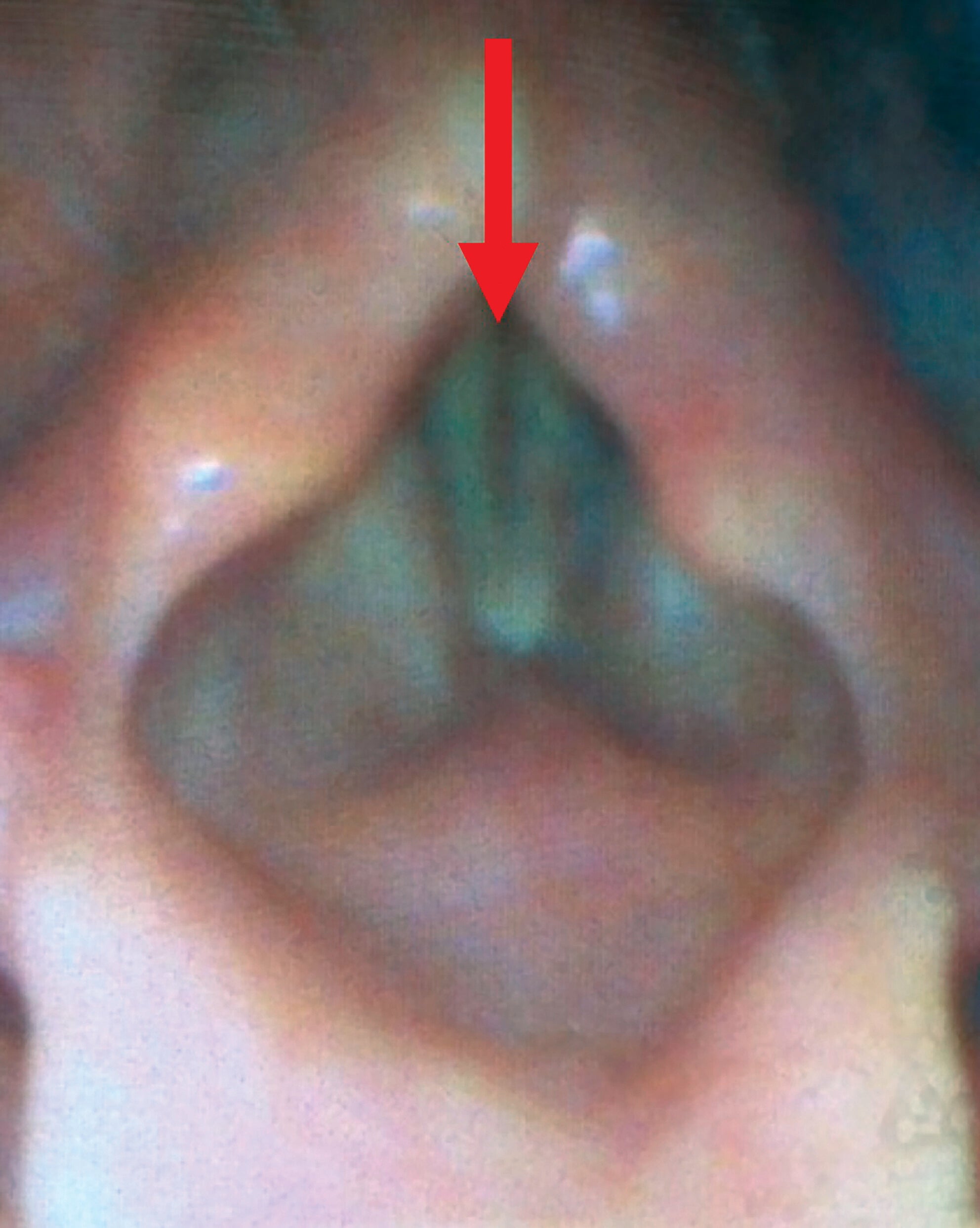
Figure 1. Vocal fold visualization as seen on bedside laryngoscopy. Arrow shows the maximal glottic opening due to bilateral vocal fold paralysis

A 73-year-old woman with a recent upper respiratory tract infection presented to the emergency department (ED) with three days of progressive dyspnea and stridor. Bedside laryngoscopy revealed bilateral vocal fold paralysis (Fig. 1). The patient decompensated in the ED, requiring subsequent intubation and transfer to the ICU, with tracheotomy placement planned for the next day for airway stabilization. Bedside clinical examination of the neck in the ICU was unremarkable, and the patient was taken to the operating room.

In the OR, following anesthesia, surgical positioning, and sterile prep, a visible pulsation was noted in the lower neck. After a discussion between the surgical team and vascular surgery, a decision was made to abort the procedure, given its non-emergent nature, and to pursue further imaging workup. A neck computed tomography (CT) revealed prominent vasculature within the surgical trajectory (Fig. 2A), with angiography confirming a high-riding innominate artery at the level of the upper tracheal rings (Fig. 2B).
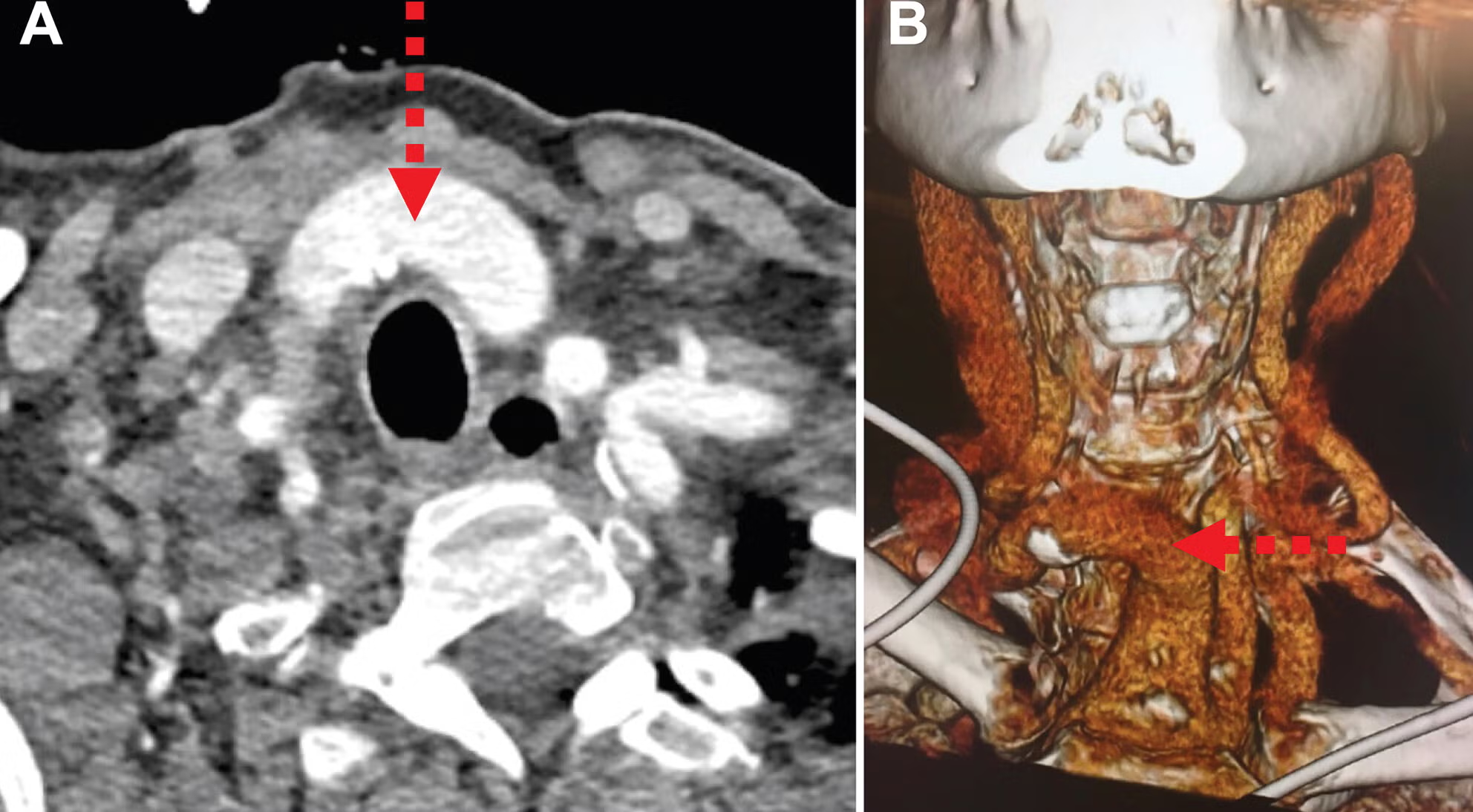
Figure 2. High-riding innominate artery. Axial CT scan of the neck with contrast demonstrating the location of the innominate artery, approximately at the levels of the first and second tracheal rings (A) Three-dimensional vascular reconstruction based on CT angiography. (B) Arrows show the innominate artery obscuring the trajectory for tracheotomy placement.

Vascular, cardiothoracic, and laryngology teams were formally consulted to discuss alternative approaches for airway management for the patient. Ultimately, the decision was made to avoid tracheotomy in favor of bilateral vocal fold suture lateralization performed by the laryngology team. The patient was extubated the following day without subsequent airway difficulty and was able to tolerate food while still having reasonable phonation.

CONCLUSION

Regardless of tracheotomy placement route (percutaneous or surgical), anticipation of anatomic irregularities is essential for patient safety and procedure success. A patient-centered approach that involves discussions with other surgical fields is imperative in determining the best approach for difficult airway securement.

Read the entire article here.

Filed Under: How I Do It Tagged With: high-riding innominate artery, ICU tracheotomyIssue: February 2026

You Might Also Like:

  • Tracheotomy Management Update
  • Easier-to-Use Vocal Fold Injectables Prompt More In-Office Procedures
  • How To: Does Intralesional Steroid Injection Effectively Mitigate Vocal Fold Scarring in a Rabbit Model?
  • Vocal Fold Paresis: A Well-Recognized Condition of Ambiguous Significance

Leave a Reply Cancel reply

Your email address will not be published. Required fields are marked *

The Triological SocietyENTtoday is a publication of The Triological Society.

Polls

Has your practice or department been affected by the lack of anesthesiologists?

View Results

Loading ... Loading ...
  • Polls Archive

Top Articles for Residents

  • Applications Open for Resident Members of the ENTtoday Editorial Board
  • A Resident’s View of AI in Otolaryngology
  • Call for Resident Bowl Questions
  • Resident Pearls: Pediatric Otolaryngologists Share Tips for Safer, Smarter Tonsillectomies
  • A Letter to My Younger Self: Making Deliberate Changes Can Help Improve the Sense of Belonging
  • Popular this Week
  • Most Popular
  • Most Recent
    • Rewriting the Rules of Rhinosinusitis

    • Some Laryngopharyngeal Reflux Resists PPI Treatment

    • Otolaryngologists Are Still Debating the Effectiveness of Tongue Tie Treatment

    • Office Laryngoscopy Is Not Aerosol Generating When Evaluated by Optical Particle Sizer

    • Empty Nose Syndrome: Physiological, Psychological, or Perhaps a Little of Both?

    • The Dramatic Rise in Tongue Tie and Lip Tie Treatment

    • Rating Laryngopharyngeal Reflux Severity: How Do Two Common Instruments Compare?

    • Is Middle Ear Pressure Affected by Continuous Positive Airway Pressure Use?

    • Otolaryngologists Are Still Debating the Effectiveness of Tongue Tie Treatment

    • Keeping Watch for Skin Cancers on the Head and Neck

    • Applications Open for Resident Members of the ENTtoday Editorial Board
    • Bottleneck In the OR: How Anesthesiologist Shortages Threaten Surgical Care
    • Onboarding and Working with APPs
    • Evaluating Treatment Patterns in Bell’s Palsy Using Nationwide Employer- Sponsored Healthcare Claims
    • Randomized Trials Comparing Inferior Turbinoplasty Techniques for Nasal Obstruction

Follow Us

  • Contact Us
  • About Us
  • Advertise
  • The Triological Society
  • The Laryngoscope
  • Laryngoscope Investigative Otolaryngology
  • Privacy Policy
  • Terms of Use
  • Cookies

Wiley

Copyright © 2026 by John Wiley & Sons, Inc. All rights reserved, including rights for text and data mining and training of artificial technologies or similar technologies. ISSN 1559-4939