As I gently pulled the drapes open from our Viking River Cruise suite window, the early morning light outlining rows of trees along the Rhine riverbank took my breath away. The water shimmered like glass with gentle waves as the boat drifted past villages that had stood for centuries. All was quiet except for the low hum of the engines and the occasional call of a gull. For the first time in years, I felt still.
Explore This Issue
January 2026This European trip was long anticipated, planned since January, after what I experienced taking care of my father when he was hospitalized for acute cholecystitis in a suburban Los Angeles community hospital. My memories from being his caretaker and advocate were traumatic: Monitoring timely lab draws and IV antibiotics, waiting for daily rounds by the hospitalist to confirm care plan and next steps, meeting the surgeon and GI on call, translating care plans to my parents, ensuring his peri-operative readiness for anesthesia (ERCP stenting first, then laparoscopic cholecystectomy), and preparing for his prolonged recovery over the next month. I prayed and decided back then that, as long as my father recovered, I would take him and my mother on a trip of a lifetime.
I invited my mother-in-law as well. She deserved nothing less than to be pampered and experience a vacation like no other. She was the tireless caretaker for my father-in-law, who suffered poor health for over a decade and passed away two years ago. She was also a devoted daughter-in-law to Dave’s amazing grandmother, Tilly, whom we lost at age 106 during the pandemic.
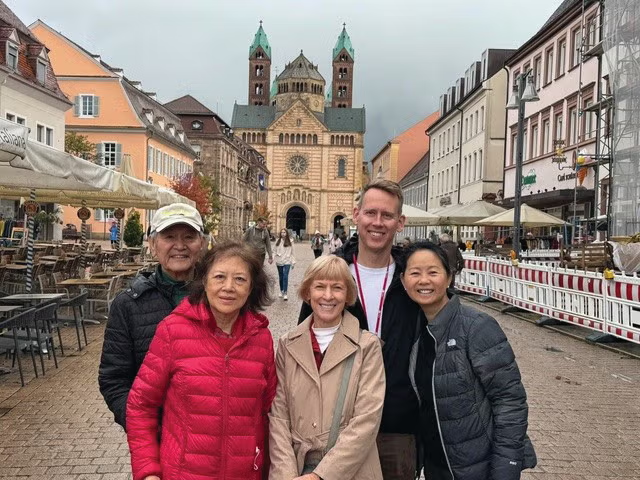
So, Dave and I, with an 81-year-old and two 76-year-olds, shared our first river cruise experience. While my parents are well-traveled in the U.S. and Asia, it was the first time in Europe for all three parents. Amidst constant demands of patient care, administrative and leadership responsibilities for the division, onboarding two new faculty and advanced practice providers, it seemed surreal that we were finally on our way. The river, unknown to me, would set the pace.
Recent research shows that leisure travel is not merely a break from work but a reset for body and mind: Vacationers report lower stress, improved mood, and renewed motivation. I needed a reset for sure, but could never have realized the gifts this vacation provided that were unique from all other trips Dave, Claire, and I have taken.
The Cruise
A river cruise in Europe was intriguing, but I must admit my bias, as marketing suggests Dave and I were younger than the usual demographic. But I cherished and appreciated the intimacy, simplicity, sense of calm, and well-organized itineraries provided by Viking River Cruises. Most of all, the staff on this ship provided such personalized and kind service; we were spoiled every moment. Perhaps it is because most passengers are senior in age, and because of the Viking commitment to their customers, the pace and feel were truly healing and inspired much reflection and many authentic connections for us with our parents. With only 195 passengers per long ship, Dave would tell you that, typical of Julie Wei, by a few days into the journey, I knew the names of and connected with the captain, maître d’, servers, cabin housekeeping staff, bartender, program director, and others. In addition, I befriended other passengers. I chose October, not realizing just how lucky we would be to see the palette of every autumn leaf color, from Amsterdam on the day we arrived, in every port we visited, (Rüdesheim, Cologne, Speyer, Strasbourg, Colmar, Black Forest, Breisach), and across the amazing rolling hills on the way to the Swiss Alps and Lake Brienz (private day tour I arranged when we got off the cruise in Basel).
I rarely eat two or even three meals a day; however, during the cruise, this was almost cursory (yes, I am three pounds up)! Each mealtime became routine but special, not only because of the great food and being served and pampered, but also because we got to sit down every morning with our parents to start the day. Then again, for lunch and dinner. At every meal, we shared laughter, small talk, and stories from our day or our past. Such joy was shared all over the single dining room on the ship, amidst others who were also traveling with friends and families. Food, family, and travel, perhaps the greatest intersection of LOVE we all experience, is shared across cultures and geography. I was constantly reminded of the immense gratitude I felt that we were blessed as a family, to be on the Rhine, on this ship, to enjoy all three parents at once.
The Cathedrals, Stones, and the Clock
Every time I have the privilege to see a cathedral in a European city, I am in awe of the human ingenuity and grit, along with the reality of politics, human labor, and suffering reflected in these stunning architectures and what they represent. On a cold, gray morning, we walked across the bridge over the Rhine to see the Köln Cathedral, a bridge heavy with thousands of locks representing love from previous visitors.
Once inside the cathedral, I performed a ritual of pressing my palm against the cool, gray stone wall to try and comprehend how this cathedral took more than six centuries to build! The stone was smooth from perhaps millions of hands that had touched it before mine. Standing there, I thought about how different the builders’ concept of time must have been. Each mason worked knowing he would never live to see the spires finished. Their work stretched across generations— patient, faithful, enduring. What it took to build a cathedral like this can be so easily destroyed in a matter of seconds throughout human history, from the tragedy of war and violence.
What a contrast for the world we live in as physicians and surgeons, our daily reality measured and experienced in minutes and hours, with self-imposed and structured deadlines, clinical or otherwise. Racing against the clock and schedules from the operating room, clinics, performance metrics, emails, and countless challenges to fix (not including quality and safety initiatives), just to mitigate our own burnout and optimize our tasks and goals within our complex healthcare systems, amidst the social challenges of the patients that we serve. The training environment and culture in healthcare prize efficiency, productivity, and speed. I cherish such moments in every cathedral visited, where the walls and stones whisper the lesson I needed: Not all work is meant to be completed in our lifetime. Some of the most meaningful contributions are those we begin but never finish. Training future generations of physicians and surgeons, restoring function, improving the quality of, and even saving, lives, means that we sustain humanity even if we never realize our contributions and the impact of what we do daily.
Perhaps well-being and wellness in our modern world begin with reclaiming a different relationship with time—not as something to conquer, but as something to honor.
The Caregiver’s Gaze
Over the final days of the cruise, several passengers made comments to me that were humbling and embarrassing. After boarding a motorcoach for an excursion, as well as during buffet lines for breakfast and dinner, lovely gentlemen and women made similar remarks: “I just want you to know I have been moved watching how you take care of your parents. It’s beautiful how you care for them.” I smiled and thanked them, but I was very surprised. What did they mean? Helping my frail mother, who walks slowly due to both hip fractures that require hardware, but is unable to have a hip replacement due to severe osteoporosis? Ordering for them, as, despite speaking conversational English, they are intimidated by the menus? Constantly making sure no one tripped or fell, and they kept up with the tour groups? Bringing them hot tea when sitting in the lounge before dinner? One passenger explained, “Don’t get me wrong, my kids are good kids, but this would never happen.”
I was flattered and touched by the complimentary remarks, but also puzzled. Caring for my parents feels as natural as breathing. In my culture, filial piety—the act of tending to one’s parents as they age—is not an exception but an expectation. It’s an expression of gratitude for life itself. Yet I realized that, through their eyes, it looked extraordinary. When we were infants, toddlers, and children, our parents did their very best to provide for us in basic and extraordinary ways, feeding, cleaning, and protecting us, and then ensuring that my sister and I had every opportunity to receive the best college and graduate school education possible, while being as frugal as possible for themselves, even to this day.
In Western culture, independence is prized; aging parents often strive not to be a burden to their children. Our vast geography, training destinations, and the jobs we choose often mean many of us don’t have the luxury of living in the same city as our parents. But to me, love expressed through service is not a burden—it’s belonging. To walk slowly beside my father on a cobblestone street, to steady my mother’s arm, to make sure my mother-in-law had warm soup she could enjoy—all of this is simply love in motion.
Recently, Claire shared with me her short essay explaining why her favorite book of all time is “Crying in H Mart,” by Michelle Zauner, a memoir in which the biracial author reflects on the way Asian culture expresses love not through words but through actions. I have learned that even non-Asian friends and colleagues also never grew up hearing “I love you,” but instead harsh criticisms and lack of support, even worse, traumatic experiences. The river and this trip provided me with the opportunity for complete healing regarding my relationship with my parents. Instead of dwelling on past issues, I chose to focus on the present and to express my gratitude and love for them in my actions, right up until their last days.
Wellness and well-being are not always about self-care. In fact, it’s also about “other-care” —the quiet but consistent acts that remind us we are part of something larger than ourselves.
Witnessing My Parents Anew
Traveling with my parents at this stage of their lives was both joy and a reminder about their vulnerabilities. I watched my father (who was once so strong and never took a day off or sick day, did whatever was required, and learned to fix just about everything), now nodding off multiple times a day with limited energy, and moving more slowly and more carefully. Yet on this cruise, as he indulged in Coca-Cola despite my scolding, he shared a story that I had never heard. When he was 18, his first job was at the American Embassy in Taipei, where in the dining room, Americans were served Coca-Cola. He was given the opportunity to taste his first Coke then.
This story, and picturing my father then, stopped my judgment and nagging about how terrible soda is for one’s health. Instead, I held back tears as I could almost feel his nostalgia and how tasting Coke brought him back to positive memories of his youth. I watched my mother decline just about every dessert and European pastry on and off the cruise, as she continues to monitor her HbA1C. She weighs 107 lbs. wet, yet genetics has made her at risk for type 2 diabetes. Tempered by the fatigue of long days, I noticed the small hesitations—the way they paused before each new set of stairs, the gratitude when we found a bench anywhere, along the walking paths, in a palace, in the sun or rain. I found myself looking proactively and asking the tour guides for every public restroom to ensure they were comfortable at all points of our daily excursions.
It struck me that time had softened them and softened me too. I found myself far more patient, more protective, more aware that every shared laugh or photo captured was, in some way, a keepsake of impermanence
As members of the “sandwich generation,” many of us straddle two worlds—caring for our children’s futures while tending to our parents’ twilight years. It can feel like being pulled in opposite directions. Yet on this cruise, I realized that being between generations can also be a sacred space: We are the bridge, the living link in an unbroken chain of love and legacy.
The River as Teacher
Each day, as the ship moved from one town to the next—Amsterdam to Kinder Dijk, Koblenz, Köln, Rüdesheim, Speyer, Strasbourg, Breisach, and finally Basel— the rhythm of the river became my quiet meditation. The current never rushed. It flowed with purpose, unhurried and sure. I thought of how much of my professional life is spent swimming upstream— against time, against pressure, against exhaustion. The Rhine reminded me there is another way.

“May we all find a river that slows us, a cathedral that humbles us, and a family that reminds us why we journey at all.” Dr. Wei
The river reaches every destination not by fighting, but by flowing. There is a kind of wisdom in its patience. A kind of healing in its surrender.
For those of us who measure our lives in productivity, it can be radical to simply “be.” But perhaps that is what wellness truly asks of us—to make space for stillness, to find small rivers even in the busiest days. Maybe that means a quiet cup of tea before clinic. Maybe it’s a walk at sunset. Maybe it’s choosing presence over perfection.
Returning Home
When we disembarked in Basel, my heart felt both full and tender. My parents moved slowly but smiled constantly. My mother-in-law declared it the most beautiful trip of her life. I booked a private tour for eight hours to see the Swiss Alps and lakes. We visited Lauterbrunnen and the stunning village of Mürren via cable car, and drove along Lake Brienz, mesmerized by the mountains, rolling green hills, and stunning turquoise water. After spending the night in Zurich, we flew home the next day. Despite delays and missing our connection from O’Hare back to Cleveland, and fatigue from hours of flight and travel, my parents never complained. Despite frustrations with travel delays, I found myself silently thanking time itself—for giving us this chapter together.
Back home to Akron, I returned to the operating room, the meetings, clinics, and the tempo of modern medicine. But something in me had shifted. I now keep both the image of that cathedral wall and the way the river flowed across centuries—both reminders that endurance, not urgency, defines the things that last.
The river still flows somewhere far away, carrying stories older than mine. And I am reminded: In both life and medicine, we are all builders and travelers at once—laying stones we may never see completed, guiding those we love along the water’s edge.
May we all find a river that slows us, a cathedral that humbles us, and a family that reminds us why we journey at all.
Dr. Wei is the Alfred J. Magoline Endowed Chair in otolaryngology–head neck surgery, division director of pediatric otolaryngology at Akron Children’s Hospital, and professor of otolaryngology at the University of Cincinnati College of Medicine and Northeast Ohio College of Medicine, both in Akron, Ohio.


Leave a Reply