• Home
  • Practice Focus
    • Facial Plastic/Reconstructive
    • Head and Neck
    • Laryngology
    • Otology/Neurotology
    • Pediatric
    • Rhinology
    • Sleep Medicine
    • How I Do It
    • TRIO Best Practices
  • Business of Medicine
    • Health Policy
    • Legal Matters
    • Practice Management
    • Tech Talk
    • AI
  • Literature Reviews
    • Facial Plastic/Reconstructive
    • Head and Neck
    • Laryngology
    • Otology/Neurotology
    • Pediatric
    • Rhinology
    • Sleep Medicine
  • Career
    • Medical Education
    • Professional Development
    • Resident Focus
  • ENT Perspectives
    • ENT Expressions
    • Everyday Ethics
    • From TRIO
    • The Great Debate
    • Letter From the Editor
    • Rx: Wellness
    • The Voice
    • Viewpoint
  • TRIO Resources
    • Triological Society
    • The Laryngoscope
    • Laryngoscope Investigative Otolaryngology
    • TRIO Combined Sections Meetings
    • COSM
    • Related Otolaryngology Events
  • Search

Otolaryngologists Well-Positioned for Diagnosis, Treatment of Pediatric Patients with Eosinophilic Esophagitis

by Amy E. Hamaker • June 20, 2017

  • Tweet
  • Click to email a link to a friend (Opens in new window) Email
Print-Friendly Version

What are the clinical presentation and the role of the otolaryngologist in evaluating eosinophilic esophagitis (EoE) at a tertiary pediatric hospital?

Bottom line
Patients with EoE frequently present to otolaryngology undiagnosed in the first five years of life, making esophagoscopy with biopsy an important adjunct to airway endoscopy in children with refractory aerodigestive symptoms.

You Might Also Like

  • Eosinophilic Esophagitis, CRS Show Associations as Comorbid Conditions
  • FDA Approves First Treatment for Eosinophilic Esophagitis
  • Eosinophilic Esophagitis: Serious But Misunderstood
  • Early Diagnosis, Treatment Essential in Acute Invasive Fungal Sinusitis in Patients with Recent COVID-19 Infection
Explore This Issue
June 2017

Background: EoE diagnosis requires esophageal dysfunction symptoms, esophageal eosinophilia on esophageal biopsy, and exclusion of alternative causes of esophageal eosinophlia. Recently, there has been increased recognition of EoE as a cause of gastrointestinal morbidity and reduced quality of life in affected children, as well as EoE airway manifestations being a possible cause of recurrent croup, stridor, dysphonia, and chronic cough. As a consequence, the otolaryngologist’s role is evolving.

Study design: Retrospective review of 251 pediatric patients with an EoE diagnosis from 2003 to 2015.

Setting: Children’s Hospital of Pittsburgh, Pa.

Synopsis: Overall, 26% of patients presented initially with airway symptoms including chronic cough, dysphonia, stridor, or recurrent croup. Ninety-seven percent of patients had GI symptoms on presentation, the most common being dysphagia, recurrent emesis/nausea, and abdominal pain, or food regurgitation. Departmental sites of initial patient presentation were: gastroenterology 67%, otolaryngology 18%, allergy/immunology 3%, and emergency department 13%. Of patients initially evaluated by otolaryngology, 82% were diagnosed with eosphageal eosinophilia during diagnostic panendoscopy, while 18% were later diagnosed by the GI service. Median time to diagnosis did not depend on initial presentation site. Patients initially presenting to otolaryngology were significantly younger than those presenting to GI, and airway symptomatology was more common.
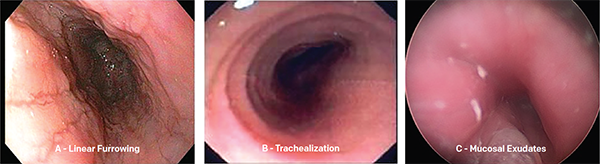
Common endoscopic abnormalities seen in patients with eosinophilic esophagitis. Credit: Copyright 2017 The American Laryngological, Rhinological and Otological Society, Inc.

Common endoscopic abnormalities seen in patients with eosinophilic esophagitis.
Credit: Copyright 2017 The American Laryngological, Rhinological and Otological Society, Inc.

Endoscopic esophagus appearance was normal in 17% of patients with pathologically confirmed esophageal esosinophilia; linear furrowing was the most common abnormality noted. Airway endoscopy was performed in 25% of the otolaryngology cohort; common findings included tracheal cobblestoning, laryngomalacia, and subglottic stenosis.

Ultimately, 14% of patients were diagnosed by otolaryngology on the basis of esophageal biopsy results during diagnostic panendoscopy. In only 18% of cases evaluated by otolaryngology was the diagnosis missed and subsequently made by GI.

Citation: Kubik M, Thottam P, Shaffer A, Choi S. The role of the otolaryngologist in the evaluation and diagnosis of eosinophilic esophagitis. Laryngoscope. 2017;127:1459–1464.

Filed Under: Literature Reviews, Pediatric Tagged With: diagnosis, endoscopy, eosinophilic esophagitis, esophagoscopy, otolaryngology, pediatrics, treatmentIssue: June 2017

You Might Also Like:

  • Eosinophilic Esophagitis, CRS Show Associations as Comorbid Conditions
  • FDA Approves First Treatment for Eosinophilic Esophagitis
  • Eosinophilic Esophagitis: Serious But Misunderstood
  • Early Diagnosis, Treatment Essential in Acute Invasive Fungal Sinusitis in Patients with Recent COVID-19 Infection

The Triological SocietyENTtoday is a publication of The Triological Society.

Polls

Do you use TXA to reduce intraoperative and post-op bleeding?

View Results

Loading ... Loading ...
  • Polls Archive

Top Articles for Residents

  • A Resident’s View of AI in Otolaryngology
  • Call for Resident Bowl Questions
  • Resident Pearls: Pediatric Otolaryngologists Share Tips for Safer, Smarter Tonsillectomies
  • A Letter to My Younger Self: Making Deliberate Changes Can Help Improve the Sense of Belonging
  • ENTtoday Welcomes Resident Editorial Board Members
  • Popular this Week
  • Most Popular
  • Most Recent
    • Office Laryngoscopy Is Not Aerosol Generating When Evaluated by Optical Particle Sizer

    • Call for Resident Bowl Questions

    • The Dramatic Rise in Tongue Tie and Lip Tie Treatment

    • Ethical Obligations and Duty to Advocate for Patients in Prior Authorization for Surgery

    • Some Laryngopharyngeal Reflux Resists PPI Treatment

    • The Dramatic Rise in Tongue Tie and Lip Tie Treatment

    • Rating Laryngopharyngeal Reflux Severity: How Do Two Common Instruments Compare?

    • Is Middle Ear Pressure Affected by Continuous Positive Airway Pressure Use?

    • Otolaryngologists Are Still Debating the Effectiveness of Tongue Tie Treatment

    • Keeping Watch for Skin Cancers on the Head and Neck

    • Growing Use of Tranexamic Acid in Otolaryngology
    • Reconnect, Recharge, Relax, and Choose Joy This Season
    • A Resident’s View of AI in Otolaryngology
    • Faculty Mentorship of Academic Surgeons
    • CMS’ New Rule Aims to Streamline the Prior Authorization Process

Follow Us

  • Contact Us
  • About Us
  • Advertise
  • The Triological Society
  • The Laryngoscope
  • Laryngoscope Investigative Otolaryngology
  • Privacy Policy
  • Terms of Use
  • Cookies

Wiley

Copyright © 2025 by John Wiley & Sons, Inc. All rights reserved, including rights for text and data mining and training of artificial technologies or similar technologies. ISSN 1559-4939