
• Home
  • Practice Focus
    • Facial Plastic/Reconstructive
    • Head and Neck
    • Laryngology
    • Otology/Neurotology
    • Pediatric
    • Rhinology
    • Sleep Medicine
    • How I Do It
    • TRIO Best Practices
  • Business of Medicine
    • Health Policy
    • Legal Matters
    • Practice Management
    • Tech Talk
    • AI
  • Literature Reviews
    • Facial Plastic/Reconstructive
    • Head and Neck
    • Laryngology
    • Otology/Neurotology
    • Pediatric
    • Rhinology
    • Sleep Medicine
  • Career
    • Medical Education
    • Professional Development
    • Resident Focus
  • ENT Perspectives
    • ENT Expressions
    • Everyday Ethics
    • From TRIO
    • The Great Debate
    • Letter From the Editor
    • Rx: Wellness
    • The Voice
    • Viewpoint
  • TRIO Resources
    • Triological Society
    • The Laryngoscope
    • Laryngoscope Investigative Otolaryngology
    • TRIO Combined Sections Meetings
    • COSM
    • Related Otolaryngology Events
  • Search

Bottleneck In the OR: How Anesthesiologist Shortages Threaten Surgical Care

by Mary Beth Nierengarten • February 2, 2026

  • Tweet
  • Click to email a link to a friend (Opens in new window) Email
Print-Friendly Version

You Might Also Like

  • Some Studies Predict a Shortage of Otolaryngologists. Do the Numbers Support Them?
  • National Drug Shortage Hits ENT Surgeries: Succinylcholine, propofol and tetracaine in limited supply
  • Drug Shortages in Otolaryngology
  • Why Facial Plastic Surgeons Should Consider Bringing More Surgical Procedures In-House
Explore This Issue
February 2026

Numerous studies have documented the shortage of anesthesiologists and its effect on surgical specialties. The shortage is largely a result of the imbalance of supply and demand, which, as described in a 2024 study by the American Society of Anesthesiologists (ASA), is not unique to anesthesiology but cuts across all areas of healthcare (Anesthesiology. doi.org/10.1097/aln.0000000000005052). As in other areas of healthcare, the COVID-19 pandemic further exacerbated the already growing healthcare staffing shortages and significantly affected the shortage of anesthesia providers. The 2024 ASA report, which is based on two workforce summits held in 2022 and 2023, describes how the surge in demand for surgical procedures post COVID-19 put additional stress on an anesthesiology workforce that, before the pandemic, was already feeling a slight shortage. A 35% anesthesiology workforce shortage reported by facilities before the pandemic became a 78% shortage two years after the pandemic.

The ASA report also describes trends affecting the anesthesiology workforce that will impact surgical specialties, including the need for increased anesthesiology providers for an aging population with increased medical morbidities that require a disproportionate number of surgeries and procedures; the evolution of procedures from hospital-based to outpatient, which will result in an increased demand for non-operating room anesthesia care; an aging workforce, with 57% of anesthesiologists older than 55 years of age; and the number of anesthesia providers estimated to have left the workforce in 2022 (2,500 anesthesiologists, 2,200 nurse anesthetists, and 65 anesthesiologist assistants).

Although training programs for anesthesiology providers who have entered the workforce since 2023 (1,900 anesthesiologists, 3,000 nurse anesthesiologists, and 300 anesthesiologist assistants) have made up for some of this deficit, it is estimated that inefficiencies in scheduling will continue to put a strain on anesthesiology providers as the number of procedures, and the increased complexity of those procedures, only continue to grow.
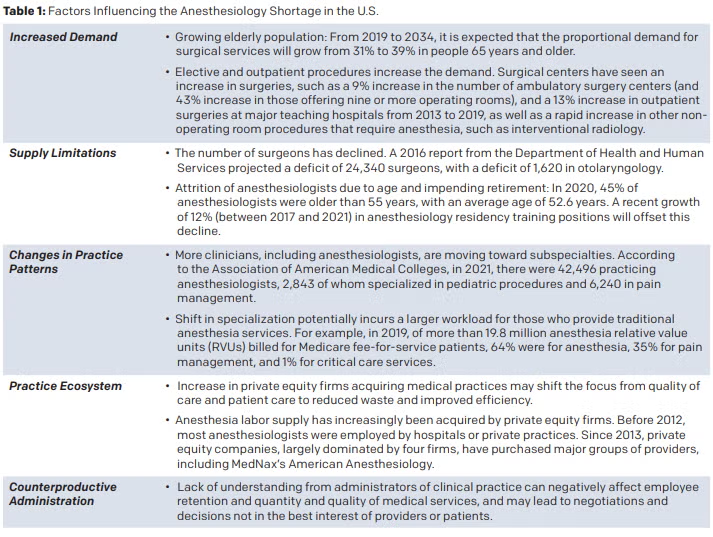
Along with the pandemic, other factors continue to influence the shortage of anesthesia providers (Journal of Medicine, Surgery, and Public Health. doi.org/10.1016/j.glmedi.2024.100048; see Table 1).

Looking ahead, recent data from Medicus Healthcare Solutions, a leading locum tenens staffing firm, highlight the projected growing gap between supply and demand of anesthesiologists. About 52,300 anesthesiologists currently practice in the U.S., a number that is projected to see a shortage of 8,450 by 2037 (Medicus. https://tinyurl.com/2s48svzz). Making up for some of this is the increasing demand for certified registered nurse anesthetists (CRNAs), with a projected 10% growth from 49,900 in 2023 to 55,100 in 2033. Furthermore, demand for certified anesthesiologist assistants (CAAs) is predicted to increase as part of team-based anesthesia staffing models. Currently, CAAs can practice in 19 states and jurisdictions.

Like all surgical specialties, otolaryngology is affected by the anesthesiology provider workforce shortage and changes. Mary Dale Peterson, MD, executive vice president and chief operating officer at Driscoll Health System and past president of ASA, said that the ASA does not have specific data for how different surgeons are staffed, but that otolaryngology is definitely prioritized at Driscoll Health. “Our ENT surgeons are very efficient and flexible, willing to fill in scheduling gaps with their patients in addition to their block schedules,” she said. “CARE teams help us be more efficient with our ENT surgeons as well.”

Experts Weigh In

Anthony Sheyn, MD, professor of otolaryngology–head and neck surgery at the University of Tennessee Health Center and division chief of pediatrics and otolaryngology at Lebonheur Children’s Hospital and St. Jude Children’s Research Hospital, all in Memphis, Tenn., said that the biggest impact of COVID-19 at his institution is that it forced a lot of people, including anesthesiologists, to either retire or move closer to their families, and the newly hired providers, specifically CRNAs, are recent grads and bring less experience and training during the expected acclimation period before they become more efficient. “This has slowed things down,” he said. He said that after the initial struggle to get anesthesiology coverage coming out of COVID-19, which made it difficult to schedule surgeries, his institution has now “passed a corner and is back to the volumes we used to have to provide access to our patients.”

He attributes this rebound largely to his hospital’s leadership, who, for the most part, come from a clinic background and almost all of whom have directly cared for patients in the past, including the president of the hospital, who previously served as the surgeon in chief. “So, our anesthesia departments are growing, [and] our surgery center has been able to open up more rooms and is more efficient than a tertiary center,” he said.

He said the bigger challenge currently, like other otolaryngology practices, is not having enough surgeons to perform procedures. “But we are going from six to eight surgeons in July,” he said, “so our staffing will be good, or at least better.”

Dr. Sheyn emphasized that despite some problems with getting anesthesiology provider coverage before COVID-19, he believes his institution was not as affected because of the leadership of a clinician who understood the importance of otolaryngology as a specialty that generates a lot of finances for the hospital.

Other institutions, he said, may be more affected because they are operated by private equity firms and run by leaders with MBA degrees who do not necessarily understand the importance of taking care of surgical needs efficiently. Others have just not recovered as quickly from COVID-19, and he noted that pediatric anesthesiologists are particularly in demand right now because of their scarcity.

Andrew J. Tompkins, MD, MBA, an otolaryngologist at Ohio ENT and Allergy Physicians in Columbus, Ohio, said the effect of COVID-19 on the shortage of anesthesiology providers, as documented in the literature, is borne out by the salaries that anesthesiology providers can now garner. “You need to offer CRNAs much more than what was typical prior to COVID-19,” he said. “Hospitals are having problems with staffing as well and are trying to put together a good package to get them to stay.”

He added that hospitals are particularly intent on snatching up nurse anesthesiologists and are offering to pay them a lot of money. “This may set the market rate much higher and create a shortfall elsewhere,” he said.

Dr. Tompkins said the shortage in anesthesiology providers points to the need to understand other workforces that affect our own. “We need other specialties to function, including audiology, so a shortage in any one area affects our ability to provide care,” he said.

“If you have a bottleneck somewhere else in anesthesia or audiology, then it means we aren’t fully able to provide care for patients in a timely manner,” he said. “The shortage in the anesthesia workforce highlights that we’re all interrelated and one workforce affects the other.”

As the chair of the American Academy of Otolaryngology–Head and Neck Surgery Workforce and Socioeconomic Survey Task Force, Dr. Tompkins said the anesthesiology provider workforce shortage’s effect on otolaryngology is a good issue to study in the next iteration of the workforce survey.

As an otolaryngologist working at a Veterans Affairs (VA) hospital, Jonathan Bock, MD, professor of otolaryngology–head and neck surgery at Froedtert Hospital and Medical College of Wisconsin, in Milwaukee, has seen the anesthesiology provider workforce shortage significantly impact the number of surgeries performed. “We have had to limit our operating cases at our VA hospital significantly, including dropping 25% of our current OR capacity,” he said, adding that posting elective cases has become increasingly challenging due to timing constraints.

“This has affected case volumes significantly and added increased challenges to the timely booking of urgent/emergent cases,” he said.

At the main medical campus of Froedtert Hospital and Medical College, he said a significant patient safety concern arises from the need to hire many locum tenens anesthesia staff, as well as multiple new practitioners. These healthcare professionals are now responsible for handling high-complexity cases for which they lack prior experience, including JET anesthesia cases and complex airway procedures.

Dr. Bock emphasized that the shortage of anesthesia providers at his facility has been a longstanding issue and has often been the “rate-limiting” step for operating room flow at their major tertiary care operating room. “The department here appears to be doing some stopgap solutions, but I am concerned that these are temporary fixes and not a real answer,” he said, citing the increased hiring of locum tenens, part-time hires, temporary hires, and international hires.

“We continue to lose our best operating room anesthesia staff to private practice groups that pay significantly more and do not require call,” he said. “Unless [this institution] raises pay for its academic anesthesiology staff, I fear that we’ll be in a continued shortage cycle.”

Solutions for Overcoming the Shortage

Solving the anesthesiology provider shortage will require a multiprong approach that basically addresses the problem of supply and demand. As laid out in the article by Abouleish et al, closing the gap between supply and demand requires both short- and long-term approaches, some of which can be done at the local level and some that require broader support from various stakeholders (Table 2). The ASA intends to continue focusing on this issue in its annual stakeholder summit, which will help to continue to monitor trends and progress, as well as modify strategies to ensure the anesthesiology workforce can meet the demands of surgical specialties such as otolaryngology.

Mary Beth Nierengarten is a freelance medical writer based in Minnesota.


Filed Under: Home Slider, Practice Management Tagged With: Anesthesiologist ShortagesIssue: February 2026

You Might Also Like:

  • Some Studies Predict a Shortage of Otolaryngologists. Do the Numbers Support Them?
  • National Drug Shortage Hits ENT Surgeries: Succinylcholine, propofol and tetracaine in limited supply
  • Drug Shortages in Otolaryngology
  • Why Facial Plastic Surgeons Should Consider Bringing More Surgical Procedures In-House

Leave a Reply Cancel reply

Your email address will not be published. Required fields are marked *

The Triological SocietyENTtoday is a publication of The Triological Society.

Polls

Has experience as a patient influenced your professional development or demeanor?

View Results

Loading ... Loading ...
  • Polls Archive

Top Articles for Residents

  • A Resident’s View of AI in Otolaryngology
  • Call for Resident Bowl Questions
  • Resident Pearls: Pediatric Otolaryngologists Share Tips for Safer, Smarter Tonsillectomies
  • A Letter to My Younger Self: Making Deliberate Changes Can Help Improve the Sense of Belonging
  • ENTtoday Welcomes Resident Editorial Board Members
  • Popular this Week
  • Most Popular
  • Most Recent
    • Rewriting the Rules of Rhinosinusitis

    • Some Laryngopharyngeal Reflux Resists PPI Treatment

    • Otolaryngologists Are Still Debating the Effectiveness of Tongue Tie Treatment

    • Office Laryngoscopy Is Not Aerosol Generating When Evaluated by Optical Particle Sizer

    • Empty Nose Syndrome: Physiological, Psychological, or Perhaps a Little of Both?

    • The Dramatic Rise in Tongue Tie and Lip Tie Treatment

    • Rating Laryngopharyngeal Reflux Severity: How Do Two Common Instruments Compare?

    • Is Middle Ear Pressure Affected by Continuous Positive Airway Pressure Use?

    • Otolaryngologists Are Still Debating the Effectiveness of Tongue Tie Treatment

    • Keeping Watch for Skin Cancers on the Head and Neck

    • Bottleneck In the OR: How Anesthesiologist Shortages Threaten Surgical Care
    • Onboarding and Working with APPs
    • Evaluating Treatment Patterns in Bell’s Palsy Using Nationwide Employer- Sponsored Healthcare Claims
    • Randomized Trials Comparing Inferior Turbinoplasty Techniques for Nasal Obstruction
    • Why Collaboration Is the Missing Ingredient in Healthcare GenAI

Follow Us

  • Contact Us
  • About Us
  • Advertise
  • The Triological Society
  • The Laryngoscope
  • Laryngoscope Investigative Otolaryngology
  • Privacy Policy
  • Terms of Use
  • Cookies

Wiley

Copyright © 2026 by John Wiley & Sons, Inc. All rights reserved, including rights for text and data mining and training of artificial technologies or similar technologies. ISSN 1559-4939