• Home
  • Practice Focus
    • Facial Plastic/Reconstructive
    • Head and Neck
    • Laryngology
    • Otology/Neurotology
    • Pediatric
    • Rhinology
    • Sleep Medicine
    • How I Do It
    • TRIO Best Practices
  • Business of Medicine
    • Health Policy
    • Legal Matters
    • Practice Management
    • Tech Talk
    • AI
  • Literature Reviews
    • Facial Plastic/Reconstructive
    • Head and Neck
    • Laryngology
    • Otology/Neurotology
    • Pediatric
    • Rhinology
    • Sleep Medicine
  • Career
    • Medical Education
    • Professional Development
    • Resident Focus
  • ENT Perspectives
    • ENT Expressions
    • Everyday Ethics
    • From TRIO
    • The Great Debate
    • Letter From the Editor
    • Rx: Wellness
    • The Voice
    • Viewpoint
  • TRIO Resources
    • Triological Society
    • The Laryngoscope
    • Laryngoscope Investigative Otolaryngology
    • TRIO Combined Sections Meetings
    • COSM
    • Related Otolaryngology Events
  • Search

Development of Machine Learning Copilot to Assist Novices in Learning Flexible Laryngoscopy

by Mattea E. Miller, MD, Dan Witte, MSIS, Ioan Lina, MD, Jonathan Walsh, MD, Anaïs Rameau, MD, MPhil, MS, FACS, and Nasir I. Bhatti, MBBS, MD • November 4, 2025

  • Tweet
  • Click to email a link to a friend (Opens in new window) Email
Print-Friendly Version

Data Collection

You Might Also Like

  • Is the Best Modality to Assess Vocal Fold Mobility in Children Flexible Fiberoptic Laryngoscopy or Ultrasound?
  • Artificial Intelligence Is Leading the Way to Enhanced Diagnoses in Otolaryngology
  • From Video Game Controllers to ORs: The Surprising Role of Gaming in Modern Medical Practices
  • From Consent to Care: Protecting Patient Privacy in the Era of Advanced Imaging and AI
Explore This Issue
November 2025

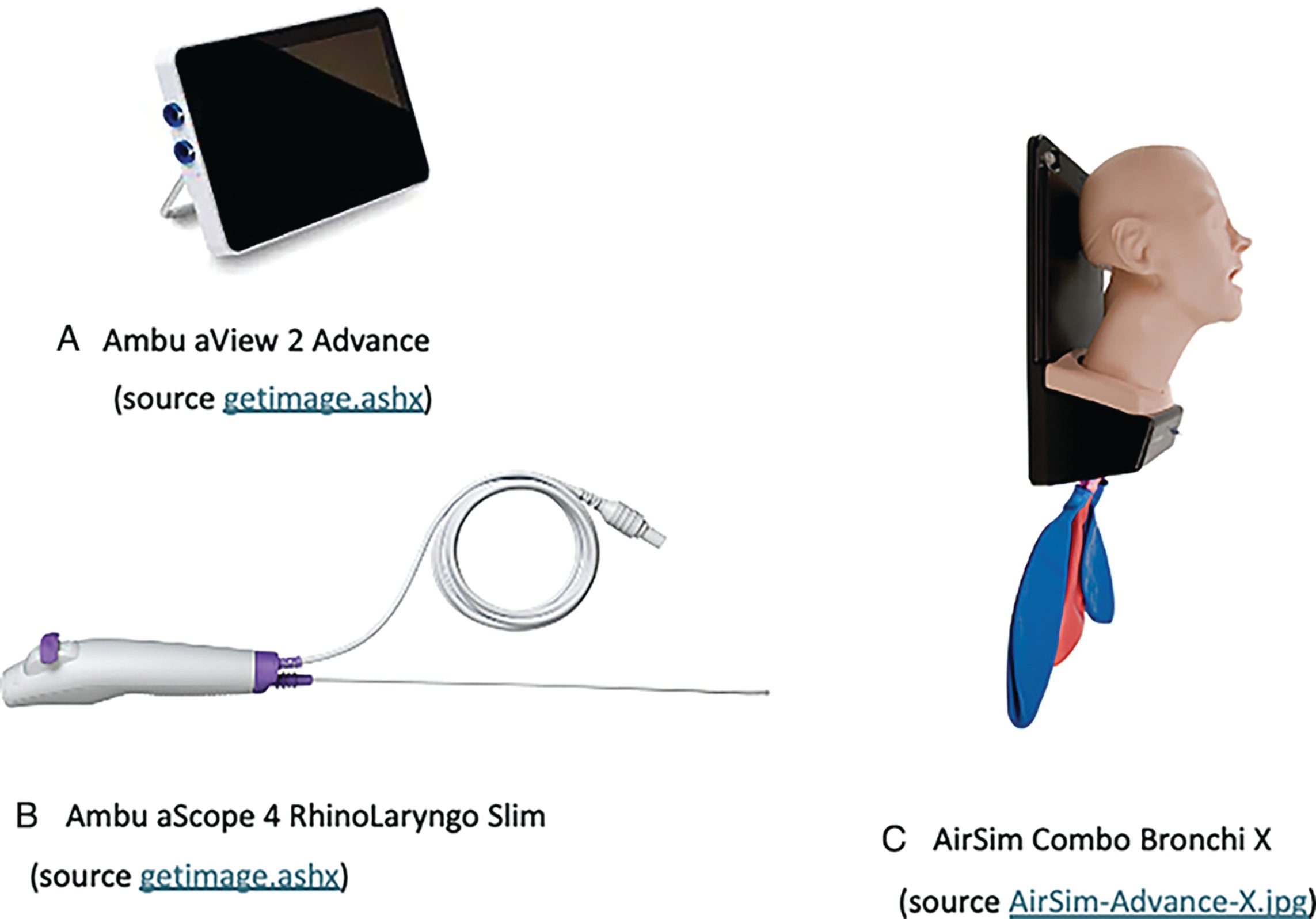
Figure 1. Setup for pilot testing of machine learning copilot. Panel A: Ambu aView 2 Advance; Panel B: Ambu

aScope 4 RhinoLaryngo Slim; Panel C: AirSim Combo Bronchi X.

The training data were collected by performing FFL on an AirSim Combo Bronchi X manikin (Fig. 1) (United Kingdom, TruCorp Ltd) using an Ambu aScope 4 RhinoLaryngo Slim (Fig. 1) connected to an Ambu aView 2 Advance Displaying Unit (Ballerup, Ambu A/S) (Fig. 1).

Data for training both models were selected from a dataset that was generated by performing 20 flexible laryngoscopies on the manikin. All scoping videos were performed by a single, experienced otolaryngologist on an Ambu aScope 4 RhinoLaryngo Slim (Fig. 1). Various levels of expertise were simulated when recording videos to ensure that a variety of angles and views were captured. The FFL AI Copilot was trained on the left nasal cavity only to keep the machine learning consistent and prevent confusion or misclassification of structures based on sidedness.

Anatomical Region Classifier

The anatomical region classifier was used to identify the physical location of the camera at the time of image capture. The classes used were Larynx, Nasal Cavity, Nasopharynx, Oropharynx, Out of Body, and Whiteout. Videos were split into image frames, and each image was assigned to a class by a trained graduate student. The classes were defined in the manikin model as follows:

  • Out of body: Any image from outside of the manikin.
  • Nasal cavity: The scope had entered the manikin but had not yet moved past the posterior nasal septum.
  • Nasopharynx: Between the distal-most end of the septum, but not yet past a clear delineation in the material where the velum would be in a human.
  • Oropharynx: Past the velum delineation but not yet past the superior border of the epiglottis.
  • Larynx: Past the superior edge of the epiglottis but not yet through the vocal folds to the trachea.
  • Whiteout: The scope was too close to the mucosa such that the image was 80% red or whited out, and a human observer could not reasonably determine where the scope was currently located without information from previous frames.

In total, there were 56,262 images in the anatomical region dataset. They were broken down into 42,971 training images, 3,596 validation images, and 9,695 testing images. To prevent data leakage due to the high correlation between consecutive frames, each video and all its images were assigned exclusively to a single split: train, validation, or test.

Pages: 1 2 3 4 5 | Single Page

Filed Under: How I Do It, Tech Talk, Tech Talk Tagged With: Machine learning in laryngologyIssue: November 2025

You Might Also Like:

  • Is the Best Modality to Assess Vocal Fold Mobility in Children Flexible Fiberoptic Laryngoscopy or Ultrasound?
  • Artificial Intelligence Is Leading the Way to Enhanced Diagnoses in Otolaryngology
  • From Video Game Controllers to ORs: The Surprising Role of Gaming in Modern Medical Practices
  • From Consent to Care: Protecting Patient Privacy in the Era of Advanced Imaging and AI

Leave a Reply Cancel reply

Your email address will not be published. Required fields are marked *

The Triological SocietyENTtoday is a publication of The Triological Society.

Polls

Do you use TXA to reduce intraoperative and post-op bleeding?

View Results

Loading ... Loading ...
  • Polls Archive

Top Articles for Residents

  • A Resident’s View of AI in Otolaryngology
  • Call for Resident Bowl Questions
  • Resident Pearls: Pediatric Otolaryngologists Share Tips for Safer, Smarter Tonsillectomies
  • A Letter to My Younger Self: Making Deliberate Changes Can Help Improve the Sense of Belonging
  • ENTtoday Welcomes Resident Editorial Board Members
  • Popular this Week
  • Most Popular
  • Most Recent
    • Office Laryngoscopy Is Not Aerosol Generating When Evaluated by Optical Particle Sizer

    • Call for Resident Bowl Questions

    • The Dramatic Rise in Tongue Tie and Lip Tie Treatment

    • Empty Nose Syndrome: Physiological, Psychological, or Perhaps a Little of Both?

    • Ethical Obligations and Duty to Advocate for Patients in Prior Authorization for Surgery

    • The Dramatic Rise in Tongue Tie and Lip Tie Treatment

    • Rating Laryngopharyngeal Reflux Severity: How Do Two Common Instruments Compare?

    • Is Middle Ear Pressure Affected by Continuous Positive Airway Pressure Use?

    • Otolaryngologists Are Still Debating the Effectiveness of Tongue Tie Treatment

    • Keeping Watch for Skin Cancers on the Head and Neck

    • Growing Use of Tranexamic Acid in Otolaryngology
    • Reconnect, Recharge, Relax, and Choose Joy This Season
    • A Resident’s View of AI in Otolaryngology
    • Faculty Mentorship of Academic Surgeons
    • CMS’ New Rule Aims to Streamline the Prior Authorization Process

Follow Us

  • Contact Us
  • About Us
  • Advertise
  • The Triological Society
  • The Laryngoscope
  • Laryngoscope Investigative Otolaryngology
  • Privacy Policy
  • Terms of Use
  • Cookies

Wiley

Copyright © 2025 by John Wiley & Sons, Inc. All rights reserved, including rights for text and data mining and training of artificial technologies or similar technologies. ISSN 1559-4939