• Home
  • Practice Focus
    • Facial Plastic/Reconstructive
    • Head and Neck
    • Laryngology
    • Otology/Neurotology
    • Pediatric
    • Rhinology
    • Sleep Medicine
    • How I Do It
    • TRIO Best Practices
  • Business of Medicine
    • Health Policy
    • Legal Matters
    • Practice Management
    • Technology
    • AI
  • Literature Reviews
    • Facial Plastic/Reconstructive
    • Head and Neck
    • Laryngology
    • Otology/Neurotology
    • Pediatric
    • Rhinology
    • Sleep Medicine
  • Career
    • Medical Education
    • Professional Development
    • Resident Focus
  • ENT Perspectives
    • ENT Expressions
    • Everyday Ethics
    • From TRIO
    • The Great Debate
    • Letter From the Editor
    • Rx: Wellness
    • The Voice
    • Viewpoint
    • SUO Corner
  • TRIO Resources
    • Triological Society
    • The Laryngoscope
    • Laryngoscope Investigative Otolaryngology
    • TRIO Combined Sections Meetings
    • COSM
    • Related Otolaryngology Events
  • Home
  • Practice Focus
    • Facial Plastic/Reconstructive
    • Head and Neck
    • Laryngology
    • Otology/Neurotology
    • Pediatric
    • Rhinology
    • Sleep Medicine
    • How I Do It
    • TRIO Best Practices
  • Business of Medicine
    • Health Policy
    • Legal Matters
    • Practice Management
    • Technology
    • AI
  • Literature Reviews
    • Facial Plastic/Reconstructive
    • Head and Neck
    • Laryngology
    • Otology/Neurotology
    • Pediatric
    • Rhinology
    • Sleep Medicine
  • Career
    • Medical Education
    • Professional Development
    • Resident Focus
  • ENT Perspectives
    • ENT Expressions
    • Everyday Ethics
    • From TRIO
    • The Great Debate
    • Letter From the Editor
    • Rx: Wellness
    • The Voice
    • Viewpoint
    • SUO Corner
  • TRIO Resources
    • Triological Society
    • The Laryngoscope
    • Laryngoscope Investigative Otolaryngology
    • TRIO Combined Sections Meetings
    • COSM
    • Related Otolaryngology Events
  • Search

How To: Modified Technique for Retrograde Placement of the Tracheoesophageal Voice Prosthesis in the Office

by Michael P. Wu, MD, Cody Sullivan, CCC-SLP, and Daniel G. Deschler, MD • November 5, 2024

  • Tweet
  • Email a link to a friend (Opens in new window) Email
Print-Friendly Version

be distal).

You Might Also Like

  • In-Office Transnasal Tracheoesophageal Punctures Yield Good Results
  • Flexible Ossicular Reconstruction Prosthesis Allows for Ease of Placement in Temporal Bone
  • Voice Prosthesis Seals Small Pharyngocutaneous Fistulas After Total Laryngectomy
  • How To: H-Type Tracheoesophageal Fistula Cannulation for Rapid Intraoperative Localization
Explore This Issue
November 2024

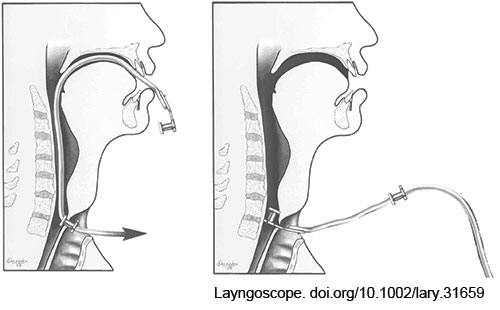
FIGURE 1: Modified retrograde prosthesis placement technique. After passing the catheter through the existing prosthesis in the TEP tract and delivering the tip up through the patient’s mouth, the new prosthesis is secured to the catheter tip and pulled retrograde down the neopharynx and into the TEP tract.

The preexisting prosthesis is now pulled from the tract over the placed red rubber catheter. The new prosthesis can now be delivered in a retrograde fashion by pulling the red rubber catheter back out of the tracheal aspect of the TEP tract (Fig. 1). This will deliver the end of the catheter and the tab of the prosthesis through the tract and into the stoma. Suctioning of mucus or secretions during this process may be necessary. Once the tab of the new prosthesis is visible from the tracheal side of the TEP tract, it is grasped with a hemostat. Another curved hemostat is then used to gently grasp the edges of the tracheal flange of the new prosthesis, adjusting the flange until its entire circumference is freed from the tract. The silk suture connecting the red rubber catheter is cut, and the catheter is discarded.

The new prosthesis is now checked to confirm the appropriate position and function. The prosthesis should rotate easily using a hemostat, confirming that the esophageal flange is properly oriented. The patient is instructed to manually occlude their stoma and phonate to confirm satisfactory function. If rotation is not possible and phonation unsuccessful, this may be due to entrapment of the esophageal flange within the tract, and a longer prosthesis may

be necessary.

RESULTS

Because of the referral nature of our practice, we use this retrograde technique two to four times per month, with 20 retrograde placements in the past year. Three (15%) of these placements were in patients with flap reconstruction, 12 (60%) in patients with a history of esophageal strictures requiring dilation, and two (10%) in patients with a history of stomal stenosis. We have had no complications, and this technique has been successful in all cases where the preexisting prosthesis can be oriented superiorly. We do not use this technique if the preexisting prosthesis cannot be oriented in this fashion. 

Pages: 1 2 | Single Page

Filed Under: Head and Neck, How I Do It, Practice Focus Tagged With: Tracheoesophageal Voice ProsthesisIssue: November 2024

You Might Also Like:

  • In-Office Transnasal Tracheoesophageal Punctures Yield Good Results
  • Flexible Ossicular Reconstruction Prosthesis Allows for Ease of Placement in Temporal Bone
  • Voice Prosthesis Seals Small Pharyngocutaneous Fistulas After Total Laryngectomy
  • How To: H-Type Tracheoesophageal Fistula Cannulation for Rapid Intraoperative Localization

The Triological SocietyENTtoday is a publication of The Triological Society.

Polls

Have you ever encountered a mentally or physically threatening patient or caregiver?

View Results

Loading ... Loading ...
  • Polls Archive

Top Articles for Residents

  • Is the SLOR in Otolaryngology Residency Applications Contributing to Rural Disparities?
  • Applications Open for Resident Members of the ENTtoday Editorial Board: Deadline Extended
  • A Resident’s View of AI in Otolaryngology
  • Call for Resident Bowl Questions
  • Resident Pearls: Pediatric Otolaryngologists Share Tips for Safer, Smarter Tonsillectomies
  • Popular this Week
  • Most Popular
  • Most Recent
    • Office Laryngoscopy Is Not Aerosol Generating When Evaluated by Optical Particle Sizer
    • More Than Skin Deep: Building a Workforce Patients Can Trust
    • Otolaryngologists Apply Safety Strategies When Treating Threatening Patients
    • Novel Fascia Taco Approach Shown Safe and Effective in Patients Receiving Nasal Septum Perforation Closure
    • Some Laryngopharyngeal Reflux Resists PPI Treatment
    • The Dramatic Rise in Tongue Tie and Lip Tie Treatment
    • Rating Laryngopharyngeal Reflux Severity: How Do Two Common Instruments Compare?
    • Is Middle Ear Pressure Affected by Continuous Positive Airway Pressure Use?
    • Otolaryngologists Are Still Debating the Effectiveness of Tongue Tie Treatment
    • Complications for When Physicians Change a Maiden Name
    • The Pursuit of Excellence—the Journey or the Gold
    • Is There Benefit of Music Training Following Cochlear Implantation?
    • Is Cognitive Behavioral Therapy Effective for Tinnitus?
    • Does Dupilumab Improve Sinonasal Outcomes in AERD Patients?
    • Making the Most of TRIO Meetings

Follow Us

  • Contact Us
  • About Us
  • Advertise
  • The Triological Society
  • The Laryngoscope
  • Laryngoscope Investigative Otolaryngology
  • Privacy Policy
  • Terms of Use
  • Cookies

Wiley

Copyright © 2026 by John Wiley & Sons, Inc. All rights reserved, including rights for text and data mining and training of artificial technologies or similar technologies. ISSN 1559-4939