• Home
  • Practice Focus
    • Facial Plastic/Reconstructive
    • Head and Neck
    • Laryngology
    • Otology/Neurotology
    • Pediatric
    • Rhinology
    • Sleep Medicine
    • How I Do It
    • TRIO Best Practices
  • Business of Medicine
    • Health Policy
    • Legal Matters
    • Practice Management
    • Tech Talk
    • AI
  • Literature Reviews
    • Facial Plastic/Reconstructive
    • Head and Neck
    • Laryngology
    • Otology/Neurotology
    • Pediatric
    • Rhinology
    • Sleep Medicine
  • Career
    • Medical Education
    • Professional Development
    • Resident Focus
  • ENT Perspectives
    • ENT Expressions
    • Everyday Ethics
    • From TRIO
    • The Great Debate
    • Letter From the Editor
    • Rx: Wellness
    • The Voice
    • Viewpoint
  • TRIO Resources
    • Triological Society
    • The Laryngoscope
    • Laryngoscope Investigative Otolaryngology
    • TRIO Combined Sections Meetings
    • COSM
    • Related Otolaryngology Events
  • Search

Lord of the (Magnetic) Rings: Rigid Bronchoscopy for Aspirated Magnetic Foreign Bodies in Tertiary Bronchi

by Lisa Zhang, MD, Daniel B. Hall, MD, Monirah Albathi, MD, Carly R. Schuett, APRN, CPNP, Rebecca S. Arch, MD, Ethan Bassett, MD, and Patrick Walz, MD • March 4, 2026

  • Tweet
  • Email a link to a friend (Opens in new window) Email
Print-Friendly Version

INTRODUCTION

You Might Also Like

  • How To: Catheter-Guided Basket Removal of a Difficult-to-Reach Pediatric Airway Foreign Body
  • Foreign Body Aspiration in Pediatric Patients: Bronchoscopy Delay May Be Beneficial
  • Hook, Line, and Sinker: Unusual and Interesting Foreign-Body Cases
  • FDA Issues Class I Notice of Recall of Some Philips Respironics CPAP, BiPAP Masks
Explore This Issue
March 2026

Airway foreign body aspiration is a serious issue in pediatrics. Although organic foreign bodies are more common, aspirating magnetic objects can cause severe morbidity, especially with multiple small magnets. Given the increasing incidence of pediatric magnetic-related foreign bodies, we present a unique case of retrieving a distal tertiary bronchi magnetic foreign body in an older pediatric patient using a flexible, ferromagnetic grasping instrument.

CASE REPORT

A 13-year-old female presented to the emergency department with a report of accidentally inhaling the backing of her magnetic nose ring. She endorsed chest discomfort but otherwise denied difficulty or noisy breathing. On arrival, her vital signs and oxygen saturation were normal. Chest X-ray (lateral and anteroposterior) demonstrated a 3mm×4mm metallic foreign body in the right lower lobe, 0.5cm from the diaphragm on expiratory film. The decision was made to proceed with operative intervention given the location of the body.
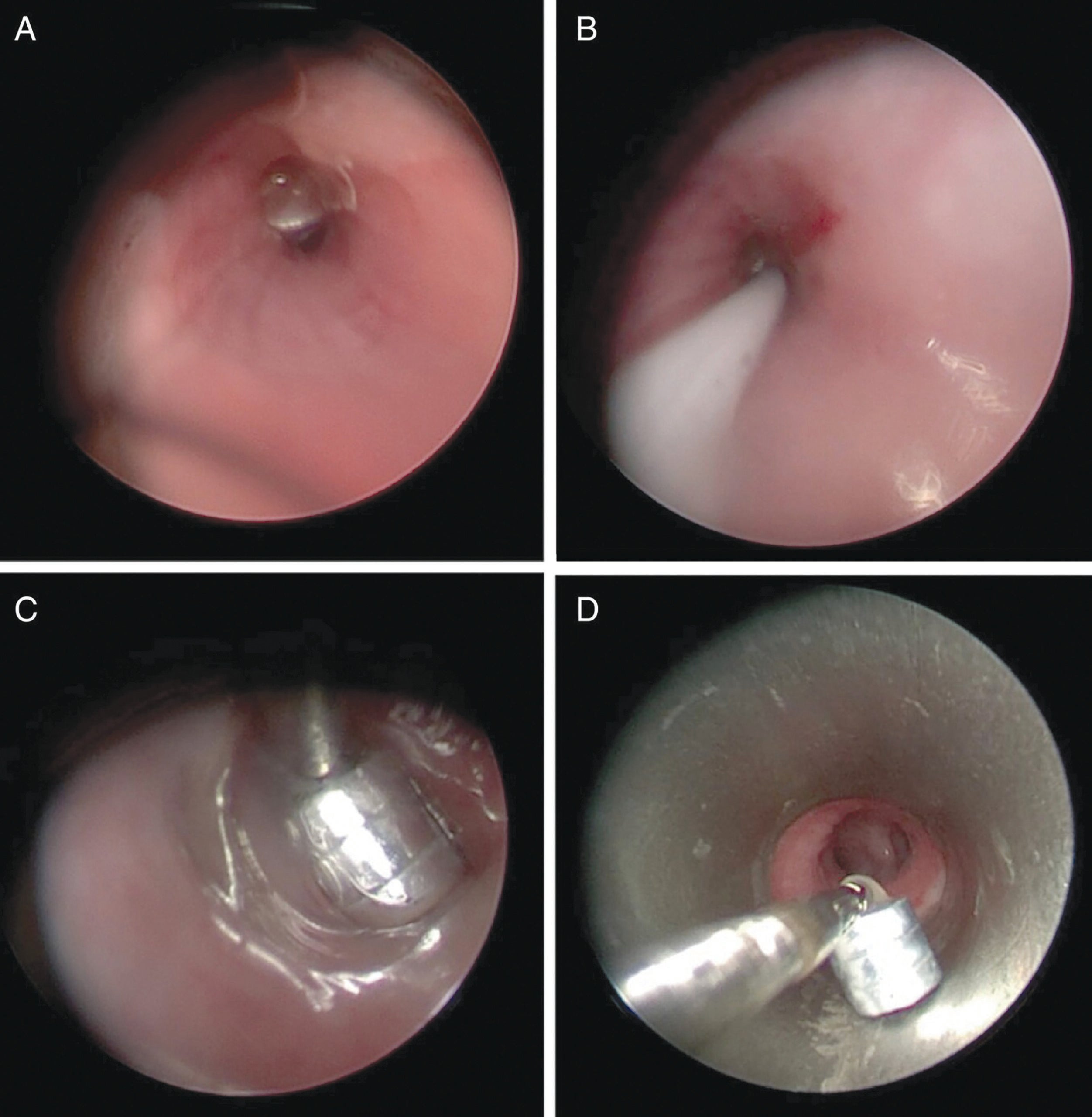
Figure 1. (A) Metallic foreign body visualized in the tertiary bronchus on rigid bronchoscopy, beyond the reach of traditional optical instruments. (B) Trial of passing a Fogarty catheter distal to the object was unsuccessful, given the relatively small size of the tertiary bronchus and foreign body obstruction. (C) Ferromagnetic pulmonary rat tooth biopsy forceps advanced into the rigid bronchoscopy and underwent magnetization near the magnetic field of the foreign body. (D) Magnetic foreign body successfully removed with rigid bronchoscopy.

After induction of general anesthesia, direct laryngoscopy was completed without evidence of a foreign body in the oropharynx or hypopharynx. A 6.0 rigid bronchoscope was inserted into the trachea and advanced into the distal trachea and segmental bronchi bilaterally. On the right, a small metallic foreign body was visualized in the distal tertiary bronchus. Traditional optical instruments, including endoscopic graspers, were unsuccessful due to the distal location of the foreign body. Attempts to pass a salivary wire basket and a ureteral stone retrieval basket to engage the foreign body were unsuccessful. An attempt to pass a 2 French Fogarty embolectomy catheter distally failed because the diameter of the catheter was too large to bypass the foreign body.

After inspection of the pulmonary flexible bronchoscopy instruments, we identified ferromagnetic flexible rat tooth biopsy forceps. These were then advanced into the tertiary bronchus distally, and the small magnetic field of the nose ring was able to attract and adhere to the ferromagnetic instrument, allowing for safe removal through the rigid bronchoscopy (Figure 1). The foreign body was noted to be three small attached magnetic nose ring backings. Repeat bronchoscopy demonstrated no further foreign bodies or airway injuries. The patient recovered uneventfully and was discharged postoperatively without complications.

CONCLUSION

We describe a unique case of an older pediatric patient who aspirated multiple small magnets used in magnetic jewelry, posing challenges for traditional removal methods due to their distal location in the tertiary bronchi and small size. Ferromagnetic flexible bronchoscopic instruments were utilized for their safe retrieval.

Filed Under: How I Do It, Pediatric, Pediatric Otolaryngology Tagged With: Aspirated Magnetic Foreign Bodies, How I Do ItIssue: March 2026

You Might Also Like:

  • How To: Catheter-Guided Basket Removal of a Difficult-to-Reach Pediatric Airway Foreign Body
  • Foreign Body Aspiration in Pediatric Patients: Bronchoscopy Delay May Be Beneficial
  • Hook, Line, and Sinker: Unusual and Interesting Foreign-Body Cases
  • FDA Issues Class I Notice of Recall of Some Philips Respironics CPAP, BiPAP Masks

Leave a Reply Cancel reply

Your email address will not be published. Required fields are marked *

The Triological SocietyENTtoday is a publication of The Triological Society.

Polls

Has your practice or department been affected by the lack of anesthesiologists?

View Results

Loading ... Loading ...
  • Polls Archive

Top Articles for Residents

  • Is the SLOR in Otolaryngology Residency Applications Contributing to Rural Disparities?
  • Applications Open for Resident Members of the ENTtoday Editorial Board
  • A Resident’s View of AI in Otolaryngology
  • Call for Resident Bowl Questions
  • Resident Pearls: Pediatric Otolaryngologists Share Tips for Safer, Smarter Tonsillectomies
  • Popular this Week
  • Most Popular
  • Most Recent
    • Office Laryngoscopy Is Not Aerosol Generating When Evaluated by Optical Particle Sizer
    • Some Laryngopharyngeal Reflux Resists PPI Treatment
    • Top 10 LARY and LIO Articles of 2024
    • Empty Nose Syndrome: Physiological, Psychological, or Perhaps a Little of Both?
    • The Dramatic Rise in Tongue Tie and Lip Tie Treatment
    • The Dramatic Rise in Tongue Tie and Lip Tie Treatment
    • Rating Laryngopharyngeal Reflux Severity: How Do Two Common Instruments Compare?
    • Is Middle Ear Pressure Affected by Continuous Positive Airway Pressure Use?
    • Otolaryngologists Are Still Debating the Effectiveness of Tongue Tie Treatment
    • Keeping Watch for Skin Cancers on the Head and Neck
    • Lord of the (Magnetic) Rings: Rigid Bronchoscopy for Aspirated Magnetic Foreign Bodies in Tertiary Bronchi
    • What Otolaryngologists Can Learn from Athletes
    • Gap Year for Research: Is It Worth It?
    • Sunshine and Mentorship
    • AI Transforms Otolaryngology

Follow Us

  • Contact Us
  • About Us
  • Advertise
  • The Triological Society
  • The Laryngoscope
  • Laryngoscope Investigative Otolaryngology
  • Privacy Policy
  • Terms of Use
  • Cookies

Wiley

Copyright © 2026 by John Wiley & Sons, Inc. All rights reserved, including rights for text and data mining and training of artificial technologies or similar technologies. ISSN 1559-4939