Explore This Issue
November 2025Sinonasal and skull base tumors pose unique challenges to patients, their families, and the clinicians who care for them. Their rarity limits the availability of clinical expertise, the pace of research, and the strength of public awareness. However, two patient-driven organizations, the Chordoma Foundation and SMARCB1 Hope, demonstrate how committed advocacy can transform the landscape for patients with rare malignancies.
For this article, we carried out in-depth interviews with key figures of both foundations: Shannon Lozinsky, director of patient services for the Chordoma Foundation, and Cassie and Jean-Baptiste Toulouse, the founders of SMARCB1 Hope. We distill these interviews to focus on the role and power of patient advocacy for otolaryngologists.
Origins in Urgent Need and Personal Tragedy
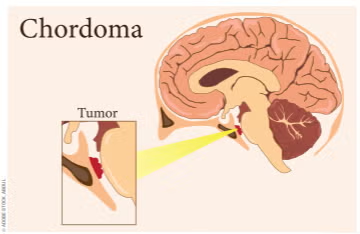
The Chordoma Foundation began in 2007 when Josh Sommer, then a Duke University student, was diagnosed with a skull base chordoma. Finding virtually no patient resources, he and his mother, a physician, connected with a small group of patients online. After his treatment, Josh got a job working with one of the few labs studying the disease, which, fortunately, was based at Duke. This small group of patients and loved ones soon realized the urgent need to unite more patients, researchers, and clinicians into a single, coordinated movement. Starting literally at one family’s kitchen table, the foundation has grown into a global leader in rare tumor advocacy and research.
SMARCB1 Hope was founded by Cassie and Jean-Baptiste Toulouse after the devastating loss of their 23-year-old daughter, Ella, to an aggressive SMARCB1-deficient sinonasal carcinoma in 2020. Lacking established networks, treatment protocols, or community support, they recognized the urgent need to build a resource for patients and families confronting this ultra-rare tumor.
Their mission grew beyond sinonasal carcinoma to encompass all SMARCB1-deficient cancers in order to build a larger, interconnected community and amplify research impact. Recently, they have also partnered with a larger French cancer organization (ARC Foundation) to strategically position SMARCB1 cancers within the broader category of adolescent and young adult cancers, thereby broadening appeal without losing focus on their original cause.
Mission and Core Activities
Chordoma Foundation
• Three Strategic Pillars:
- Research—Establishing and sharing preclinical disease models, conducting in-house research at the Foundation’s dedicated laboratory, driving global collaboration, and supporting chordoma-specific clinical trials.
- Patient Services—Education on the disease, treatment options, and recommendations, navigation to high-volume specialists, and peer support networks.
- Healthcare Improvement— Creation and dissemination of consensus, evidence-based guidelines for diagnosis, primary treatment, and recurrence.
• Patient Navigation Program: Direct access to navigators who provide immediate, personalized guidance, connect patients with experts, and link them to peer communities.
Leave a Reply