
• Home
  • Practice Focus
    • Facial Plastic/Reconstructive
    • Head and Neck
    • Laryngology
    • Otology/Neurotology
    • Pediatric
    • Rhinology
    • Sleep Medicine
    • How I Do It
    • TRIO Best Practices
  • Business of Medicine
    • Health Policy
    • Legal Matters
    • Practice Management
    • Tech Talk
    • AI
  • Literature Reviews
    • Facial Plastic/Reconstructive
    • Head and Neck
    • Laryngology
    • Otology/Neurotology
    • Pediatric
    • Rhinology
    • Sleep Medicine
  • Career
    • Medical Education
    • Professional Development
    • Resident Focus
  • ENT Perspectives
    • ENT Expressions
    • Everyday Ethics
    • From TRIO
    • The Great Debate
    • Letter From the Editor
    • Rx: Wellness
    • The Voice
    • Viewpoint
  • TRIO Resources
    • Triological Society
    • The Laryngoscope
    • Laryngoscope Investigative Otolaryngology
    • TRIO Combined Sections Meetings
    • COSM
    • Related Otolaryngology Events
  • Search

Is a Tooth Extraction Required if Dentition Lies Within a Mandible Fracture?

by Mena Said, MD, Rohith S. Voora, BS, and David B. Hom, MD • January 14, 2022

  • Tweet
  • Click to email a link to a friend (Opens in new window) Email
Print-Friendly Version

TRIO Best PracticeTRIO Best Practice articles are brief, structured reviews designed to provide the busy clinician with a handy outline and reference for day-to-day clinical decision making. The ENTtoday summaries below include the Background and Best Practice sections of the original article. To view the complete Laryngoscope article free of charge, visit Laryngoscope.

You Might Also Like

  • Erich Arch Bar Use Declines in Favor of Manual Reduction in Mandible Fracture Management
  • The Importance of Timing in Mandible Fracture Repair
  • When Is Immediate Surgical Intervention Required for Isolated Orbital Blowout Fractures?
  • Is Fixation of Mandible Fractures Urgent?
Explore This Issue
January 2022
 

Background

A frequently encountered dilemma in the evaluation of mandibular fractures is whether or not to extract teeth lying in the fracture line. Mandibular fractures involving a tooth-bearing area have an incident rate of 50%-85%. A number of surgeons have previously contended that such teeth be prophylactically extracted to minimize the chance of downstream osteomyelitis and non-union, and to optimize wound healing. However, others argue in favor of a more conservative approach to retain teeth unless a clear indication such as active signs of infection, exposed roots, or significant mobility exists. Some even argue that retaining teeth in the fracture line may aid in reduction and fixation of the fracture. Among important factors, the fracture type and location, planned treatment procedure, and condition of the teeth can confound clinical decision making.

Ultimately, post-trauma complications increase morbidity and healthcare costs. Therefore, this review aims to determine indication and timing of extraction of teeth in mandibular fracture lines.

Best Practice
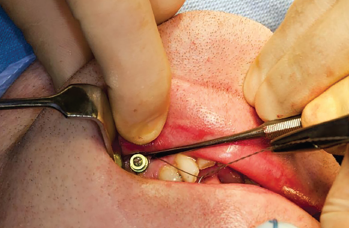
© Dr P. Marazzi / Science SourceIn reviewing these studies, when a “bad tooth” is present within a mandible fracture (such as a loose tooth risking aspiration, periapical infection, significant caries, exposed/fractured roots, or if tooth retention prevents fracture reduction), it is extracted. After addressing these tooth conditions, some studies have reported equal infection rates when a healthy tooth is left within a mandible fracture line. From these retrospective studies, there is no conclusive evidence that extraction is required when a healthy tooth is present within the fracture line. However, future randomized prospective studies are needed to investigate this further.

Filed Under: Head and Neck, Head and Neck, TRIO Best Practices Tagged With: clinical research, treatmentIssue: January 2022

You Might Also Like:

  • Erich Arch Bar Use Declines in Favor of Manual Reduction in Mandible Fracture Management
  • The Importance of Timing in Mandible Fracture Repair
  • When Is Immediate Surgical Intervention Required for Isolated Orbital Blowout Fractures?
  • Is Fixation of Mandible Fractures Urgent?

The Triological SocietyENTtoday is a publication of The Triological Society.

Polls

Has experience as a patient influenced your professional development or demeanor?

View Results

Loading ... Loading ...
  • Polls Archive

Top Articles for Residents

  • A Resident’s View of AI in Otolaryngology
  • Call for Resident Bowl Questions
  • Resident Pearls: Pediatric Otolaryngologists Share Tips for Safer, Smarter Tonsillectomies
  • A Letter to My Younger Self: Making Deliberate Changes Can Help Improve the Sense of Belonging
  • ENTtoday Welcomes Resident Editorial Board Members
  • Popular this Week
  • Most Popular
  • Most Recent
    • The Path to Department Chair: Arriving and Thriving

    • How Audiologists and Researchers Are Shaping Military Hearing Health Practices

    • Office Laryngoscopy Is Not Aerosol Generating When Evaluated by Optical Particle Sizer

    • Rewriting the Rules of Rhinosinusitis

    • Top 10 LARY and LIO Articles of 2024

    • The Dramatic Rise in Tongue Tie and Lip Tie Treatment

    • Rating Laryngopharyngeal Reflux Severity: How Do Two Common Instruments Compare?

    • Is Middle Ear Pressure Affected by Continuous Positive Airway Pressure Use?

    • Otolaryngologists Are Still Debating the Effectiveness of Tongue Tie Treatment

    • Keeping Watch for Skin Cancers on the Head and Neck

    • Why So Loud? Rethinking the Volume of Our Everyday Experiences
    • How Audiologists and Researchers Are Shaping Military Hearing Health Practices
    • A Case for Endoscopic Surgery: How Personal Experience Influenced Pursuit of a New Skill
    • The Path to Department Chair: Arriving and Thriving
    • Rewriting the Rules of Rhinosinusitis

Follow Us

  • Contact Us
  • About Us
  • Advertise
  • The Triological Society
  • The Laryngoscope
  • Laryngoscope Investigative Otolaryngology
  • Privacy Policy
  • Terms of Use
  • Cookies

Wiley

Copyright © 2026 by John Wiley & Sons, Inc. All rights reserved, including rights for text and data mining and training of artificial technologies or similar technologies. ISSN 1559-4939