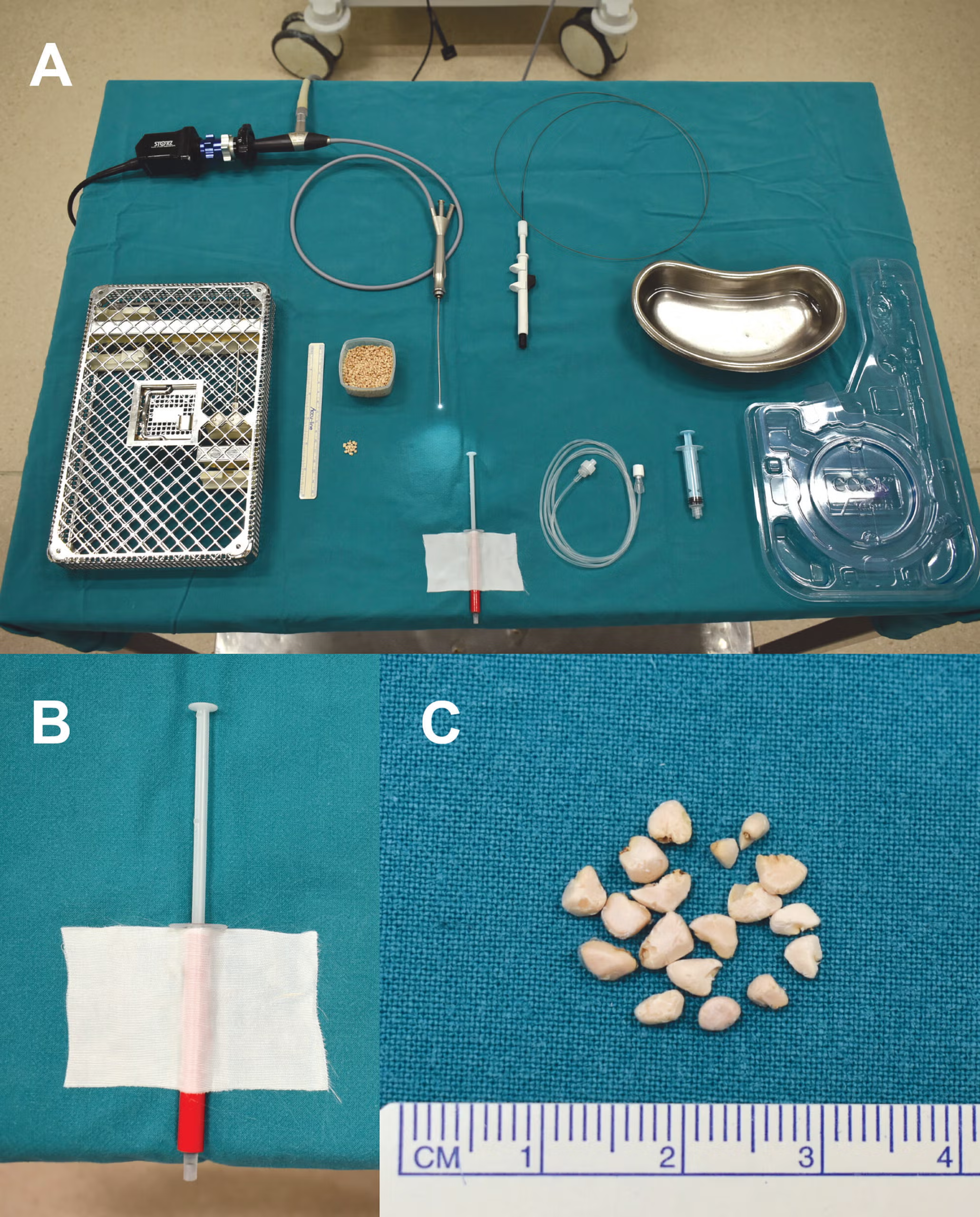
Figure 1: BSR simulator setup: (A) Components required for the simulator. (B) Insulin syringe after preparation. (C) Dried guava fruit seeds mimicking natural sialoliths.
The trainees worked in pairs, with one trainee passing a 1.6-mm semirigid all-in-one miniature sialendoscope with an angled tip (model 11583A; Karl Storz GmbH & Co., Tuttlingen, Germany) attached to an endoscopic camera, to visualize the floating seeds within the syringe lumen. The second trainee used various salivary stone extractor wire baskets (three, four, and six wires), developed by Karl Storz (Tuttlingen, Germany) and NCircle and NGage by Cook Medical Inc (Bloomington, Ind., USA), inside the scope’s working channel to practice the refined skills needed for BSR. Other interventional sialendoscope models may be used depending on availability and preference. To enhance the realism of the training, pulsed saline injection was administered using a 10-mL syringe attached by an extension tube to the sialendoscope’s irrigation channel. Trainee roles were alternated to allow practice of all required skills and to foster a harmonious training environment.
Explore This Issue
February 2026Evaluation of the sialendoscopy BSR simulator
Consenting participants of the Egyptian Sialendoscopy Hands-on/Live Surgery course and the Alexandria Sialendoscopy (AlexSIAL) International Clinical/Surgical Fellowship program courses from 2023 to 2024 participated in the evaluation of the BSR simulator. These participants were all certified medical practitioners of various nationalities, subspecialties, medical qualifications, and pretraining experiences. After completing the BSR simulator training sessions, each participant answered a predesigned, anonymous web-based questionnaire within one to two weeks. The questionnaire included five questions on participant data, five questions evaluating simulator realism, and five questions assessing the usefulness of the training process. The responses were rated on a five-point Likert scale (strongly agree, agree, neutral, disagree, and strongly disagree). A footnote was added to collect personal impressions and suggestions.
RESULTS
All 38 consenting participants detected the dried guava seeds (imitating sialoliths) and successfully performed interventional sialendoscopy retrieval using different wire baskets. Only one untoward effect occurred in the form of one wire basket breaking during training (replaced by another), with no sialendoscope damage encountered in any training session.
Evaluation of simulator realism
Twenty-eight participants (74%) strongly agreed that the simulator setup met their training objectives, while nine (24%) agreed. Thirty-seven out of 38 participants (97%) rated the simulator model as “strongly agree” or “agree” in terms of its reproducibility (replicability) in their own training settings. Regarding the use of an insulin syringe lumen and dried guava seeds, 26 participants (68%) strongly agreed that the simulator components allowed procedural training for floating stone retrieval, and 24 participants (63%) strongly agreed that dried guava seeds mimicked real sialoliths.
Leave a Reply