• Home
  • Practice Focus
    • Facial Plastic/Reconstructive
    • Head and Neck
    • Laryngology
    • Otology/Neurotology
    • Pediatric
    • Rhinology
    • Sleep Medicine
    • How I Do It
    • TRIO Best Practices
  • Business of Medicine
    • Health Policy
    • Legal Matters
    • Practice Management
    • Technology
    • AI
    • History of Otolaryngology
  • Literature Reviews
    • Facial Plastic/Reconstructive
    • Head and Neck
    • Laryngology
    • Otology/Neurotology
    • Pediatric
    • Rhinology
    • Sleep Medicine
  • Career
    • Medical Education
    • Professional Development
    • Resident Focus
  • ENT Perspectives
    • ENT Expressions
    • Everyday Ethics
    • From TRIO
    • The Great Debate
    • Letter From the Editor
    • Rx: Wellness
    • The Voice
    • Viewpoint
    • SUO Corner
  • TRIO Resources
    • Triological Society
    • The Laryngoscope
    • Laryngoscope Investigative Otolaryngology
    • TRIO Combined Sections Meetings
    • COSM
    • Related Otolaryngology Events
  • Search

Can Calcitonin Levels Guide Prophylactic Neck Dissection in Sporadic Medullary Thyroid Carcinoma?

by Ethan J. Han, BS, Krishna K. Bommakanti, MD, and Maie A. St. John, MD, PhD • October 4, 2024

  • Tweet
  • Email a link to a friend (Opens in new window) Email
Print-Friendly Version

BACKGROUND

Medullary thyroid carcinoma (MTC) comprises less than 5% of thyroid cancers but is responsible for more than 10% of deaths related to thyroid cancer. MTC arises from the calcitonin-producing parafollicular C cells. Most cases are sporadic (75%), although 25% are hereditary in people with multiple endocrine neoplasia type 2A and 2B. Regional lymph node metastasis is common and associated with mortality; thus, total thyroidectomy with central compartment (Level VI) lymph node dissection is the standard surgical treatment for MTC. However, the extent of prophylactic neck dissection (ND) of the lateral node compartments (Levels II-V) remains controversial when there is no clinical lymphadenopathy or radiographic evidence of nodal metastasis. Calcitonin is a sensitive biomarker for MTC, and there is evidence that pre-operative serum calcitonin predicts the presence and extent of lymph node metastasis. Given the postoperative morbidity and potential complications of ND, can calcitonin levels serve as a simple, cost-effective approach for risk-stratifying MTC without overt lymph node involvement?

You Might Also Like

  • What Is the Extent of Neck Dissection in Medullary Thyroid Carcinoma?
  • What Is the Treatment of the Lateral Neck in Clinically Localized Sporadic Medullary Thyroid Cancer?
  • When Is Prophylactic Neck Dissection in Papillary Thyroid Cancer Necessary?
  • What is the Appropriate Extent of Lateral Neck Dissection in the Treatment of Metastatic WDTC?
Explore This Issue
October 2024

BEST PRACTICE

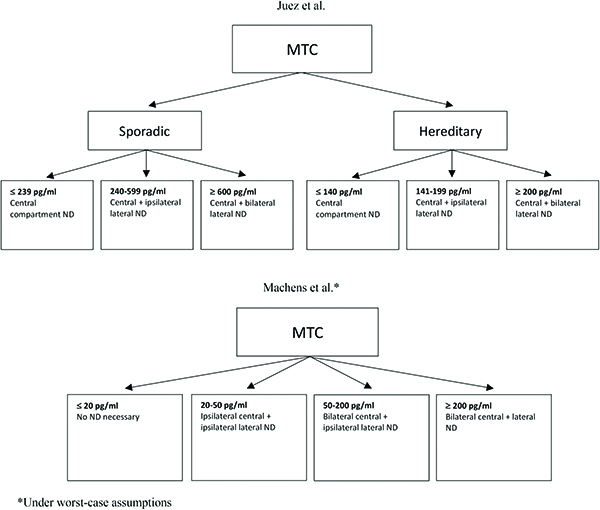
Presently, the American Thyroid Association and other authors recommend total thyroidectomy and central ND for the treatment of sporadic MTC. While calcitonin cutoffs for prophylactic lateral ND vary by guideline and study (Fig. 1), there is no consensus on whether prophylactic ND correlates with long-term survival. Based on currently available studies, not enough evidence exists to support the use of calcitonin alone as a predictor of the presence of post-operative neck lymph nodes. Rather, patients with the above-published calcitonin levels should undergo stronger consideration for more extensive ND, but the calcitonin level should be considered alongside pre-operative imaging and other clinical factors. 
Filed Under: Head and Neck, Head and Neck Cancer, Practice Focus, TRIO Best Practices Tagged With: Medullary thyroid carcinoma, MTCIssue: October 2024

You Might Also Like:

  • What Is the Extent of Neck Dissection in Medullary Thyroid Carcinoma?
  • What Is the Treatment of the Lateral Neck in Clinically Localized Sporadic Medullary Thyroid Cancer?
  • When Is Prophylactic Neck Dissection in Papillary Thyroid Cancer Necessary?
  • What is the Appropriate Extent of Lateral Neck Dissection in the Treatment of Metastatic WDTC?

The Triological SocietyENTtoday is a publication of The Triological Society.

Polls

Have you ever worked with industry on a product, device, technique, or medication to improve the ENT specialty?

View Results

Loading ...
  • Polls Archive

Top Articles for Residents

  • Rhinology’s Persistent Gender Gap
  • The Example We Set: Thoughts on the End of Residency Training
  • Is the SLOR in Otolaryngology Residency Applications Contributing to Rural Disparities?
  • Applications Open for Resident Members of the ENTtoday Editorial Board: Deadline Extended
  • A Resident’s View of AI in Otolaryngology
  • Popular this Week
  • Most Popular
  • Most Recent
    • History of the Cochlear Implant
    • The Dramatic Rise in Tongue Tie and Lip Tie Treatment
    • Empty Nose Syndrome: Physiological, Psychological, or Perhaps a Little of Both?
    • How To Provide Helpful Feedback To Residents
    • Rating Laryngopharyngeal Reflux Severity: How Do Two Common Instruments Compare?
    • The Dramatic Rise in Tongue Tie and Lip Tie Treatment
    • Rating Laryngopharyngeal Reflux Severity: How Do Two Common Instruments Compare?
    • Is Middle Ear Pressure Affected by Continuous Positive Airway Pressure Use?
    • Otolaryngologists Are Still Debating the Effectiveness of Tongue Tie Treatment
    • History of the Cochlear Implant
    • ENT Surgeons Working with Industry
    • What an Extraordinary Time to Be an Otolaryngologist
    • Outcomes of Pediatric Prophylactic Thyroidectomy in MEN2: A Systematic Review
    • Blue-Laser Posterior Nasal Neurolysis via Dual-Layer Nerve Modulation for Chronic Rhinitis
    • Hypoglossal Nerve Stimulation and the Incidence of Cardiovascular Disease

Follow Us

  • Contact Us
  • About Us
  • Advertise
  • The Triological Society
  • The Laryngoscope
  • Laryngoscope Investigative Otolaryngology
  • Privacy Policy
  • Terms of Use
  • Cookies

Wiley

Copyright © 2026 by The Triological Society. All rights reserved, including rights for text and data mining and training of artificial technologies or similar technologies. ISSN 1559-4939