• Home
  • Practice Focus
    • Facial Plastic/Reconstructive
    • Head and Neck
    • Laryngology
    • Otology/Neurotology
    • Pediatric
    • Rhinology
    • Sleep Medicine
    • How I Do It
    • TRIO Best Practices
  • Business of Medicine
    • Health Policy
    • Legal Matters
    • Practice Management
    • Technology
    • AI
  • Literature Reviews
    • Facial Plastic/Reconstructive
    • Head and Neck
    • Laryngology
    • Otology/Neurotology
    • Pediatric
    • Rhinology
    • Sleep Medicine
  • Career
    • Medical Education
    • Professional Development
    • Resident Focus
  • ENT Perspectives
    • ENT Expressions
    • Everyday Ethics
    • From TRIO
    • The Great Debate
    • Letter From the Editor
    • Rx: Wellness
    • The Voice
    • Viewpoint
    • SUO Corner
  • TRIO Resources
    • Triological Society
    • The Laryngoscope
    • Laryngoscope Investigative Otolaryngology
    • TRIO Combined Sections Meetings
    • COSM
    • Related Otolaryngology Events
  • Search

A Patient with Gradual Airway Obstruction

by John Carter, MD, Ryan Chastant, MD, Paul Friedlander, MD, Rizwan Aslam, DO, Tulane University School of Medicine, New Orleans • October 1, 2013

  • Tweet
  • Email a link to a friend (Opens in new window) Email
Print-Friendly Version

You Might Also Like

  • Cine MRI and DISE Equally Effective for Identifying Upper Airway Obstruction in Children
  • Is Adenoidectomy Alone Sufficient for Treating Pediatric Airway Obstruction?
  • Sponsored Supplement: New Paradigms in the Treatment of Nasal Airway Obstruction
  • Septal Deformity Grading Helps Nasal Airway Obstruction Diagnosis
Explore This Issue
October 2013
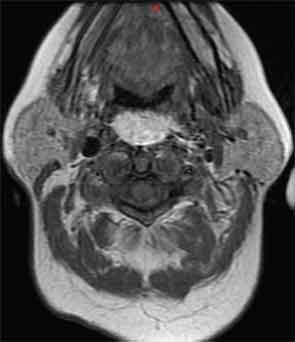
Figure 1a, 1b. Axial and sagittal contrast-enhanced
computed tomography of the neck displays a 8.3 x 4.4-cm low-density retropharyngeal mass.

Figure 1a, 1b. Axial and sagittal contrast-enhanced computed tomography of the neck displays a 8.3 x 4.4-cm low-density retropharyngeal mass.

Presentation: A 64-year-old female presented to the emergency department complaining of shortness of breath. This patient stated that she has had some progressive dyspnea and dysphagia for approximately six months. Physical examination revealed an afebrile female with tachypneic respirations and no stridor. Flexible fiberoptic exam revealed an obstructive submucosal process emanating from the retropharynx extending to the level of the epiglottis and obscuring the endolarynx.

The patient was quickly brought to the operating suite where flexible fiberoptic intubation was attempted, but visualization was obstructed secondary to the mass. A tracheotomy was then performed after the patient underwent rapid respiratory decompensation.
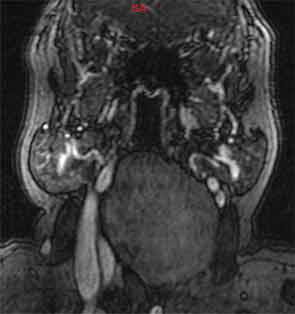
Figure 1a, 1b. Axial and sagittal contrast-enhanced
computed tomography of the neck displays a 8.3 x 4.4-cm low-density retropharyngeal mass.

Axial and sagittal contrast enhanced computed tomography of the neck (Figure 1a, 1b) showed a 8.3 x 4.4 x 8-cm low-density retropharyngeal mass. Axial MRI T1 images (Figure 2) exhibited high signal intensity, while coronal T2-weighted images (Figure 3) revealed low signal intensity.

—John Carter, MD; Ryan Chastant, MD; Paul Friedlander, MD; Rizwan Aslam, DO, Tulane University School of Medicine, New Orleans.

What is your diagnosis, and how would you manage this patient? Go to the next page for the answer.

Pages: 1 2 | Single Page

Filed Under: Case of the Month, Departments, Laryngology, Practice Focus Tagged With: airway obstruction, patient careIssue: October 2013

You Might Also Like:

  • Cine MRI and DISE Equally Effective for Identifying Upper Airway Obstruction in Children
  • Is Adenoidectomy Alone Sufficient for Treating Pediatric Airway Obstruction?
  • Sponsored Supplement: New Paradigms in the Treatment of Nasal Airway Obstruction
  • Septal Deformity Grading Helps Nasal Airway Obstruction Diagnosis

Leave a Reply Cancel reply

Your email address will not be published. Required fields are marked *

The Triological SocietyENTtoday is a publication of The Triological Society.

Polls

Have you ever participated in a professional group's advocacy or Hill Day event?

View Results

Loading ... Loading ...
  • Polls Archive

Top Articles for Residents

  • Is the SLOR in Otolaryngology Residency Applications Contributing to Rural Disparities?
  • Applications Open for Resident Members of the ENTtoday Editorial Board: Deadline Extended
  • A Resident’s View of AI in Otolaryngology
  • Call for Resident Bowl Questions
  • Resident Pearls: Pediatric Otolaryngologists Share Tips for Safer, Smarter Tonsillectomies
  • Popular this Week
  • Most Popular
  • Most Recent
    • The Dramatic Rise in Tongue Tie and Lip Tie Treatment
    • Some Laryngopharyngeal Reflux Resists PPI Treatment
    • Empty Nose Syndrome: Physiological, Psychological, or Perhaps a Little of Both?
    • What Does The Pitt Have Against Otolaryngologists?
    • Rating Laryngopharyngeal Reflux Severity: How Do Two Common Instruments Compare?
    • The Dramatic Rise in Tongue Tie and Lip Tie Treatment
    • Rating Laryngopharyngeal Reflux Severity: How Do Two Common Instruments Compare?
    • Is Middle Ear Pressure Affected by Continuous Positive Airway Pressure Use?
    • Otolaryngologists Are Still Debating the Effectiveness of Tongue Tie Treatment
    • Complications for When Physicians Change a Maiden Name
    • Society Debuts TRIO Leadership Academy
    • Innovations in Otolaryngology: Two Paths to Progress
    • How to Have Effective Presurgical Discussions
    • Advocacy: Finding Our Voice
    • A Royal Family Heritage: The Habsburg Jaw

Follow Us

  • Contact Us
  • About Us
  • Advertise
  • The Triological Society
  • The Laryngoscope
  • Laryngoscope Investigative Otolaryngology
  • Privacy Policy
  • Terms of Use
  • Cookies

Wiley

Copyright © 2026 by John Wiley & Sons, Inc. All rights reserved, including rights for text and data mining and training of artificial technologies or similar technologies. ISSN 1559-4939