• Home
  • Practice Focus
    • Facial Plastic/Reconstructive
    • Head and Neck
    • Laryngology
    • Otology/Neurotology
    • Pediatric
    • Rhinology
    • Sleep Medicine
    • How I Do It
    • TRIO Best Practices
  • Business of Medicine
    • Health Policy
    • Legal Matters
    • Practice Management
    • Technology
    • AI
    • History of Otolaryngology
  • Literature Reviews
    • Facial Plastic/Reconstructive
    • Head and Neck
    • Laryngology
    • Otology/Neurotology
    • Pediatric
    • Rhinology
    • Sleep Medicine
  • Career
    • Medical Education
    • Professional Development
    • Resident Focus
  • ENT Perspectives
    • ENT Expressions
    • Everyday Ethics
    • From TRIO
    • The Great Debate
    • Letter From the Editor
    • Rx: Wellness
    • The Voice
    • Viewpoint
    • SUO Corner
  • TRIO Resources
    • Triological Society
    • The Laryngoscope
    • Laryngoscope Investigative Otolaryngology
    • TRIO Combined Sections Meetings
    • COSM
    • Related Otolaryngology Events
  • Search

Figure 1. Screenshots of Dr. Sowerby’s multimedia module for patient consent. Audio voice-over, images, and relevant figures were synchronized to convey clinical information. Animations were used to describe visual phenomena. To optimize patient comprehension, the module contained information at the eighth grade level and incorporated large fonts, bulleting, bolding, and underlining, as well as graphic displays using pictographs of risks and benefits. The module was designed to be interactive to let the patient control the information flow rate. Credit: The Laryngoscope. ©The American Laryngological, Rhinological and Otological Society, Inc.

January 20, 2017

Print-Friendly Version

Figure 1. Screenshots of Dr. Sowerby’s multimedia module for patient consent. Audio voice-over, images, and relevant figures were synchronized to convey clinical information. Animations were used to describe visual phenomena. To optimize patient comprehension, the module contained information at the eighth grade level and incorporated large fonts, bulleting, bolding, and underlining, as well as graphic displays using pictographs of risks and benefits. The module was designed to be interactive to let the patient control the information flow rate. Credit: The Laryngoscope. ©The American Laryngological, Rhinological and Otological Society, Inc.

You Might Also Like

No related posts.

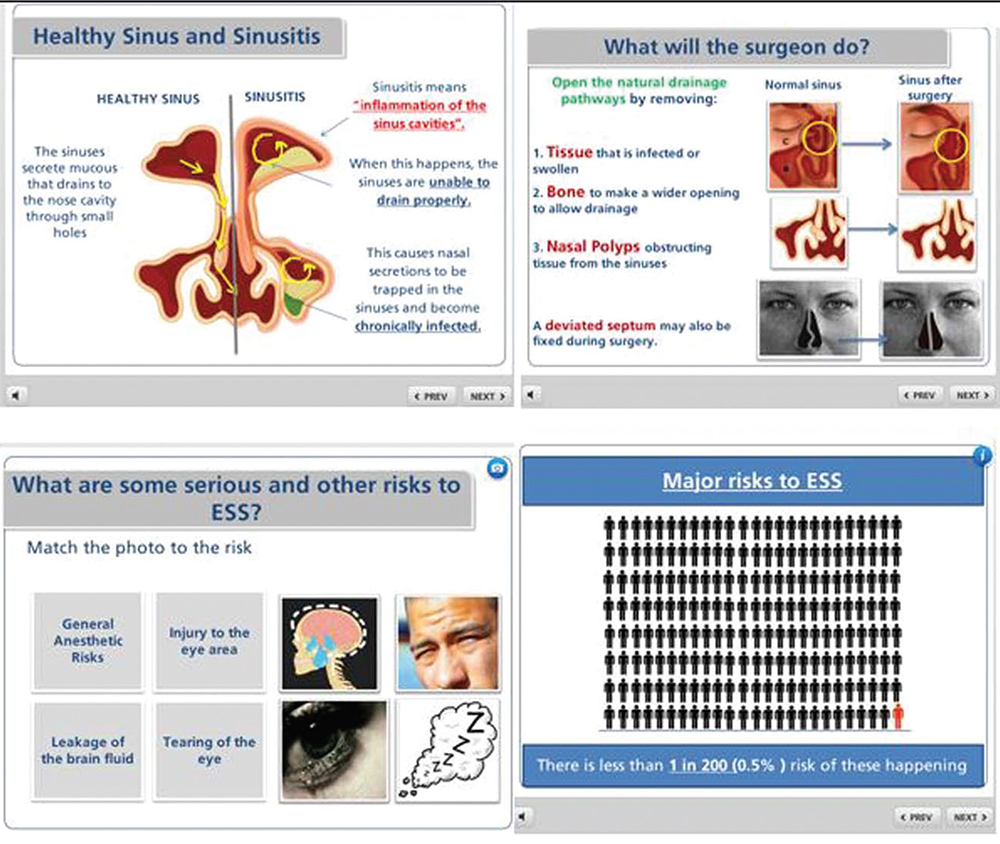
Figure 1. Screenshots of Dr. Sowerby’s multimedia module for patient consent. Audio voice-over, images, and relevant figures were synchronized to convey clinical information. Animations were used to describe visual phenomena. To optimize patient comprehension, the module contained information at the eighth grade level and incorporated large fonts, bulleting, bolding, and underlining, as well as graphic displays using pictographs of risks and benefits. The module was designed to be interactive to let the patient control the information flow rate.

Credit: The Laryngoscope. ©The American Laryngological, Rhinological and Otological Society, Inc.

You Might Also Like:

The Triological SocietyENTtoday is a publication of The Triological Society.

Polls

Have you participated in any leadership training to further your career?

View Results

Loading ... Loading ...
  • Polls Archive

Top Articles for Residents

  • Is the SLOR in Otolaryngology Residency Applications Contributing to Rural Disparities?
  • Applications Open for Resident Members of the ENTtoday Editorial Board: Deadline Extended
  • A Resident’s View of AI in Otolaryngology
  • Call for Resident Bowl Questions
  • Resident Pearls: Pediatric Otolaryngologists Share Tips for Safer, Smarter Tonsillectomies
  • Popular this Week
  • Most Popular
  • Most Recent
    • Otolaryngology Hospitalists: A Relatively New Role
    • The Dramatic Rise in Tongue Tie and Lip Tie Treatment
    • History of the Cochlear Implant
    • Signaling in Otolaryngology Resident Matching
    • Empty Nose Syndrome: Physiological, Psychological, or Perhaps a Little of Both?
    • The Dramatic Rise in Tongue Tie and Lip Tie Treatment
    • Rating Laryngopharyngeal Reflux Severity: How Do Two Common Instruments Compare?
    • Is Middle Ear Pressure Affected by Continuous Positive Airway Pressure Use?
    • Otolaryngologists Are Still Debating the Effectiveness of Tongue Tie Treatment
    • Complications for When Physicians Change a Maiden Name
    • Otolaryngology Hospitalists: A Relatively New Role
    • Feeling the Squeeze
    • Patient and Procedural Predictors of Early Recovery Quality after Endoscopic Endonasal Surgery
    • What’s New Versus Tried and True in Pulsatile Tinnitus
    • The Impact of Chronic Particulate Matter Exposure on Quality-of-Life Outcomes after ESS

Follow Us

  • Contact Us
  • About Us
  • Advertise
  • The Triological Society
  • The Laryngoscope
  • Laryngoscope Investigative Otolaryngology
  • Privacy Policy
  • Terms of Use
  • Cookies

Wiley

Copyright © 2026 by John Wiley & Sons, Inc. All rights reserved, including rights for text and data mining and training of artificial technologies or similar technologies. ISSN 1559-4939

Figure 1. Screenshots of Dr. Sowerby’s multimedia module for patient consent. Audio voice-over, images, and relevant figures were synchronized to convey clinical information. Animations were used to describe visual phenomena. To optimize patient comprehension, the module contained information at the eighth grade level and incorporated large fonts, bulleting, bolding, and underlining, as well as graphic displays using pictographs of risks and benefits. The module was designed to be interactive to let the patient control the information flow rate. Credit: The Laryngoscope. ©The American Laryngological, Rhinological and Otological Society, Inc.