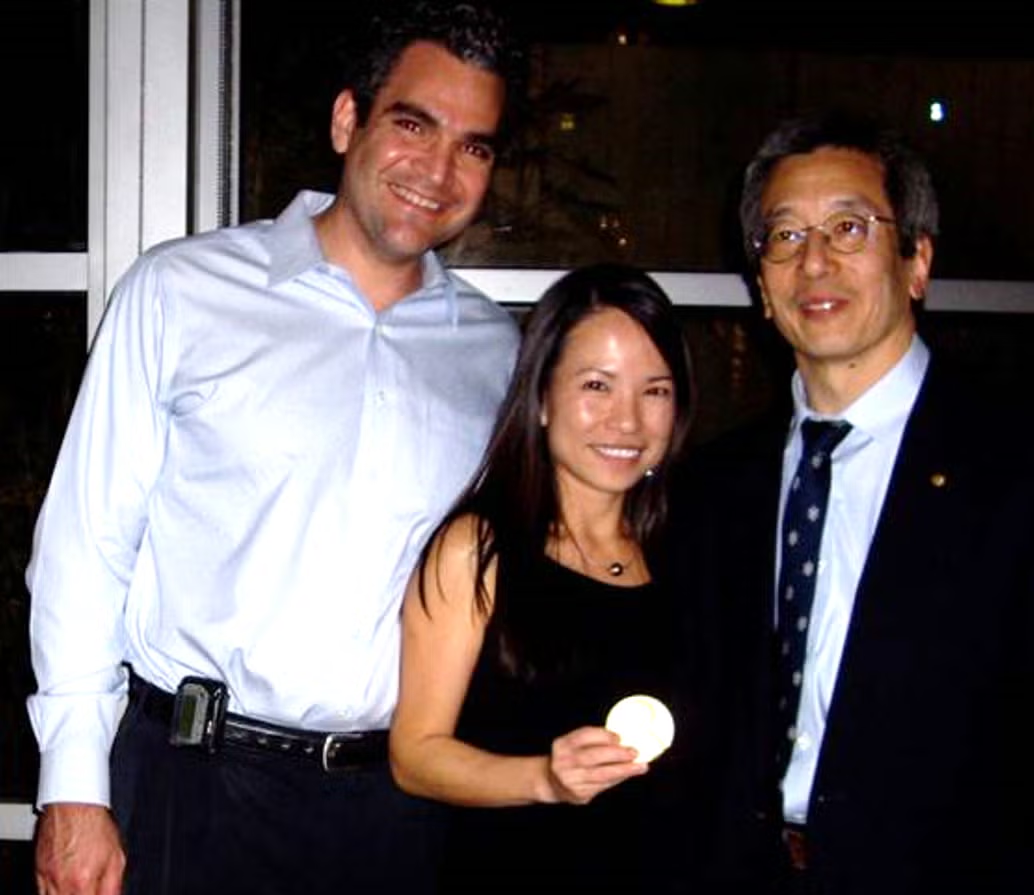
Dr. Nguyen holding Dr. Roger Tsien’s (right) Nobel Prize medal in 2008, at the celebratory dinner with her husband, Brett Berman (left)
If you spend even five minutes with Quyen Nguyen, MD, PhD, you immediately understand why colleagues describe her work as visionary and her presence as grounding. She speaks with a blend of wonder, precision, and generosity that makes you feel as if you’re discovering the field anew, right alongside her.
Explore This Issue
January 2026Dr. Nguyen, professor and neurotologist at UC San Diego, has spent more than two decades pursuing an idea that first grew quietly in the back of her mind as an ENT resident: What if surgeons could simply see nerves? Not through guess-work, experience, or anatomical memory—but truly see them, glowing against surrounding tissue? That question now sits at the center of her “in-human” clinical trial evaluating Bevonescein, a fluorescent nerve-labeling molecule she co-invented with the late Nobel laureate Dr. Roger Tsien.
Our conversation began, not with molecules or microscopes, but with our shared love for people and the stories that form the fabric of our specialty.
This interview was condensed and edited for clarity.
Dr. Rapoport: You shared a beautiful story with me about attending the “Forbes 50 Over 50” event, where a 78-year-old honoree said she sees time as a canvas, not as a linear road. How did her comment resonate with you?
Dr. Nguyen: That moment has stayed with me. She said a woman doesn’t have to move through time in a straight line— we can reinvent ourselves whenever we want. As a mother of three daughters and a working physician–scientist, I felt that deeply. You want your children to know they can do anything, at any time, and that their life isn’t limited by a prescribed timeline. I try to center that lesson at home and in my career.
Dr. Rapoport: What initially drew you to medicine and, more specifically, to the field of otolaryngology?
Dr. Nguyen: I recently attended our Academy’s meeting in Indianapolis, where I heard Dr. Jim Netterville’s keynote address. He said the meaning of life for him is to be in service to others. As physicians, we give cures, and we give hope. And when we can’t provide either, we give comfort. Decades after my initial decision to pursue medicine, I believe that he articulated the most succinct way to describe why this profession is important to me. I can’t imagine anything more meaningful than to be helpful when someone is in their greatest moment of need.
Leave a Reply