• Home
  • Practice Focus
    • Facial Plastic/Reconstructive
    • Head and Neck
    • Laryngology
    • Otology/Neurotology
    • Pediatric
    • Rhinology
    • Sleep Medicine
    • How I Do It
    • TRIO Best Practices
  • Business of Medicine
    • Health Policy
    • Legal Matters
    • Practice Management
    • Technology
    • AI
  • Literature Reviews
    • Facial Plastic/Reconstructive
    • Head and Neck
    • Laryngology
    • Otology/Neurotology
    • Pediatric
    • Rhinology
    • Sleep Medicine
  • Career
    • Medical Education
    • Professional Development
    • Resident Focus
  • ENT Perspectives
    • ENT Expressions
    • Everyday Ethics
    • From TRIO
    • The Great Debate
    • Letter From the Editor
    • Rx: Wellness
    • The Voice
    • Viewpoint
    • SUO Corner
  • TRIO Resources
    • Triological Society
    • The Laryngoscope
    • Laryngoscope Investigative Otolaryngology
    • TRIO Combined Sections Meetings
    • COSM
    • Related Otolaryngology Events
  • Home
  • Practice Focus
    • Facial Plastic/Reconstructive
    • Head and Neck
    • Laryngology
    • Otology/Neurotology
    • Pediatric
    • Rhinology
    • Sleep Medicine
    • How I Do It
    • TRIO Best Practices
  • Business of Medicine
    • Health Policy
    • Legal Matters
    • Practice Management
    • Technology
    • AI
  • Literature Reviews
    • Facial Plastic/Reconstructive
    • Head and Neck
    • Laryngology
    • Otology/Neurotology
    • Pediatric
    • Rhinology
    • Sleep Medicine
  • Career
    • Medical Education
    • Professional Development
    • Resident Focus
  • ENT Perspectives
    • ENT Expressions
    • Everyday Ethics
    • From TRIO
    • The Great Debate
    • Letter From the Editor
    • Rx: Wellness
    • The Voice
    • Viewpoint
    • SUO Corner
  • TRIO Resources
    • Triological Society
    • The Laryngoscope
    • Laryngoscope Investigative Otolaryngology
    • TRIO Combined Sections Meetings
    • COSM
    • Related Otolaryngology Events
  • Search

These Are Some of the Anti-Racism Initiatives Leaders in Medicine Are Undertaking

by Karen Appold • October 12, 2020

  • Tweet
  • Email a link to a friend (Opens in new window) Email
Print-Friendly Version

Overcoming Hurdles

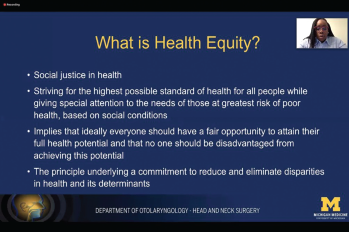
Dr. Shannon Fayson presenting on Health Equity Advocacy, along with Dr. David J. Brown, at University of Michigan's Virtual Subinternship on June 13, 2020. Photo by Ramsha Akhund.

Dr. Shannon Fayson presenting on Health Equity Advocacy, along with Dr. David J. Brown, at University of Michigan’s Virtual Subinternship on June 13, 2020. Photo by Ramsha Akhund.

There are many barriers to combating racism and promoting inclusion in the medical community that also affect otolaryngology. One issue is that racist policies and procedures have become so ingrained in systems that they can be challenging to undo, Dr. Chadwick said. The best way to overcome this problem is for leaders to actively make a dedicated effort to evaluate potentially biased policies and replace them with more inclusive ones.

You Might Also Like

  • A Look at the Past, Present, and Future of DEI Medical Education Initiatives
  • Leaders in Otolaryngology Are Increasing Racial Diversity
  • These Women Have Risen as Leaders of Otolaryngology Associations
  • Black Otolaryngologists Share Their Experiences with Discrimination in Medicine
Explore This Issue
October 2020

Dr. Yoshikawa believes that well-intentioned people are often paralyzed by the fear of saying the wrong thing or offending the person they want to help. “We will make mistakes, and when we do, we have to be open to feedback, even if it stings, and make earnest efforts to do better,” she said. “If we allow ourselves to stay quiet, then we allow racism to continue.”

The bottom line is that combating racism takes an incredible amount of courage, tenacity, empathy, and innovation. “Some people won’t want to speak up because it will disturb the peace or they may feel inadequate to fight for justice because they cannot fully relate to the barriers minorities have to overcome,” Dr. Fayson said. “Whatever the hurdle may be, keep fighting for equity. You’ll make people uncomfortable when combating racism, but real growth occurs when individuals are pushed outside of their comfort zones.” 


Karen Appold is a freelance medical writer based in Pennsylvania.

Initiating Anti-Racism Efforts

How do you begin anti-racism initiatives at your own facility or practice? Otolaryngologists offer some advice.

Identify and Evaluate. The first step in combating racism is to identify it, said Keith A. Chadwick, MD, MS, an assistant professor in the department of surgery, division of otolaryngology–head and neck surgery, at Stony Brook University in Stony Brook, N.Y. “The best way to do that is for institutions to offer mandatory training and workshops in bias, privilege, diversity, inclusion, anti-racism, and allyship,” he said. “However, it’s also important that institutional leaders evaluate their policies and procedures to determine what systemic barriers exist that prevent all groups from being equally represented and recognized. It may be worthwhile to examine other institutions that have had success in diversity efforts and adopt some of the same policies and principles.”

Pages: 1 2 3 4 5 | Single Page

Filed Under: Features, Home Slider Tagged With: diversity, otolaryngologyIssue: October 2020

You Might Also Like:

  • A Look at the Past, Present, and Future of DEI Medical Education Initiatives
  • Leaders in Otolaryngology Are Increasing Racial Diversity
  • These Women Have Risen as Leaders of Otolaryngology Associations
  • Black Otolaryngologists Share Their Experiences with Discrimination in Medicine

The Triological SocietyENTtoday is a publication of The Triological Society.

Polls

More and more medical trainees are taking dedicated, prolonged gap years. Did you?

View Results

Loading ... Loading ...
  • Polls Archive

Top Articles for Residents

  • Is the SLOR in Otolaryngology Residency Applications Contributing to Rural Disparities?
  • Applications Open for Resident Members of the ENTtoday Editorial Board
  • A Resident’s View of AI in Otolaryngology
  • Call for Resident Bowl Questions
  • Resident Pearls: Pediatric Otolaryngologists Share Tips for Safer, Smarter Tonsillectomies
  • Popular this Week
  • Most Popular
  • Most Recent
    • Office Laryngoscopy Is Not Aerosol Generating When Evaluated by Optical Particle Sizer
    • MRI Surveillance Should Extend to 10 Years Post- Op for Vestibular Schwannoma Patients
    • Some Laryngopharyngeal Reflux Resists PPI Treatment
    • Empty Nose Syndrome: Physiological, Psychological, or Perhaps a Little of Both?
    • Top 10 LARY and LIO Articles of 2024
    • The Dramatic Rise in Tongue Tie and Lip Tie Treatment
    • Rating Laryngopharyngeal Reflux Severity: How Do Two Common Instruments Compare?
    • Is Middle Ear Pressure Affected by Continuous Positive Airway Pressure Use?
    • Otolaryngologists Are Still Debating the Effectiveness of Tongue Tie Treatment
    • Complications for When Physicians Change a Maiden Name
    • Short-Term Efficacy of Biologics in Recalcitrant AFRS: A Systematic Review and Meta-Analysis
    • The Devaluation of Otolaryngology: An Evaluation of CMS’s Involvement in Physician Reimbursement
    • Embolized Middle Meningeal Artery as a Surgical Landmark in Infratemporal Fossa
    • Lord of the (Magnetic) Rings: Rigid Bronchoscopy for Aspirated Magnetic Foreign Bodies in Tertiary Bronchi
    • What Otolaryngologists Can Learn from Athletes

Follow Us

  • Contact Us
  • About Us
  • Advertise
  • The Triological Society
  • The Laryngoscope
  • Laryngoscope Investigative Otolaryngology
  • Privacy Policy
  • Terms of Use
  • Cookies

Wiley

Copyright © 2026 by John Wiley & Sons, Inc. All rights reserved, including rights for text and data mining and training of artificial technologies or similar technologies. ISSN 1559-4939