
Explore This Issue
March 2026You wouldn’t (and shouldn’t!) take surgical advice from Steph Curry, Simone Biles, or Patrick Mahomes. But any one of these elite athletes could teach you a few things that may improve your surgical performance and elevate your career. The gulf between the Olympics and the operating room isn’t as wide as you may think. Both are high-pressure environments that require constant adaptation and split-second decision making. Both venues require extraordinary physical dexterity and concentration. Both award outcomes, not effort.
You may not spend hours a day shooting hoops, like NBA star Steph Curry, who famously told a reporter that he practices until he makes 500 baskets a day, but you’ve certainly spent thousands of hours refining your surgical techniques (ESPN. https://tinyurl.com/3k752zds). You’ve probably never faced a balance beam, but the anxiety you felt returning to the OR after a harrowing surgical case likely rivals what USA gymnast Biles felt when she returned to international competition after her withdrawal from the 2021 Tokyo Olympics due to a serious case of the “twisties,” a loss of connection between the brain’s intent and the body’s execution in mid-air (Olympics. com. https://tinyurl.com/57bnwm54). And although you almost surely do not have a Super Bowl ring, you know that studying and analyzing your options increases your odds of a successful surgery, just as careful analyses of football patterns and evolving plays have contributed to the success of NFL quarterback Mahomes (NY Times. https://tinyurl.com/3eauppyx).
Curry, Biles, Mahomes, and most other professional athletes have devoted countless hours to honing their mind game. Biles and Mahomes have spoken publicly about their work with sports psychologists, and most D1 and professional athletic teams employ sports psychologists and/or mental performance coaches to bring out the best in their athletes. Yet despite the similarities between sports and surgery, very few surgeons work with sports psychologists or performance coaches (The Kansas City Star. https://tinyurl.com/yc5tnwkn; ESPN. https://tinyurl.com/2aky235a). Most otolaryngologists and otolaryngology residents have never received any formal mental skills training, even though their success—and their patients’ outcomes— rely on their ability to maintain focus and adroitly adapt to changing circumstances.
“The sports world really acknowledges that the mental dimension is important for outcomes,” said W. Jack Palmer, MD, a senior otolaryngology resident at Thomas Jefferson University in Philadelphia and lead author of “Optimizing Otolaryngology Training Through Sports Psychology” (JAMA Otolaryngol Head Neck Surg. doi: 10.1001/jamaoto.2025.2896).
In contrast, he said, “this sort of mental development is not as acknowledged as important in medicine. It’s assumed that, as you go through the process of a difficult training program, you will accumulate these skills. Mental skills training is not formally taught in medical education or otolaryngology residency, and I think it should be.”
Dr. Palmer’s interest in mental skills training and its possible applicability to otolaryngology was fueled, in part, by Tiger Woods, the legendary golfer.
“What really struck me was that a lot of his wins boiled down to his mental fortitude,” Dr. Palmer said. “He entered the 2008 US Open with a broken leg and a torn ACL. He didn’t have a great start, and somehow, he clawed his way back and won the tournament.”
Dr. Palmer theorized that otolaryngologists with similar mental fortitude and focus may be better prepared to face and withstand the rigors of a modern medical career—and limited research, plus the anecdotal experiences of otolaryngologist–athletes, suggests he’s right.
“Surgery feels like a sport,” said Eric Dowling, MD, an otolaryngologist at the University of Virginia Health in Charlottesville (and former semi-pro football player) who specializes in head and neck surgical oncology and microvascular reconstruction. “It takes the same kind of technical preparation and mental fortitude as athletics does. A big part of it is being in the right headspace.”
Devoting even a small amount of time to developing your mental game can pay meaningful dividends. Deliberately incorporating mental skills training into otolaryngology education could improve the performance, longevity, and career satisfaction of the next generation of otolaryngologists. Here are a few evidence-informed mental training strategies—drawn from athletics—that you can begin applying right now.
Pre-Performance Preparation
No one gets to the Olympics, the NFL, or the operating room without a lot of practice and preparation. Repetition allows you to perfect your physical skills; certain movements and responses get encoded into muscle memory. With practice, certain skills become routine and automatic.

Dr. Matthew Miller is a former D1 swimmer and an elite amateur triathlete.
Athletes learn to turn off their conscious mind and allow the subconscious mind to take over during competition, said Matthew Q. Miller, MD, a former D1 swimmer and elite amateur triathlete who currently serves as director of the UNC Facial Nerve Center in Chapel Hill, N.C.
“In sports, you learn that you’ve got to have extremely intense focus during training. But when it comes to race day, you’ve just got to stop thinking. The same is true for surgery,” Dr. Miller said.
Physicians, of course, have to think during clinical encounters and surgery. Questioning and second-guessing every move, though, is counterproductive; at a certain point, you must trust your training, preparation, and plan.
Visualization is a tool elite athletes commonly use to support their performance. Before a race, meet, or competition, they imagine the event (and their actions) in great detail. They engage in mental rehearsal, repeatedly imagining and envisioning success. This practice both boosts their confidence and improves their physical performance, with published research showing that internalized rehearsal may strengthen the cognitive and motor circuits associated with the imagined actions (Open Neuroimag J. doi: 10.2174/1874440000802010005).
A recent randomized trial of surgical trainees found that mental rehearsal improved laparoscopic knot-tying precision and reduced leaks, with neuroimaging suggesting the gains were driven by reduced reliance on conscious executive control and more efficient activation of motor cortex networks (Front Hum Neurosci. doi: 10.3389/fnhum.2024.1386005). The trainees assigned to mental rehearsal were given a standardized mental imagery script to follow, one that walked them through the exact steps of suturing and instructed them to imagine instrument positioning and hand movements, as well as how the task might feel.
That kind of specificity is key to effective visualization, said Madison Martins, PsyD, a licensed clinical and sports psychologist and clinical assistant professor of the department of psychiatry and behavioral sciences at Keck School of Medicine of USC in Los Angeles (and former D1 equestrian).
“When many people think of visualization, they often just think of sight,” she said. “But in order to really activate the same parts of the brain as motor execution, we want to build in as many senses as possible—all five, if possible.”
Surgeons should think about what they see, hear, and feel in the OR. Dr. Martins recommends thinking through an entire procedure and considering variables as the case progresses. “You might feel fresh at first, but your legs might feel a bit more fatigued halfway through,” she said. “So, how do you then focus your attention on the helpful, right thing instead of drawing attention to that fatigue and making it worse?”
Detailed mental rehearsal allows athletes and surgeons to anticipate, prepare for, and practice responses to difficult moments—particularly when paired with regular, deliberate practice of relaxation and mindfulness techniques, which regulate the stress response, preserve attentional control, and support precise motor execution under pressure.
“It’s teaching not only mastery of the technique or strategy, but also the management of stress and how to operate through it,” Dr. Martins said.
Focus Under Pressure
A regular meditation or mindfulness practice can also enhance surgeons’ (and athletes’) ability to remain calm in challenging circumstances. Dr. Miller said he used meditation as part of his triathlon and surgical preparation, often listening to meditations (using one of the many available meditation apps) during his 30-minute walk to and from work. Now, he meditates about once a week.
Dr. Palmer also uses mindfulness and meditation to strengthen his focus, though he admits his practice isn’t consistent. “I’ve gone on kicks where I meditate a lot and also had times where I’m not as good about it,” he said. “When I am good about it, I notice a pretty incredible boost in my ability to stay levelheaded, manage emotions, and remain even-keeled throughout the day.”
The ability to manage stress and stay levelheaded is crucial to surgical success.
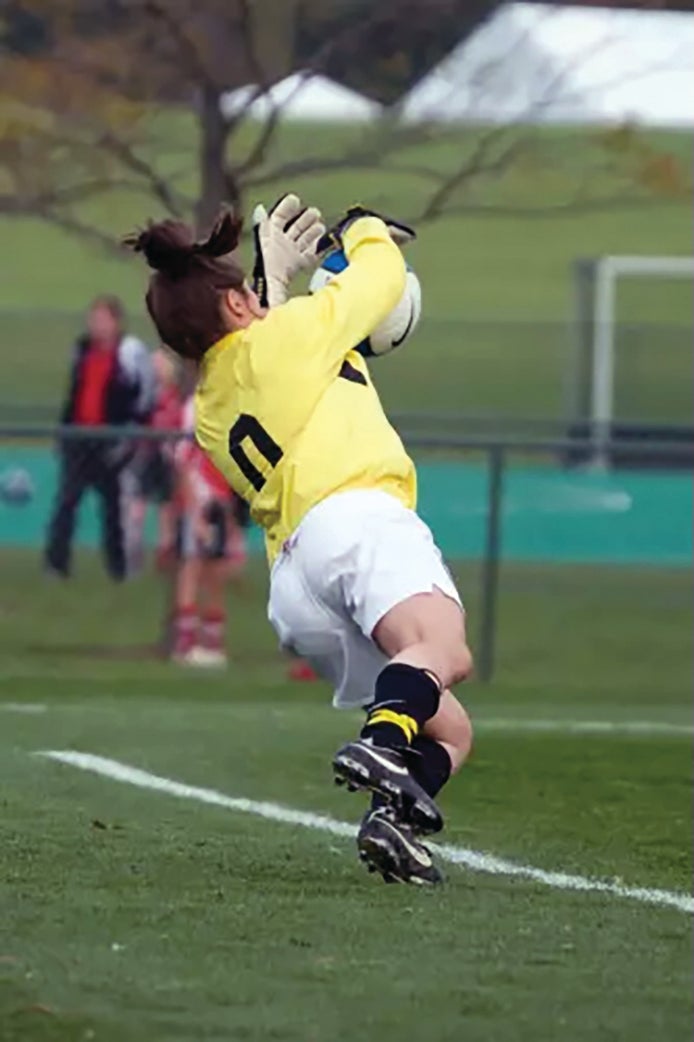
Dr. Natalie Krane is a former collegiate soccer player.
“Surgeries are not like building cars in a manufacturing plant. They don’t all go the same way every single time,” said Natalie Krane, MD, an assistant professor of otolaryngology–head and neck surgery in the division of facial plastic and reconstructive surgery at Oregon Health and Science University in Portland.
No two patients’ sinuses are the same, and despite pre-surgical imaging, you may encounter unexpected obstacles and challenges intra-operatively. Surgeons’ stress levels tend to rise at that time—and although rising adrenaline levels are a good, helpful response designed to sharpen focus so you can respond quickly and accurately, an unchecked stress response can also lead to shaky hands and scattered focus.
A 2025 systematic review of literature examining the impacts of stress on surgical performance found that acute stress consistently leads to impairment in both technical and non-technical skills, including diminished instrument handling, higher procedural error rates, and impaired communication (Surg Endosc. doi: 10.1007/s00464-024-11389- 3). “Pushing through” stress—continuing work without attempting to lower stress levels—may be harmful for both healthcare providers and patients.
Deliberately pausing and resetting your nervous system can help you think more clearly and work more effectively.
Dr. Krane, a former collegiate soccer player, routinely uses breathing techniques to calm herself during surgery or challenging clinical encounters.
“Restorative breath practices switch us from a sympathetic to a parasympathetic state; they take us from fight-or-flight to a sense of calm and spatial awareness,” she said. “Breath is the quickest way back to the present moment.”
Athletes use—and sports and performance psychologists teach—a variety of breathing techniques, including box breathing (inhale for four counts, hold for four, exhale for four, hold for four), frequency breathing (slow, deep, rhythmic breathing), and belly (or diaphragmatic) breathing. The specific technique doesn’t matter as much as finding a practice that works for you and using it deliberately to pause, reset, and refocus.
Simply pausing and deliberately concentrating on the feeling of your feet on the ground can also lower stress levels. “It is grounding yourself in the present moment, so you are not ruminating on the past or anxious about the future,” Dr. Krane said. “It’s an approach I learned in sports and have definitely taken off the field.”
Increasing your awareness of your level of arousal during surgery (or clinical encounters) can also help you spend more time operating in a flow state, rather than a distracted or anxious one. Dr. Martins teaches her clients about the Yerkes-Dodson law, a psychological principle that describes the intersection of performance and mental arousal (SimplyPsychology. https://tinyurl.com/58fcssre). Up to a certain point, arousal improves performance; beyond that, performance deteriorates. She helps clients identify how they feel when they are both under- and over-aroused and then teaches them techniques they can use to manage their arousal state.
“As we get to know how we experience increased arousal, we can then plan: Okay, when that happens, I’m going to take a deep breath. Or, I’m going to pause for a second and do a quick mental rehearsal of my next move,” Dr. Martins said.
Dr. Dowling learned the value of identifying and sharing your attention or stress level with the rest of your team from UVA sports psychologists, whom he invited to speak to the otolaryngology department. The psychologists taught the physicians in attendance three attention zones: Zone One, a somewhat under-aroused state; Zone Two, a just-right flow state; and Zone Three, an over-stimulated, tense state.
Now, in the OR, if stress is high, Dr. Dowling may say aloud, “I’m feeling a little Zone Three right now.” That simple comment releases some of the tension and creates shared awareness, making it easier for the surgical team to stay aligned. During particularly high-stress moments, Dr. Dowling may put his instruments down and step away from the table for a moment.
“It’s very rare in surgery that you can’t take five seconds to ease the tension in the room, come back into your body, and get yourself into the right headspace,” he said.
Staying in the Game
Stress management and other performance psychology techniques can contribute to career longevity as well. Think about it: Simone Biles’ long gymnastics career is likely directly related to the fact that she prioritizes her mental well-being and cares for both her physical and mental health.
“Generally, the ones who have the longest careers are the ones who are able to manage their emotions, manage their mind,” Dr. Martins said.
Elite athletes also continue to practice and build their skills—including mental discipline and fortitude—throughout their career. Brian Moore, MD, a head and neck surgical oncologist (and former Tulane University tennis player) who serves as a chief medical officer at Ochsner Health in New Orleans, thinks a similar approach could benefit medicine.
“Maybe we need to approach the development of master clinicians and physician leaders in the same way we develop Olympic or professional athletes,” with continued investments in time and training, Dr. Moore said. “Right now, once folks graduate from residency or fellowship, we consider them baked, when in fact they may be just learning the game.”
For surgeons, mental skills training may offer a similar path—not only toward better performance in the moment, but toward careers that are more sustainable over decades. Like athletes, otolaryngologists who continue to train their minds, not just their hands, may be better equipped to navigate pressure, recover from setbacks, and remain engaged in their work over the long term.
Jennifer Fink is a freelance medical writer based in Wisconsin.
Leave a Reply