• Home
  • Practice Focus
    • Facial Plastic/Reconstructive
    • Head and Neck
    • Laryngology
    • Otology/Neurotology
    • Pediatric
    • Rhinology
    • Sleep Medicine
    • How I Do It
    • TRIO Best Practices
  • Business of Medicine
    • Health Policy
    • Legal Matters
    • Practice Management
    • Technology
    • AI
  • Literature Reviews
    • Facial Plastic/Reconstructive
    • Head and Neck
    • Laryngology
    • Otology/Neurotology
    • Pediatric
    • Rhinology
    • Sleep Medicine
  • Career
    • Medical Education
    • Professional Development
    • Resident Focus
  • ENT Perspectives
    • ENT Expressions
    • Everyday Ethics
    • From TRIO
    • The Great Debate
    • Letter From the Editor
    • Rx: Wellness
    • The Voice
    • Viewpoint
    • SUO Corner
  • TRIO Resources
    • Triological Society
    • The Laryngoscope
    • Laryngoscope Investigative Otolaryngology
    • TRIO Combined Sections Meetings
    • COSM
    • Related Otolaryngology Events
  • Home
  • Practice Focus
    • Facial Plastic/Reconstructive
    • Head and Neck
    • Laryngology
    • Otology/Neurotology
    • Pediatric
    • Rhinology
    • Sleep Medicine
    • How I Do It
    • TRIO Best Practices
  • Business of Medicine
    • Health Policy
    • Legal Matters
    • Practice Management
    • Technology
    • AI
  • Literature Reviews
    • Facial Plastic/Reconstructive
    • Head and Neck
    • Laryngology
    • Otology/Neurotology
    • Pediatric
    • Rhinology
    • Sleep Medicine
  • Career
    • Medical Education
    • Professional Development
    • Resident Focus
  • ENT Perspectives
    • ENT Expressions
    • Everyday Ethics
    • From TRIO
    • The Great Debate
    • Letter From the Editor
    • Rx: Wellness
    • The Voice
    • Viewpoint
    • SUO Corner
  • TRIO Resources
    • Triological Society
    • The Laryngoscope
    • Laryngoscope Investigative Otolaryngology
    • TRIO Combined Sections Meetings
    • COSM
    • Related Otolaryngology Events
  • Search

New Research Presented at Triological Society Annual Meeting

by Elizabeth Hofheinz, PhD, MEd • July 7, 2019

  • Tweet
  • Email a link to a friend (Opens in new window) Email
Print-Friendly Version

Improving Inpatient Resident Hand-Offs and Transitions of Care

Austin N. DeHart, MDTo explore ways to improve the accuracy of resident handoffs, a team from Virginia Commonwealth University in Richmond undertook a quality improvement (QI) initiative. Their work was presented by Austin N. DeHart, MD, who is now a fellow in pediatric otolaryngology at Arkansas Children’s Hospital in Little Rock.

You Might Also Like

  • Otolaryngology Research Highlights from Triological Society Annual Meeting
  • Research Highlights from 2016 Triological Society Annual Meeting
  • Three New Fellows Present Thesis Awards at Triological Society Annual Meeting
  • Coverage from the 2017 Triological Society Annual Meeting
Explore This Issue
July 2019

“We know that 20% to 40% of malpractice claims are associated with patient handoffs, communication failures, and transitions of care,” said Dr. DeHart. “The ACGME has new requirements that programs ensure and monitor effective and structured handoffs in order to facilitate the continuity of care and patient safety.”

Their institute is a tertiary care academic hospital with residents who rotate among multiple teams and cross-cover call, so there are numerous handoffs every day. “We were using a handwritten list to keep track of patients during rounds and handoffs, which took a lot of time to make and were variable in quality,” she said.
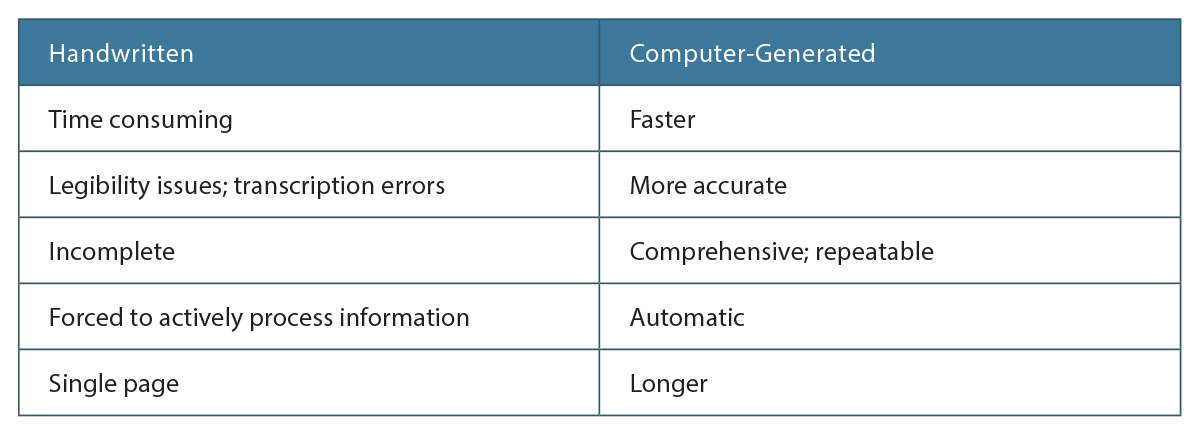
Handwritten vs. Computer-Generated Hand-Off Lists

Handwritten vs. Computer-Generated Hand-Off Lists

She and her team wanted to see if a computer could improve the process and initiated a QI project to determine if they could create a computer-generated list that would save time and improve accuracy. They performed a retrospective analysis of the handwritten lists over a one-month period and found large variability in the accuracy and reliability among the lists, depending on who made them. They used this information to obtain support from the bioinformatics department to contract with a third party to create a computer-generated list.

“Once the residents were familiar with the computer-generated list, we held a workshop where all team members created both lists and compared the processes,” she said. A survey of the trainees revealed that 100% found the computer-
generated lists helpful and 80% indicated that the computer-generated lists were better for patient care; 70% preferred the computer-generated list to the handwritten list.

“One of the positive aspects of a handwritten list is that it forces you to actively think about what is required,” said Dr. DeHart. “But, obviously, too many things are being missed with this method.” 


Elizabeth Hofheinz is a freelance medical writer based in Louisiana.

Mentorship Program Goals

  • Early exposure to the profession of otolaryngology
  • Early introduction of surgical mentorship
  • Feedback-oriented longitudinal clinical experience
  • Education on the residency application process
  • Career advice, networking, and research opportunities
  • Focus on professionalism.

Pages: 1 2 3 | Single Page

Filed Under: Features Tagged With: clinical research, Triological Society Annual Meeting 2019Issue: July 2019

You Might Also Like:

  • Otolaryngology Research Highlights from Triological Society Annual Meeting
  • Research Highlights from 2016 Triological Society Annual Meeting
  • Three New Fellows Present Thesis Awards at Triological Society Annual Meeting
  • Coverage from the 2017 Triological Society Annual Meeting

The Triological SocietyENTtoday is a publication of The Triological Society.

Polls

Have you ever encountered a mentally or physically threatening patient or caregiver?

View Results

Loading ... Loading ...
  • Polls Archive

Top Articles for Residents

  • Is the SLOR in Otolaryngology Residency Applications Contributing to Rural Disparities?
  • Applications Open for Resident Members of the ENTtoday Editorial Board
  • A Resident’s View of AI in Otolaryngology
  • Call for Resident Bowl Questions
  • Resident Pearls: Pediatric Otolaryngologists Share Tips for Safer, Smarter Tonsillectomies
  • Popular this Week
  • Most Popular
  • Most Recent
    • Office Laryngoscopy Is Not Aerosol Generating When Evaluated by Optical Particle Sizer
    • More Than Skin Deep: Building a Workforce Patients Can Trust
    • Is Cognitive Behavioral Therapy Effective for Tinnitus?
    • Some Laryngopharyngeal Reflux Resists PPI Treatment
    • Top 10 LARY and LIO Articles of 2024
    • The Dramatic Rise in Tongue Tie and Lip Tie Treatment
    • Rating Laryngopharyngeal Reflux Severity: How Do Two Common Instruments Compare?
    • Is Middle Ear Pressure Affected by Continuous Positive Airway Pressure Use?
    • Otolaryngologists Are Still Debating the Effectiveness of Tongue Tie Treatment
    • Complications for When Physicians Change a Maiden Name
    • The Pursuit of Excellence—the Journey or the Gold
    • Is There Benefit of Music Training Following Cochlear Implantation?
    • Is Cognitive Behavioral Therapy Effective for Tinnitus?
    • Does Dupilumab Improve Sinonasal Outcomes in AERD Patients?
    • Making the Most of TRIO Meetings

Follow Us

  • Contact Us
  • About Us
  • Advertise
  • The Triological Society
  • The Laryngoscope
  • Laryngoscope Investigative Otolaryngology
  • Privacy Policy
  • Terms of Use
  • Cookies

Wiley

Copyright © 2026 by John Wiley & Sons, Inc. All rights reserved, including rights for text and data mining and training of artificial technologies or similar technologies. ISSN 1559-4939