
• Home
  • Practice Focus
    • Facial Plastic/Reconstructive
    • Head and Neck
    • Laryngology
    • Otology/Neurotology
    • Pediatric
    • Rhinology
    • Sleep Medicine
    • How I Do It
    • TRIO Best Practices
  • Business of Medicine
    • Health Policy
    • Legal Matters
    • Practice Management
    • Technology
    • AI
  • Literature Reviews
    • Facial Plastic/Reconstructive
    • Head and Neck
    • Laryngology
    • Otology/Neurotology
    • Pediatric
    • Rhinology
    • Sleep Medicine
  • Career
    • Medical Education
    • Professional Development
    • Resident Focus
  • ENT Perspectives
    • ENT Expressions
    • Everyday Ethics
    • From TRIO
    • The Great Debate
    • Letter From the Editor
    • Rx: Wellness
    • The Voice
    • Viewpoint
    • SUO Corner
  • TRIO Resources
    • Triological Society
    • The Laryngoscope
    • Laryngoscope Investigative Otolaryngology
    • TRIO Combined Sections Meetings
    • COSM
    • Related Otolaryngology Events
  • Home
  • Practice Focus
    • Facial Plastic/Reconstructive
    • Head and Neck
    • Laryngology
    • Otology/Neurotology
    • Pediatric
    • Rhinology
    • Sleep Medicine
    • How I Do It
    • TRIO Best Practices
  • Business of Medicine
    • Health Policy
    • Legal Matters
    • Practice Management
    • Technology
    • AI
  • Literature Reviews
    • Facial Plastic/Reconstructive
    • Head and Neck
    • Laryngology
    • Otology/Neurotology
    • Pediatric
    • Rhinology
    • Sleep Medicine
  • Career
    • Medical Education
    • Professional Development
    • Resident Focus
  • ENT Perspectives
    • ENT Expressions
    • Everyday Ethics
    • From TRIO
    • The Great Debate
    • Letter From the Editor
    • Rx: Wellness
    • The Voice
    • Viewpoint
    • SUO Corner
  • TRIO Resources
    • Triological Society
    • The Laryngoscope
    • Laryngoscope Investigative Otolaryngology
    • TRIO Combined Sections Meetings
    • COSM
    • Related Otolaryngology Events
  • Search

Should Surgeons Routinely Inform Patients about Risks of Taste Dysfunction after Tongue Base Surgery for Sleep Apnea?

by Adam Kwinter, BSc, Kenny Pang, MD, and Brian Rotenberg, MD, MPH • November 9, 2017

  • Tweet
  • Email a link to a friend (Opens in new window) Email
Print-Friendly Version

TRIO Best Practice

You Might Also Like

  • TORS Base of Tongue Surgery Reduces Sleepiness, AHI in OSA
  • No Persistent Postoperative Swallowing Dysfunction Following Pharyngeal Surgery in Patients with Obstructive Sleep Apnea
  • Transoral Robotic Surgery for Obstructive Sleep Apnea Results in Significant Changes
  • Gaps in the Knowledge Base Regarding Surgery for Obstructive Sleep Apnea
Explore This Issue
November 2017

Background

Multilevel pharyngeal surgery is routinely indicated for patients suffering from obstructive sleep apnea (OSA) as both a first-line treatment and for patients whose disease is refractory to continuous positive airway pressure (CPAP) treatment. Tongue-base reduction surgeries to correct relative macroglasia are rapidly gaining traction as useful treatments for OSA. Novel techniques and technologies such as radio frequency ablation, coblation lingual tonsillectomy, and transoral robotic surgery (TORS)—as well as more traditional tongue-base reduction techniques—are being employed in the operating room to achieve tongue reduction. When offering surgery to a patient, the informed consent process is key in helping the patient understand the risks of the procedure. With regard to surgery of the tongue base of OSA, most consent discussions revolve around risks of bleeding or airway swelling. Because surgery is typically directed to the posterior tongue base and not the anterior tongue, taste dysfunction (TD) typically has not been emphasized in the literature. However, it remains an understandable concern of patients undergoing tongue reduction surgery, and thus physicians should be able to knowledgeably inform patients about this complication.

Best Practice
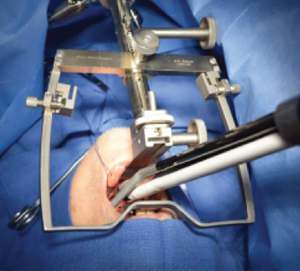
Robotic tongue-base resection.

Robotic tongue-base resection.

The literature suggests that the incidence of alteration in taste sensation with coblation lingual tonsillectomy, TORS tongue-base reduction, and submucosal lingualplasty is sufficiently high to warrant warning patients of this complication. For each of these procedures, TD appears to be a complication that frequently resolves after a few months; however, in some cases it can persist for far longer and become problematic. Radiofrequency tongue-base reduction has been the most heavily studied with respect to TD and is considered a safe option that does not seem to increase the risk of TD, whereas the other tongue procedures for OSA all seem to be associated with some degree of TD after surgery. Further investigations are needed to better characterize the TD associated with each procedure and quantify the risk of TD associated with each surgery. In addition, because TD may be associated with the duration of the surgery, as well as tongue retraction instrumentation used (e.g., laryngoscope placement, Boyle-Davis gag placement), these possibilities should be considered when counseling patients (Laryngoscope. 2017;127:1253–1254).

Filed Under: Head and Neck, Head and Neck, Practice Focus, TRIO Best Practices Tagged With: patient care, risks, sleep apnea, srugery, taste dysfunction, TORS tongue-base reductionIssue: November 2017

You Might Also Like:

  • TORS Base of Tongue Surgery Reduces Sleepiness, AHI in OSA
  • No Persistent Postoperative Swallowing Dysfunction Following Pharyngeal Surgery in Patients with Obstructive Sleep Apnea
  • Transoral Robotic Surgery for Obstructive Sleep Apnea Results in Significant Changes
  • Gaps in the Knowledge Base Regarding Surgery for Obstructive Sleep Apnea

The Triological SocietyENTtoday is a publication of The Triological Society.

Polls

More and more medical trainees are taking dedicated, prolonged gap years. Did you?

View Results

Loading ... Loading ...
  • Polls Archive

Top Articles for Residents

  • Is the SLOR in Otolaryngology Residency Applications Contributing to Rural Disparities?
  • Applications Open for Resident Members of the ENTtoday Editorial Board
  • A Resident’s View of AI in Otolaryngology
  • Call for Resident Bowl Questions
  • Resident Pearls: Pediatric Otolaryngologists Share Tips for Safer, Smarter Tonsillectomies
  • Popular this Week
  • Most Popular
  • Most Recent
    • Office Laryngoscopy Is Not Aerosol Generating When Evaluated by Optical Particle Sizer
    • Some Laryngopharyngeal Reflux Resists PPI Treatment
    • Cochlear Implants Improve Performance and Net Savings in Infants
    • Top 10 LARY and LIO Articles of 2024
    • Empty Nose Syndrome: Physiological, Psychological, or Perhaps a Little of Both?
    • The Dramatic Rise in Tongue Tie and Lip Tie Treatment
    • Rating Laryngopharyngeal Reflux Severity: How Do Two Common Instruments Compare?
    • Is Middle Ear Pressure Affected by Continuous Positive Airway Pressure Use?
    • Otolaryngologists Are Still Debating the Effectiveness of Tongue Tie Treatment
    • Keeping Watch for Skin Cancers on the Head and Neck
    • Short-Term Efficacy of Biologics in Recalcitrant AFRS: A Systematic Review and Meta-Analysis
    • The Devaluation of Otolaryngology: An Evaluation of CMS’s Involvement in Physician Reimbursement
    • Embolized Middle Meningeal Artery as a Surgical Landmark in Infratemporal Fossa
    • Lord of the (Magnetic) Rings: Rigid Bronchoscopy for Aspirated Magnetic Foreign Bodies in Tertiary Bronchi
    • What Otolaryngologists Can Learn from Athletes

Follow Us

  • Contact Us
  • About Us
  • Advertise
  • The Triological Society
  • The Laryngoscope
  • Laryngoscope Investigative Otolaryngology
  • Privacy Policy
  • Terms of Use
  • Cookies

Wiley

Copyright © 2026 by John Wiley & Sons, Inc. All rights reserved, including rights for text and data mining and training of artificial technologies or similar technologies. ISSN 1559-4939