Military audiology integrates advanced research and clinical care to protect and restore hearing health in service members and veterans. Efforts include innovative diagnostic tools, protective devices, and treatments for hearing loss and tinnitus.


Ankyloglossia, or tongue tie, remains a controversial condition regarding its diagnosis and treatment, particularly frenotomy, with ongoing debates about its impact on breastfeeding, speech, and sleep apnea. Recent research and clinical guidelines emphasize the need for careful assessment and multidisciplinary approaches to care.
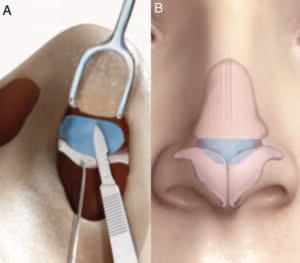
The butterfly graft (BFG) is a surgical technique used to treat nasal airway obstruction by reconstructing the internal nasal valve, but it can lead to external nasal contour irregularities. This study evaluates a secondary contouring procedure designed to address these irregularities while preserving nasal function and improving patient satisfaction.

Chronic cough affects about 10% of people globally and can persist for many years, often requiring a multidisciplinary approach for diagnosis and treatment. Recent research suggests that chronic cough should be considered a distinct disease, with neurogenic mechanisms playing a significant role in some cases.
Does the type of pre-operative nodal biopsy influence the risk of ENE in patients with p16-positive OPSCC, and is it associated with adjuvant therapy type?
What ergonomic risks do rhinologists face during common office-based procedures, and how does procedure type influence the frequency of high-risk postures?
What is the comparative efficacy of steroid irrigation, steroid-eluting sinus (SES) stents, and their combination in improving endoscopic outcomes following ESS in patients with chronic rhinosinusitis?
Does ChatGPT exhibit demographic bias—based on race, gender, or sexual orientation—when simulating residency selection rankings in otolaryngology?

With the Trump administration interrupting research at academic medical centers, court fights over the proposal of a 15% cap on the indirect rate, diversity research de-funded, and a proposal that would cut the NIH budget by 40%, traditionally robust federal support for medical research in the U.S. has eroded, and the research community shows little confidence that this will change in the short term.

In a 2016 survey of American Rhinologic Society (ARS) members on practice patterns regarding office-based rhinology procedures, 63% of the respondents reported an increase in the number of office-based procedures they performed over the last five years.