
• Home
  • Practice Focus
    • Facial Plastic/Reconstructive
    • Head and Neck
    • Laryngology
    • Otology/Neurotology
    • Pediatric
    • Rhinology
    • Sleep Medicine
    • How I Do It
    • TRIO Best Practices
  • Business of Medicine
    • Health Policy
    • Legal Matters
    • Practice Management
    • Technology
    • AI
  • Literature Reviews
    • Facial Plastic/Reconstructive
    • Head and Neck
    • Laryngology
    • Otology/Neurotology
    • Pediatric
    • Rhinology
    • Sleep Medicine
  • Career
    • Medical Education
    • Professional Development
    • Resident Focus
  • ENT Perspectives
    • ENT Expressions
    • Everyday Ethics
    • From TRIO
    • The Great Debate
    • Letter From the Editor
    • Rx: Wellness
    • The Voice
    • Viewpoint
    • SUO Corner
  • TRIO Resources
    • Triological Society
    • The Laryngoscope
    • Laryngoscope Investigative Otolaryngology
    • TRIO Combined Sections Meetings
    • COSM
    • Related Otolaryngology Events
  • Home
  • Practice Focus
    • Facial Plastic/Reconstructive
    • Head and Neck
    • Laryngology
    • Otology/Neurotology
    • Pediatric
    • Rhinology
    • Sleep Medicine
    • How I Do It
    • TRIO Best Practices
  • Business of Medicine
    • Health Policy
    • Legal Matters
    • Practice Management
    • Technology
    • AI
  • Literature Reviews
    • Facial Plastic/Reconstructive
    • Head and Neck
    • Laryngology
    • Otology/Neurotology
    • Pediatric
    • Rhinology
    • Sleep Medicine
  • Career
    • Medical Education
    • Professional Development
    • Resident Focus
  • ENT Perspectives
    • ENT Expressions
    • Everyday Ethics
    • From TRIO
    • The Great Debate
    • Letter From the Editor
    • Rx: Wellness
    • The Voice
    • Viewpoint
    • SUO Corner
  • TRIO Resources
    • Triological Society
    • The Laryngoscope
    • Laryngoscope Investigative Otolaryngology
    • TRIO Combined Sections Meetings
    • COSM
    • Related Otolaryngology Events
  • Search

Is Topical Tranexamic Acid Effective in Treating Epistaxis?

by Kelti M. Munroe, MD, Leigh J. Sowerby, MD, FRCSC, and Christopher J. Chin, MD, FRCSC • April 3, 2025

  • Tweet
  • Email a link to a friend (Opens in new window) Email
Print-Friendly Version

TRIO Best PracticeTRIO Best Practice articles are brief, structured reviews designed to provide the busy clinician with a handy outline and reference for day-to-day clinical decision making. The ENTtoday summaries below include the Background and Best Practice sections of the original article. To view the complete Laryngoscope articles free of charge, visit Laryngoscope.com.

You Might Also Like

  • Is Tranexamic Acid Effective for Hemostasis During Endoscopic Sinus Surgery?
  • Assessment of Tranexamic Acid in Reducing Intraoperative Blood Loss During Rhytidectomy
  • Should Tranexamic Acid Be Used to Reduce Intraoperative Blood Loss During Rhytidectomy?
  • What is the Role of Tranexamic Acid in Septorhinoplasty?
Explore This Issue
April 2025

BACKGROUND

Epistaxis is a common emergency department (ED) presentation. Many cases are self-limited, but other cases may require an intervention to stop bleeding. Methods to manage epistaxis include nasal compression, topical vasoconstrictors, cautery, nasal packing, and even surgical ligation in severe cases.

Though generally effective, nasal packing is associated with complications such as pain, mucosal irritation, rebleeding with pack removal, infection, and tissue necrosis. As a result, the search for alternative methods to treat epistaxis continues. Tranexamic acid (TXA), a well-known antifibrinolytic agent, is used commonly in the ED in the setting of trauma and has been used in the operating room to reduce bleeding. It has recently gained popularity as a treatment modality for epistaxis. The goal of this review is to determine whether topical TXA is an effective treatment modality for epistaxis.

BEST PRACTICE

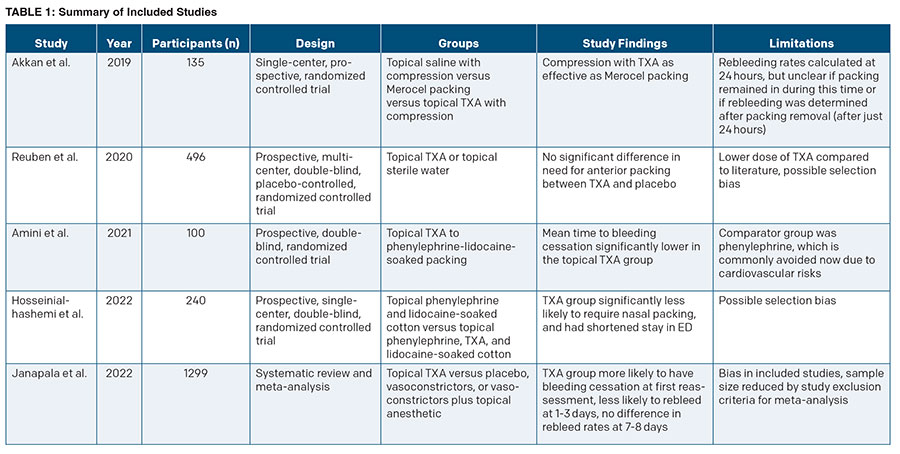
A review of relevant literature (Table 1) suggests that topical TXA could potentially be a useful adjunct in the management of anterior epistaxis. The current evidence is somewhat flawed, however, and multiple limitations have been identified. Further study is warranted to ascertain the role of topical TXA in the management of epistaxis.   
Filed Under: Practice Focus, Rhinology, Rhinology, TRIO Best Practices Tagged With: epistaxis, Tranexamic Acid, TXAIssue: April 2025

You Might Also Like:

  • Is Tranexamic Acid Effective for Hemostasis During Endoscopic Sinus Surgery?
  • Assessment of Tranexamic Acid in Reducing Intraoperative Blood Loss During Rhytidectomy
  • Should Tranexamic Acid Be Used to Reduce Intraoperative Blood Loss During Rhytidectomy?
  • What is the Role of Tranexamic Acid in Septorhinoplasty?

Leave a Reply Cancel reply

Your email address will not be published. Required fields are marked *

The Triological SocietyENTtoday is a publication of The Triological Society.

Polls

More and more medical trainees are taking dedicated, prolonged gap years. Did you?

View Results

Loading ... Loading ...
  • Polls Archive

Top Articles for Residents

  • Is the SLOR in Otolaryngology Residency Applications Contributing to Rural Disparities?
  • Applications Open for Resident Members of the ENTtoday Editorial Board
  • A Resident’s View of AI in Otolaryngology
  • Call for Resident Bowl Questions
  • Resident Pearls: Pediatric Otolaryngologists Share Tips for Safer, Smarter Tonsillectomies
  • Popular this Week
  • Most Popular
  • Most Recent
    • Gap Year for Research: Is It Worth It?
    • What Otolaryngologists Can Learn from Athletes
    • Office Laryngoscopy Is Not Aerosol Generating When Evaluated by Optical Particle Sizer
    • Some Laryngopharyngeal Reflux Resists PPI Treatment
    • The Dramatic Rise in Tongue Tie and Lip Tie Treatment
    • The Dramatic Rise in Tongue Tie and Lip Tie Treatment
    • Rating Laryngopharyngeal Reflux Severity: How Do Two Common Instruments Compare?
    • Is Middle Ear Pressure Affected by Continuous Positive Airway Pressure Use?
    • Otolaryngologists Are Still Debating the Effectiveness of Tongue Tie Treatment
    • Complications for When Physicians Change a Maiden Name
    • Short-Term Efficacy of Biologics in Recalcitrant AFRS: A Systematic Review and Meta-Analysis
    • The Devaluation of Otolaryngology: An Evaluation of CMS’s Involvement in Physician Reimbursement
    • Embolized Middle Meningeal Artery as a Surgical Landmark in Infratemporal Fossa
    • Lord of the (Magnetic) Rings: Rigid Bronchoscopy for Aspirated Magnetic Foreign Bodies in Tertiary Bronchi
    • What Otolaryngologists Can Learn from Athletes

Follow Us

  • Contact Us
  • About Us
  • Advertise
  • The Triological Society
  • The Laryngoscope
  • Laryngoscope Investigative Otolaryngology
  • Privacy Policy
  • Terms of Use
  • Cookies

Wiley

Copyright © 2026 by John Wiley & Sons, Inc. All rights reserved, including rights for text and data mining and training of artificial technologies or similar technologies. ISSN 1559-4939