• Home
  • Practice Focus
    • Facial Plastic/Reconstructive
    • Head and Neck
    • Laryngology
    • Otology/Neurotology
    • Pediatric
    • Rhinology
    • Sleep Medicine
    • How I Do It
    • TRIO Best Practices
  • Business of Medicine
    • Health Policy
    • Legal Matters
    • Practice Management
    • Tech Talk
    • AI
  • Literature Reviews
    • Facial Plastic/Reconstructive
    • Head and Neck
    • Laryngology
    • Otology/Neurotology
    • Pediatric
    • Rhinology
    • Sleep Medicine
  • Career
    • Medical Education
    • Professional Development
    • Resident Focus
  • ENT Perspectives
    • ENT Expressions
    • Everyday Ethics
    • From TRIO
    • The Great Debate
    • Letter From the Editor
    • Rx: Wellness
    • The Voice
    • Viewpoint
  • TRIO Resources
    • Triological Society
    • The Laryngoscope
    • Laryngoscope Investigative Otolaryngology
    • TRIO Combined Sections Meetings
    • COSM
    • Related Otolaryngology Events
  • Search

Research Breakthroughs: Award-winning studies blaze new trails in hearing treatment

by Thomas R. Collins • June 9, 2010

  • Tweet
  • Click to email a link to a friend (Opens in new window) Email
Print-Friendly Version

LAS VEGAS—A test that measures in real time how a noise stimulus on one side affects contralateral otoacoustic emissions (OAEs) could be a new, more accurate predictor of hearing in newborns, according to award-winning research presented at the Annual Meeting of the Triological Society, part of the Combined Otolaryngology Spring Meetings held here April 28-May 2.

You Might Also Like

  • Award-Winning Theses Shed New Light on Treatment Modalities, Disease Etiology
  • Choosing the Better- Or Worse-Hearing Ear for Cochlear Implantation
  • Choice of Ear for Cochlear Implantation: Implant the Better- or Worse-Hearing Ear?
  • New Research in Hearing Loss
Explore This Issue
June 2010

Contralateral suppression, or the medial olivocochlear (MOC) reflex, could also be used to assess the effects on hearing of neonatal disorders like hyperbilirubinemia, said Adrian James, MD, a pediatric otorhinolaryngologist at the Hospital for Sick Children in Toronto.

Dr. James won the Mosher Award at the Triological Society’s meeting for his work. In another research highlight, the society gave the Fowler Award to Philip Littlefield, MD, a neurotologist at the Walter Reed Army Medical Center, for his work on laser stimulation of auditory nerve fibers, which shows the potential to boost the quality of help for the hearing impaired. That research was done at Northwestern University in Chicago under the mentorship of Claus Peter-Richter MD, PhD.
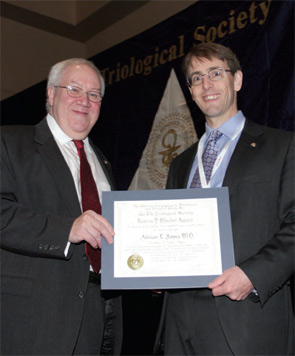
Adrian James, MD, accepts the Mosher Award

Adrian James, MD, accepts the Mosher Award

Mosher Award

In Dr. James’ work, testing contralateral suppression was a better predictor of hearing outcomes in hyperbilirubinemia-affected infants than the standard auditory brainstem response (ABR) test. In contralateral suppression, a noise stimulus in one ear causes a signal to pass along the cochlear nerve across the brainstem to the other side, where it has the effect of reducing otoacoustic emissions.

It is known that in certain forms of auditory neuropathy, this reflex is lost. But Dr. James thought that conditions with more variable severity might have a varied effect on the reflex. The test is done by giving a sound stimulus, then detecting OAEs with digital filtering, which gives a continuous readout of the response.

In unsedated infants with normal hearing who were tested in the noisy neonatal intensive care unit (NICU), all had a detectable contralateral suppression response. “This demonstrated that it’s a feasible test even in the acoustically inhospitable environment of the NICU,” Dr. James said.

In infants with hyperbilirubinemia, the OAE levels dipped down within the same amount of time as those without, but it took longer for OAEs to come back up after the stimulus stopped. “It’s quite plausible that the brainstem is where hyperbilirubinemia is affecting the pathway, although further work would have to be done to substantiate this hypothesis,” Dr. James said.

Pages: 1 2 3 | Single Page

Filed Under: Articles, Clinical, News Issue: June 2010

You Might Also Like:

  • Award-Winning Theses Shed New Light on Treatment Modalities, Disease Etiology
  • Choosing the Better- Or Worse-Hearing Ear for Cochlear Implantation
  • Choice of Ear for Cochlear Implantation: Implant the Better- or Worse-Hearing Ear?
  • New Research in Hearing Loss

Leave a Reply Cancel reply

Your email address will not be published. Required fields are marked *

The Triological SocietyENTtoday is a publication of The Triological Society.

Polls

Has experience as a patient influenced your professional development or demeanor?

View Results

Loading ... Loading ...
  • Polls Archive

Top Articles for Residents

  • A Resident’s View of AI in Otolaryngology
  • Call for Resident Bowl Questions
  • Resident Pearls: Pediatric Otolaryngologists Share Tips for Safer, Smarter Tonsillectomies
  • A Letter to My Younger Self: Making Deliberate Changes Can Help Improve the Sense of Belonging
  • ENTtoday Welcomes Resident Editorial Board Members
  • Popular this Week
  • Most Popular
  • Most Recent
    • Office Laryngoscopy Is Not Aerosol Generating When Evaluated by Optical Particle Sizer

    • Rewriting the Rules of Rhinosinusitis

    • Top 10 LARY and LIO Articles of 2024

    • A Case for Endoscopic Surgery: How Personal Experience Influenced Pursuit of a New Skill

    • The Dramatic Rise in Tongue Tie and Lip Tie Treatment

    • The Dramatic Rise in Tongue Tie and Lip Tie Treatment

    • Rating Laryngopharyngeal Reflux Severity: How Do Two Common Instruments Compare?

    • Is Middle Ear Pressure Affected by Continuous Positive Airway Pressure Use?

    • Otolaryngologists Are Still Debating the Effectiveness of Tongue Tie Treatment

    • Keeping Watch for Skin Cancers on the Head and Neck

    • Why So Loud? Rethinking the Volume of Our Everyday Experiences
    • How Audiologists and Researchers Are Shaping Military Hearing Health Practices
    • A Case for Endoscopic Surgery: How Personal Experience Influenced Pursuit of a New Skill
    • The Path to Department Chair: Arriving and Thriving
    • Rewriting the Rules of Rhinosinusitis

Follow Us

  • Contact Us
  • About Us
  • Advertise
  • The Triological Society
  • The Laryngoscope
  • Laryngoscope Investigative Otolaryngology
  • Privacy Policy
  • Terms of Use
  • Cookies

Wiley

Copyright © 2026 by John Wiley & Sons, Inc. All rights reserved, including rights for text and data mining and training of artificial technologies or similar technologies. ISSN 1559-4939