• Home
  • Practice Focus
    • Facial Plastic/Reconstructive
    • Head and Neck
    • Laryngology
    • Otology/Neurotology
    • Pediatric
    • Rhinology
    • Sleep Medicine
    • How I Do It
    • TRIO Best Practices
  • Business of Medicine
    • Health Policy
    • Legal Matters
    • Practice Management
    • Technology
    • AI
  • Literature Reviews
    • Facial Plastic/Reconstructive
    • Head and Neck
    • Laryngology
    • Otology/Neurotology
    • Pediatric
    • Rhinology
    • Sleep Medicine
  • Career
    • Medical Education
    • Professional Development
    • Resident Focus
  • ENT Perspectives
    • ENT Expressions
    • Everyday Ethics
    • From TRIO
    • The Great Debate
    • Letter From the Editor
    • Rx: Wellness
    • The Voice
    • Viewpoint
    • SUO Corner
  • TRIO Resources
    • Triological Society
    • The Laryngoscope
    • Laryngoscope Investigative Otolaryngology
    • TRIO Combined Sections Meetings
    • COSM
    • Related Otolaryngology Events
  • Home
  • Practice Focus
    • Facial Plastic/Reconstructive
    • Head and Neck
    • Laryngology
    • Otology/Neurotology
    • Pediatric
    • Rhinology
    • Sleep Medicine
    • How I Do It
    • TRIO Best Practices
  • Business of Medicine
    • Health Policy
    • Legal Matters
    • Practice Management
    • Technology
    • AI
  • Literature Reviews
    • Facial Plastic/Reconstructive
    • Head and Neck
    • Laryngology
    • Otology/Neurotology
    • Pediatric
    • Rhinology
    • Sleep Medicine
  • Career
    • Medical Education
    • Professional Development
    • Resident Focus
  • ENT Perspectives
    • ENT Expressions
    • Everyday Ethics
    • From TRIO
    • The Great Debate
    • Letter From the Editor
    • Rx: Wellness
    • The Voice
    • Viewpoint
    • SUO Corner
  • TRIO Resources
    • Triological Society
    • The Laryngoscope
    • Laryngoscope Investigative Otolaryngology
    • TRIO Combined Sections Meetings
    • COSM
    • Related Otolaryngology Events
  • Search

AAO-HNS Releases Multispeciality Practice Guidelines for Adult Rhinosinusitis

by Margot Fromer • November 1, 2007

  • Tweet
  • Email a link to a friend (Opens in new window) Email
Print-Friendly Version

WASHINGTON, DC-At its annual meeting, the American Academy of Otolaryngology-Head and Neck Surgery released its long-awaited multispecialty practice guidelines for treatment of adult rhinosinusitis.

You Might Also Like

  • New Cerumen Guidelines Development Process Reflects AAO-HNS’s Methodical Approach
  • AAO–HNS Updates Clinical Guidelines for Benign Paroxysmal Positional Vertigo
  • AAO-HNS Releases Updated Clinical Indicators for Parotidectomy and Tracheostomy
  • New Rhinosinusitis Consensus Statement Offers Comprehensive Guidelines
Explore This Issue
November 2007

The ailment affects one in seven adults, has a profound effect on the quality of life, and costs the health care system almost $6 billion every year, said Richard M. Rosenfeld, MD, of the Department of Otolaryngology at State University of New York Downstate Medical Center in Brooklyn, who was chairman of the guidelines panel and lead author of the guidelines. The panel was composed of members of a number of medical specialties: allergy, emergency medicine, family medicine, health insurance, immunology, infectious disease, internal medicine, medical informatics, nursing, otolaryngology, head and neck surgery, and radiology.
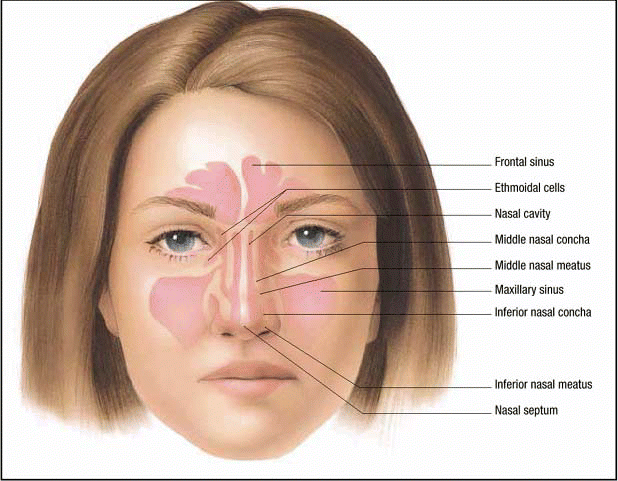
Figure. Anatomical Chart Co.: Rhinosinusitis affects one in seven adults. Considerable practice variations exist for its treatment; the new guidelines include evidence-based statements about which are better and more effective than others.

click for large version
Figure. Anatomical Chart Co.: Rhinosinusitis affects one in seven adults. Considerable practice variations exist for its treatment; the new guidelines include evidence-based statements about which are better and more effective than others.

Beyond its financial impact, sinusitis is responsible for 20% of all antibiotics prescribed in the United States, as well as half a million surgical procedures each year.

Characteristics of the Guidelines

Considerable practice variations exist among the physicians who treat sinusitis, and although there is no one absolutely correct way to proceed, some practices are better and more effective than others, said Dr. Rosenfeld. Therefore, the guidelines consist of 17 evidence-based statements with associated levels of statement strength-for example, strong recommendation, recommendation, recommendation against, or optional.

The guidelines are targeted toward patients aged 18 or older with a clinical diagnosis of uncomplicated rhinosinusitis. Rhinosinusitis is defined as symptomatic inflammation of the paranasal sinuses and nasal cavity. The term rhinosinusitis is preferred because sinusitis is almost always accompanied by inflammation of the contiguous nasal mucosa. When the ailment is called uncomplicated it means that there is no inflammation outside the paranasal sinuses and nasal cavity at the time of diagnosis.

Rhinosinusitis can be further classified by duration as acute (less than 4 weeks), subacute (4 to 12 weeks), or chronic (more than 12 weeks, with or without acute exacerbation).

Most acute rhinosinusitis begins when a viral upper respiratory infection (URI) extends into the paranasal sinuses, which may be followed by bacterial infection. About 20 million cases occur each year, which makes it one of the most common conditions that send people to the physician’s office. Its importance in health care relates not only to its prevalence but also to the potential for rare but serious sequelae: meningitis, brain abscess, orbital cellulitis, and orbital abscess.

Pages: 1 2 3 | Single Page

Filed Under: Head and Neck, Health Policy, Rhinology Issue: November 2007

You Might Also Like:

  • New Cerumen Guidelines Development Process Reflects AAO-HNS’s Methodical Approach
  • AAO–HNS Updates Clinical Guidelines for Benign Paroxysmal Positional Vertigo
  • AAO-HNS Releases Updated Clinical Indicators for Parotidectomy and Tracheostomy
  • New Rhinosinusitis Consensus Statement Offers Comprehensive Guidelines

Leave a Reply Cancel reply

Your email address will not be published. Required fields are marked *

The Triological SocietyENTtoday is a publication of The Triological Society.

Polls

More and more medical trainees are taking dedicated, prolonged gap years. Did you?

View Results

Loading ... Loading ...
  • Polls Archive

Top Articles for Residents

  • Is the SLOR in Otolaryngology Residency Applications Contributing to Rural Disparities?
  • Applications Open for Resident Members of the ENTtoday Editorial Board
  • A Resident’s View of AI in Otolaryngology
  • Call for Resident Bowl Questions
  • Resident Pearls: Pediatric Otolaryngologists Share Tips for Safer, Smarter Tonsillectomies
  • Popular this Week
  • Most Popular
  • Most Recent
    • Gap Year for Research: Is It Worth It?
    • What Otolaryngologists Can Learn from Athletes
    • Office Laryngoscopy Is Not Aerosol Generating When Evaluated by Optical Particle Sizer
    • What Happens to Medical Students Who Don’t Match?
    • MRI Surveillance Should Extend to 10 Years Post- Op for Vestibular Schwannoma Patients
    • The Dramatic Rise in Tongue Tie and Lip Tie Treatment
    • Rating Laryngopharyngeal Reflux Severity: How Do Two Common Instruments Compare?
    • Is Middle Ear Pressure Affected by Continuous Positive Airway Pressure Use?
    • Otolaryngologists Are Still Debating the Effectiveness of Tongue Tie Treatment
    • Complications for When Physicians Change a Maiden Name
    • Short-Term Efficacy of Biologics in Recalcitrant AFRS: A Systematic Review and Meta-Analysis
    • The Devaluation of Otolaryngology: An Evaluation of CMS’s Involvement in Physician Reimbursement
    • Embolized Middle Meningeal Artery as a Surgical Landmark in Infratemporal Fossa
    • Lord of the (Magnetic) Rings: Rigid Bronchoscopy for Aspirated Magnetic Foreign Bodies in Tertiary Bronchi
    • What Otolaryngologists Can Learn from Athletes

Follow Us

  • Contact Us
  • About Us
  • Advertise
  • The Triological Society
  • The Laryngoscope
  • Laryngoscope Investigative Otolaryngology
  • Privacy Policy
  • Terms of Use
  • Cookies

Wiley

Copyright © 2026 by John Wiley & Sons, Inc. All rights reserved, including rights for text and data mining and training of artificial technologies or similar technologies. ISSN 1559-4939