• Home
  • Practice Focus
    • Facial Plastic/Reconstructive
    • Head and Neck
    • Laryngology
    • Otology/Neurotology
    • Pediatric
    • Rhinology
    • Sleep Medicine
    • How I Do It
    • TRIO Best Practices
  • Business of Medicine
    • Health Policy
    • Legal Matters
    • Practice Management
    • Technology
    • AI
  • Literature Reviews
    • Facial Plastic/Reconstructive
    • Head and Neck
    • Laryngology
    • Otology/Neurotology
    • Pediatric
    • Rhinology
    • Sleep Medicine
  • Career
    • Medical Education
    • Professional Development
    • Resident Focus
  • ENT Perspectives
    • ENT Expressions
    • Everyday Ethics
    • From TRIO
    • The Great Debate
    • Letter From the Editor
    • Rx: Wellness
    • The Voice
    • Viewpoint
    • SUO Corner
  • TRIO Resources
    • Triological Society
    • The Laryngoscope
    • Laryngoscope Investigative Otolaryngology
    • TRIO Combined Sections Meetings
    • COSM
    • Related Otolaryngology Events
  • Home
  • Practice Focus
    • Facial Plastic/Reconstructive
    • Head and Neck
    • Laryngology
    • Otology/Neurotology
    • Pediatric
    • Rhinology
    • Sleep Medicine
    • How I Do It
    • TRIO Best Practices
  • Business of Medicine
    • Health Policy
    • Legal Matters
    • Practice Management
    • Technology
    • AI
  • Literature Reviews
    • Facial Plastic/Reconstructive
    • Head and Neck
    • Laryngology
    • Otology/Neurotology
    • Pediatric
    • Rhinology
    • Sleep Medicine
  • Career
    • Medical Education
    • Professional Development
    • Resident Focus
  • ENT Perspectives
    • ENT Expressions
    • Everyday Ethics
    • From TRIO
    • The Great Debate
    • Letter From the Editor
    • Rx: Wellness
    • The Voice
    • Viewpoint
    • SUO Corner
  • TRIO Resources
    • Triological Society
    • The Laryngoscope
    • Laryngoscope Investigative Otolaryngology
    • TRIO Combined Sections Meetings
    • COSM
    • Related Otolaryngology Events
  • Search

Cases Demonstrate Difficulty of Treating Tricky Vocal Fold Cysts

by Thomas R. Collins • October 1, 2009

  • Tweet
  • Email a link to a friend (Opens in new window) Email
Print-Friendly Version
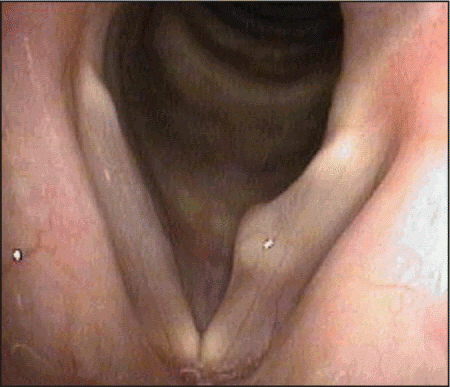
Figure 2. Keratin cyst on the right vocal fold.

You Might Also Like

  • Tricky Vocal Fold Cysts Require Extra Preparation-For Both Physicians and Patients
  • Voice Therapy May Help Treat Vocal Fold Polyps and Cysts
  • AAO-HNSF 2012: Challenging Vocal Fold Paralysis Cases
  • Pulsed-Dye Laser May Be Useful for Vocal Fold Scarring
Explore This Issue
October 2009
click for large version
Figure 2. Keratin cyst on the right vocal fold.

Dr. Ossoff said it might look like an easy procedure, but it probably wouldn’t be. It looks like it should come out easily, he said. It’s like shucking a clam or shucking an oyster. But when you do that there’s always a piece of flesh that stays on the shell and it doesn’t come out so easily. So don’t be seduced.

Dr. Koufman said she realized it was going to be a difficult case once she started the procedure. I realized it was really stuck there. I had just made a hole in it, and now it was decompressed and I had basically this huge fibrous nothing, she said. There was no subepithelial space. All there was was a scarred vocal fold, and digging it out would have just meant digging out all the scar, digging around in muscle. So I put a little deposteroid in it and quit.

I agree with that decision, Dr. Ossoff said. If you inadvertently get into it so early that you’re not going to be able to define it, I think it’s better to quit and start again another day than to try to do all this digging and leave things far worse than you found them.

Two months later, Dr. Koufman said, the patient developed polypoid changes on the good side.

Dr. Pitman said it is predictable that this will be a long road for the patient and that she should be prepared for that. She’s always had a bad voice, he said. When you see a cyst like that, even if everything goes perfectly, they’re still going to have a long recovery. He said it might be best to work on the area around the cyst to avoid a rupture at the very beginning of the procedure.

Dr. Koufman said the patient ended up with quite a good result but still has some polypoid changes.

Sometimes those polypoid changes actually aid the voice, Dr. Ossoff said. You have something to vibrate and that makes a huge difference. At first, I hated to see that but then I said, ‘That’s my helper.’

Case 3: Multiple Cysts

In another case, a 25-year-old businesswoman came to Dr. Koufman with glottal closure symptoms. One side was mostly cyst. On the other side was a partially removed, decompressed cyst (Figure 3). These are the ones I’ve agonized over, Dr. Koufman said.

Pages: 1 2 3 4 | Single Page

Filed Under: Everyday Ethics, Head and Neck, Laryngology, Medical Education Tagged With: cysts, patient safety, research, treatment, vocal foldsIssue: October 2009

You Might Also Like:

  • Tricky Vocal Fold Cysts Require Extra Preparation-For Both Physicians and Patients
  • Voice Therapy May Help Treat Vocal Fold Polyps and Cysts
  • AAO-HNSF 2012: Challenging Vocal Fold Paralysis Cases
  • Pulsed-Dye Laser May Be Useful for Vocal Fold Scarring

Leave a Reply Cancel reply

Your email address will not be published. Required fields are marked *

The Triological SocietyENTtoday is a publication of The Triological Society.

Polls

More and more medical trainees are taking dedicated, prolonged gap years. Did you?

View Results

Loading ... Loading ...
  • Polls Archive

Top Articles for Residents

  • Is the SLOR in Otolaryngology Residency Applications Contributing to Rural Disparities?
  • Applications Open for Resident Members of the ENTtoday Editorial Board
  • A Resident’s View of AI in Otolaryngology
  • Call for Resident Bowl Questions
  • Resident Pearls: Pediatric Otolaryngologists Share Tips for Safer, Smarter Tonsillectomies
  • Popular this Week
  • Most Popular
  • Most Recent
    • Gap Year for Research: Is It Worth It?
    • Office Laryngoscopy Is Not Aerosol Generating When Evaluated by Optical Particle Sizer
    • What Otolaryngologists Can Learn from Athletes
    • MRI Surveillance Should Extend to 10 Years Post- Op for Vestibular Schwannoma Patients
    • Empty Nose Syndrome: Physiological, Psychological, or Perhaps a Little of Both?
    • The Dramatic Rise in Tongue Tie and Lip Tie Treatment
    • Rating Laryngopharyngeal Reflux Severity: How Do Two Common Instruments Compare?
    • Is Middle Ear Pressure Affected by Continuous Positive Airway Pressure Use?
    • Otolaryngologists Are Still Debating the Effectiveness of Tongue Tie Treatment
    • Complications for When Physicians Change a Maiden Name
    • Short-Term Efficacy of Biologics in Recalcitrant AFRS: A Systematic Review and Meta-Analysis
    • The Devaluation of Otolaryngology: An Evaluation of CMS’s Involvement in Physician Reimbursement
    • Embolized Middle Meningeal Artery as a Surgical Landmark in Infratemporal Fossa
    • Lord of the (Magnetic) Rings: Rigid Bronchoscopy for Aspirated Magnetic Foreign Bodies in Tertiary Bronchi
    • What Otolaryngologists Can Learn from Athletes

Follow Us

  • Contact Us
  • About Us
  • Advertise
  • The Triological Society
  • The Laryngoscope
  • Laryngoscope Investigative Otolaryngology
  • Privacy Policy
  • Terms of Use
  • Cookies

Wiley

Copyright © 2026 by John Wiley & Sons, Inc. All rights reserved, including rights for text and data mining and training of artificial technologies or similar technologies. ISSN 1559-4939