• Home
  • Practice Focus
    • Facial Plastic/Reconstructive
    • Head and Neck
    • Laryngology
    • Otology/Neurotology
    • Pediatric
    • Rhinology
    • Sleep Medicine
    • How I Do It
    • TRIO Best Practices
  • Business of Medicine
    • Health Policy
    • Legal Matters
    • Practice Management
    • Tech Talk
    • AI
  • Literature Reviews
    • Facial Plastic/Reconstructive
    • Head and Neck
    • Laryngology
    • Otology/Neurotology
    • Pediatric
    • Rhinology
    • Sleep Medicine
  • Career
    • Medical Education
    • Professional Development
    • Resident Focus
  • ENT Perspectives
    • ENT Expressions
    • Everyday Ethics
    • From TRIO
    • The Great Debate
    • Letter From the Editor
    • Rx: Wellness
    • The Voice
    • Viewpoint
  • TRIO Resources
    • Triological Society
    • The Laryngoscope
    • Laryngoscope Investigative Otolaryngology
    • TRIO Combined Sections Meetings
    • COSM
    • Related Otolaryngology Events
  • Search
  • Facial Plastic/Reconstructive
  • Head and Neck
  • Laryngology
  • Otology/Neurotology
  • Pediatric
  • Rhinology
  • Sleep Medicine
  • How I Do It
  • TRIO Best Practices

Practice Focus » Pediatric

Age, Experience Factors in Predicting Failure of Subglottic Stenosis Procedures

September 1, 2008

Physicians have suggested that the likelihood of failure of surgery to correct subglottic stenosis appears to be related to the age of the child at the time of treatment and whether the child is being treated at a tertiary care facility.

Pages: 1 2 | Multi-Page

State of the Art in Tonsillectomy

July 1, 2008

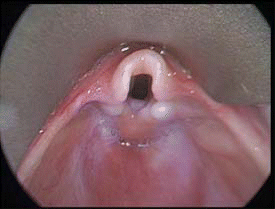
Even though tonsillectomies are a commonly performed procedure, research continues to find out more about how to best do the surgery, as well as other values of the procedure.

Pages: 1 2 3 4 | Multi-Page

For Laryngomalacia, Microdebrider-Assisted Supraglottoplasty Preferred

May 1, 2008

Laryngomalacia is a congenital condition consisting of three anatomical abnormalities: short aryepiglottic folds, suprarythenoid redundant tissue, and an epiglottis that prolapses posteriorly during inspiration.

Pages: 1 2 3 4 5 6 | Multi-Page

Pediatric Extraesophageal Reflux Disease: A Diagnostic Dilemma

May 1, 2008

Pediatric extraesophageal reflux disease (EERD) refers to the manifestations of gastroesophageal reflux that arise outside of the gastrointestinal tract.

Pages: 1 2 3 4 5 | Multi-Page

Evidence Suggests a Novel and Simple Way to Detect SIDS Susceptibility at Birth

April 1, 2008

If recent evidence showing that a hearing injury in infants is a predictor of susceptibility to sudden infant death syndrome (SIDS) is validated with further studies, a perplexing and horrifying syndrome that has caused much consternation and anguish may potentially be detected by a simple hearing test at birth.

Pages: 1 2 3 4 5 | Multi-Page

Gaps in the Knowledge Base Regarding Surgery for Obstructive Sleep Apnea

March 1, 2008

Experts agree that continuous positive airway pressure (CPAP) is the gold standard for management of obstructive sleep apnea.

Pages: 1 2 3 4 | Multi-Page

SDB Morbidity in Children Can Be Improved by Surgery

December 1, 2007

Sleep-disordered breathing (SDB) is a major problem in children because it is associated with behavioral, cognitive, and emotional morbidity.

Pages: 1 2 3 4 | Multi-Page

Foreign Body Aspiration in Pediatric Patients: Bronchoscopy Delay May Be Beneficial

November 1, 2007

Does the time between aspiration and retrieval of an airway foreign body affected the pediatric patient’s outcome?

Pages: 1 2 3 | Multi-Page

A More Conservative Approach

November 1, 2007

There are few data to support primary surgical reduction of the inferior turbinates in the pediatric patient.

Pages: 1 2 | Multi-Page

Surgical Indications for Pediatric Turbinate Reduction: Arguments For and Against

November 1, 2007

Although little prospective data exist evaluating surgical turbinate reduction for chronic pediatric sinusitis and rhinitis, some otolaryngologists do perform the procedure on patients for whom medical therapy has been aggressively tried but clinical symptoms persist.

Pages: 1 2 | Multi-Page
  • « Previous Page
  • 1
  • …
  • 16
  • 17
  • 18
  • 19
  • 20
  • Next Page »

The Triological SocietyENTtoday is a publication of The Triological Society.

Polls

Do you use TXA to reduce intraoperative and post-op bleeding?

View Results

Loading ... Loading ...
  • Polls Archive

Top Articles for Residents

  • A Resident’s View of AI in Otolaryngology
  • Call for Resident Bowl Questions
  • Resident Pearls: Pediatric Otolaryngologists Share Tips for Safer, Smarter Tonsillectomies
  • A Letter to My Younger Self: Making Deliberate Changes Can Help Improve the Sense of Belonging
  • ENTtoday Welcomes Resident Editorial Board Members
  • Popular this Week
  • Most Popular
  • Most Recent
    • Office Laryngoscopy Is Not Aerosol Generating When Evaluated by Optical Particle Sizer

    • Call for Resident Bowl Questions

    • Empty Nose Syndrome: Physiological, Psychological, or Perhaps a Little of Both?

    • Ethical Obligations and Duty to Advocate for Patients in Prior Authorization for Surgery

    • The Dramatic Rise in Tongue Tie and Lip Tie Treatment

    • The Dramatic Rise in Tongue Tie and Lip Tie Treatment

    • Rating Laryngopharyngeal Reflux Severity: How Do Two Common Instruments Compare?

    • Is Middle Ear Pressure Affected by Continuous Positive Airway Pressure Use?

    • Otolaryngologists Are Still Debating the Effectiveness of Tongue Tie Treatment

    • Keeping Watch for Skin Cancers on the Head and Neck

    • Growing Use of Tranexamic Acid in Otolaryngology
    • Reconnect, Recharge, Relax, and Choose Joy This Season
    • A Resident’s View of AI in Otolaryngology
    • Faculty Mentorship of Academic Surgeons
    • CMS’ New Rule Aims to Streamline the Prior Authorization Process

Follow Us

  • Contact Us
  • About Us
  • Advertise
  • The Triological Society
  • The Laryngoscope
  • Laryngoscope Investigative Otolaryngology
  • Privacy Policy
  • Terms of Use
  • Cookies

Wiley

Copyright © 2025 by John Wiley & Sons, Inc. All rights reserved, including rights for text and data mining and training of artificial technologies or similar technologies. ISSN 1559-4939