• Home
  • Practice Focus
    • Facial Plastic/Reconstructive
    • Head and Neck
    • Laryngology
    • Otology/Neurotology
    • Pediatric
    • Rhinology
    • Sleep Medicine
    • How I Do It
    • TRIO Best Practices
  • Business of Medicine
    • Health Policy
    • Legal Matters
    • Practice Management
    • Technology
    • AI
  • Literature Reviews
    • Facial Plastic/Reconstructive
    • Head and Neck
    • Laryngology
    • Otology/Neurotology
    • Pediatric
    • Rhinology
    • Sleep Medicine
  • Career
    • Medical Education
    • Professional Development
    • Resident Focus
  • ENT Perspectives
    • ENT Expressions
    • Everyday Ethics
    • From TRIO
    • The Great Debate
    • Letter From the Editor
    • Rx: Wellness
    • The Voice
    • Viewpoint
    • SUO Corner
  • TRIO Resources
    • Triological Society
    • The Laryngoscope
    • Laryngoscope Investigative Otolaryngology
    • TRIO Combined Sections Meetings
    • COSM
    • Related Otolaryngology Events
  • Home
  • Practice Focus
    • Facial Plastic/Reconstructive
    • Head and Neck
    • Laryngology
    • Otology/Neurotology
    • Pediatric
    • Rhinology
    • Sleep Medicine
    • How I Do It
    • TRIO Best Practices
  • Business of Medicine
    • Health Policy
    • Legal Matters
    • Practice Management
    • Technology
    • AI
  • Literature Reviews
    • Facial Plastic/Reconstructive
    • Head and Neck
    • Laryngology
    • Otology/Neurotology
    • Pediatric
    • Rhinology
    • Sleep Medicine
  • Career
    • Medical Education
    • Professional Development
    • Resident Focus
  • ENT Perspectives
    • ENT Expressions
    • Everyday Ethics
    • From TRIO
    • The Great Debate
    • Letter From the Editor
    • Rx: Wellness
    • The Voice
    • Viewpoint
    • SUO Corner
  • TRIO Resources
    • Triological Society
    • The Laryngoscope
    • Laryngoscope Investigative Otolaryngology
    • TRIO Combined Sections Meetings
    • COSM
    • Related Otolaryngology Events
  • Search

Dr. Michael M. E. Johns: A Statesman of Our Time

by Jennifer Decker Arevalo, MA • November 1, 2006

  • Tweet
  • Email a link to a friend (Opens in new window) Email
Print-Friendly Version

Abstract

Through his courage and convictions, this visionary otolaryngologist is pioneering new models of health and healing for the nation in this century.

You Might Also Like

  • Academic Head and Neck Surgery: Educating Our Future
  • Otolaryngologists-Head and Neck Surgeons Urged: Be Part of the Solution in Health Care Reform
  • Developing Quality Measures in Otolaryngology-Head and Neck Surgery
  • Otolaryngologists View Resident Work-Hour Restrictions: ACS calls for in-depth investigation before mandating further restrictions
Explore This Issue
November 2006

Niccolo Machiavelli wrote in his 1532 treatise, Il Principe, There is nothing more difficult to take in hand, more perilous to conduct, or more uncertain in its success, than to take the lead in the introduction of a new order of things. Yet this is exactly what Michael M. E. Johns, MD, Executive Vice President for Health Affairs at Emory University in Atlanta, does each day as one of the nation’s renowned physician thought leaders on health care reform.

The future of health care is a gigantic issue for America, as it will affect everyone and everything, said Dr. Johns, who is also the CEO of The Robert W. Woodruff Health Sciences Center, Chairman of the Board for Emory Healthcare, Co-Chairman of the Board of EHCA, LLC, and Professor in the Department of Otolaryngology at the Emory University School of Medicine.
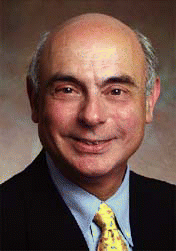
Michael M. E. Johns, MD

Michael M. E. Johns, MD

In a country with multiple health systems and almost 50 million uninsured, reform is essential and we need to address this issue again, said Dr. Johns. Unfortunately, not until costs are so high, the burden on employers and government so great, and the noise of the press so loud, will we see more serious and in-depth conversations on reform in Congress.

Almost 50% of Americans say the country’s health care system needs fundamental changes and 30% believe it should be rebuilt completely, according to a survey, Public Views on Shaping the Future of the U.S. Health System, conducted by Harris Interactive for the Commonwealth Fund. Participants, regardless of political affiliation, are very eager for the president and Congress to address specific issues, such as prescription costs and the long-term solvency of Medicare, to name a few (see sidebar.)

Predictive Health

I think health care is going to change dramatically over the upcoming decades from a reactive and acute approach of caring for individuals to one that is more proactive-that is, keeping people healthy as opposed to treating their sickness, said Dr. Johns. Eventually, the onset of disease will be considered a failure of the health care system, rather than its focus.

This paradigm shift, concentrating on health rather than disease, will come from the science that is developing around the country in the areas of genomics, proteomics, metabolomics, structural biology, computational science, and other advanced technologies, Dr. Johns said. Predictive health and healing will allow us to provide care that is predictive, prospective, personalized and preventive-what we refer to as P4.

Pages: 1 2 3 4 5 | Single Page

Filed Under: Career Development, Departments, Health Policy, Medical Education Tagged With: career, heathcare reform, insurance, leadership, medical education, outcomes, policy, Quality, trainingIssue: November 2006

You Might Also Like:

  • Academic Head and Neck Surgery: Educating Our Future
  • Otolaryngologists-Head and Neck Surgeons Urged: Be Part of the Solution in Health Care Reform
  • Developing Quality Measures in Otolaryngology-Head and Neck Surgery
  • Otolaryngologists View Resident Work-Hour Restrictions: ACS calls for in-depth investigation before mandating further restrictions

Leave a Reply Cancel reply

Your email address will not be published. Required fields are marked *

The Triological SocietyENTtoday is a publication of The Triological Society.

Polls

More and more medical trainees are taking dedicated, prolonged gap years. Did you?

View Results

Loading ... Loading ...
  • Polls Archive

Top Articles for Residents

  • Is the SLOR in Otolaryngology Residency Applications Contributing to Rural Disparities?
  • Applications Open for Resident Members of the ENTtoday Editorial Board
  • A Resident’s View of AI in Otolaryngology
  • Call for Resident Bowl Questions
  • Resident Pearls: Pediatric Otolaryngologists Share Tips for Safer, Smarter Tonsillectomies
  • Popular this Week
  • Most Popular
  • Most Recent
    • Gap Year for Research: Is It Worth It?
    • What Otolaryngologists Can Learn from Athletes
    • Office Laryngoscopy Is Not Aerosol Generating When Evaluated by Optical Particle Sizer
    • What Happens to Medical Students Who Don’t Match?
    • MRI Surveillance Should Extend to 10 Years Post- Op for Vestibular Schwannoma Patients
    • The Dramatic Rise in Tongue Tie and Lip Tie Treatment
    • Rating Laryngopharyngeal Reflux Severity: How Do Two Common Instruments Compare?
    • Is Middle Ear Pressure Affected by Continuous Positive Airway Pressure Use?
    • Otolaryngologists Are Still Debating the Effectiveness of Tongue Tie Treatment
    • Complications for When Physicians Change a Maiden Name
    • Short-Term Efficacy of Biologics in Recalcitrant AFRS: A Systematic Review and Meta-Analysis
    • The Devaluation of Otolaryngology: An Evaluation of CMS’s Involvement in Physician Reimbursement
    • Embolized Middle Meningeal Artery as a Surgical Landmark in Infratemporal Fossa
    • Lord of the (Magnetic) Rings: Rigid Bronchoscopy for Aspirated Magnetic Foreign Bodies in Tertiary Bronchi
    • What Otolaryngologists Can Learn from Athletes

Follow Us

  • Contact Us
  • About Us
  • Advertise
  • The Triological Society
  • The Laryngoscope
  • Laryngoscope Investigative Otolaryngology
  • Privacy Policy
  • Terms of Use
  • Cookies

Wiley

Copyright © 2026 by John Wiley & Sons, Inc. All rights reserved, including rights for text and data mining and training of artificial technologies or similar technologies. ISSN 1559-4939