• Home
  • Practice Focus
    • Facial Plastic/Reconstructive
    • Head and Neck
    • Laryngology
    • Otology/Neurotology
    • Pediatric
    • Rhinology
    • Sleep Medicine
    • How I Do It
    • TRIO Best Practices
  • Business of Medicine
    • Health Policy
    • Legal Matters
    • Practice Management
    • Technology
    • AI
    • History of Otolaryngology
  • Literature Reviews
    • Facial Plastic/Reconstructive
    • Head and Neck
    • Laryngology
    • Otology/Neurotology
    • Pediatric
    • Rhinology
    • Sleep Medicine
  • Career
    • Medical Education
    • Professional Development
    • Resident Focus
  • ENT Perspectives
    • ENT Expressions
    • Everyday Ethics
    • From TRIO
    • The Great Debate
    • Letter From the Editor
    • Rx: Wellness
    • The Voice
    • Viewpoint
    • SUO Corner
  • TRIO Resources
    • Triological Society
    • The Laryngoscope
    • Laryngoscope Investigative Otolaryngology
    • TRIO Combined Sections Meetings
    • COSM
    • Related Otolaryngology Events
  • Search

The Rewards and Dilemmas of Surgical Missions

by Gretchen Henkel • June 7, 2012

  • Tweet
  • Email a link to a friend (Opens in new window) Email
Print-Friendly Version

You Might Also Like

  • New Technique Uses Umbilical Cord Stem Cells for Early Cleft Palate Repair
  • Challenges and Rewards of a Physician Executive Career
  • State of the Art in Tonsillectomy
  • New Department, Everyday Ethics, Examines Ethical Dilemmas in Otolaryngology
Explore This Issue
June 2012

Dr. Senders is professor and director of the cleft and craniofacial program in the department of otolaryngology at the University of California Davis Health System in Sacramento, Calif.

Q: How do you approach the issues of informed consent in a developing country?

Mark E. Boston, MD, FAAP: Here in the United States, only a minority of patients will say, “Okay, doctor, just do whatever you think you should do.” In other countries, the perception of physicians and health care are very different. Many patients understand only that they’re sick and that they could be better with surgery. They have no idea what I am telling them. As a surgeon, you don’t like to get “talked into” doing surgery, but there are a few cases where not operating would be worse than operating, so we will proceed, with the best understanding of the patient. You have to be very thorough in your explanations and make sure that the information is well translated and understood by the patient and the family.

Dr. Boston is a lieutenant colonel with the U.S. Air Force, a surgical services consultant and chief of the provision of medical care for the Air Force Medical Operations Agency, based at Lackland Air Force Base in San Antonio, Texas.

Difficult Cases
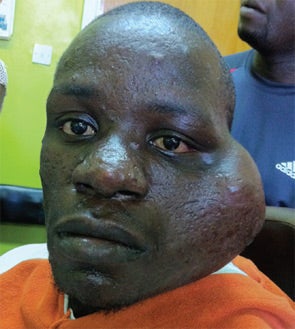
The patient prior to his mandible tumor surgery.

The patient prior to his mandible tumor surgery.

When Dr. Cordes and her team travel to Moi Teaching and Referral Hospital in Eldoret, Kenya, they try to balance straightforward cases such as cleft palate repair with one or two longer cases. One recent case was particularly troubling, however. Scheduled early in the week was a 25-year-old man with a large mandible tumor. It was a complicated case, requiring a parotidectomy, neck dissection and partial mandible resection with a pectoralis flap.

Typically, longer cases are scheduled early in the trip so that patients can be followed post-operatively by the visiting team. On the day of surgery, there were no ICU beds available, and the surgery was cancelled. The patient’s mother approached Dr. Cordes in the hallway, begging her to do the surgery and relieve her son’s pain. “The dilemma is that if we didn’t do the surgery, it wouldn’t get done,” said Dr. Cordes. “Sometimes we sit there with the patient and the Kenyan otolaryngologists who are telling us, ‘We want to get this procedure done while you’re here,’ and you know what they mean is, ‘we’re not comfortable doing it without you.’”

Pages: 1 2 3 4 5 6 | Single Page

Filed Under: Career Development, Departments, Facial Plastic/Reconstructive, Pediatric, Practice Focus Tagged With: cleft palate, facial, interview, outcomes, pediatrics, reconstructive surgery, surgical missionIssue: June 2012

You Might Also Like:

  • New Technique Uses Umbilical Cord Stem Cells for Early Cleft Palate Repair
  • Challenges and Rewards of a Physician Executive Career
  • State of the Art in Tonsillectomy
  • New Department, Everyday Ethics, Examines Ethical Dilemmas in Otolaryngology

Leave a Reply Cancel reply

Your email address will not be published. Required fields are marked *

The Triological SocietyENTtoday is a publication of The Triological Society.

Polls

How have you adopted advanced technologies in your practice?

View Results

Loading ... Loading ...
  • Polls Archive

Top Articles for Residents

  • Is the SLOR in Otolaryngology Residency Applications Contributing to Rural Disparities?
  • Applications Open for Resident Members of the ENTtoday Editorial Board: Deadline Extended
  • A Resident’s View of AI in Otolaryngology
  • Call for Resident Bowl Questions
  • Resident Pearls: Pediatric Otolaryngologists Share Tips for Safer, Smarter Tonsillectomies
  • Popular this Week
  • Most Popular
  • Most Recent
    • Novel Treatments and Advances in OSA
    • The Reasons We Keep Going
    • Some Laryngopharyngeal Reflux Resists PPI Treatment
    • The Dramatic Rise in Tongue Tie and Lip Tie Treatment
    • Onboarding and Working with APPs
    • The Dramatic Rise in Tongue Tie and Lip Tie Treatment
    • Rating Laryngopharyngeal Reflux Severity: How Do Two Common Instruments Compare?
    • Is Middle Ear Pressure Affected by Continuous Positive Airway Pressure Use?
    • Otolaryngologists Are Still Debating the Effectiveness of Tongue Tie Treatment
    • Complications for When Physicians Change a Maiden Name
    • ENTtoday Wins 2026 APEX Award
    • AI-Powered Real-Time Multimodal Model for Predicting Recurrence and Survival in Head and Neck Cancer: A Multicenter, Multinational Study
    • Voices of Leadership: Challenges Faced by Female Facial Plastic Surgeons and Considerations for Future Generations
    • AI in the Diagnosis of Cholesteatoma: A Systematic Review of Current Evidence
    • Gender Identity Disparities in Early Adolescent Sleep: Findings from the Adolescent Brain Cognitive Development Study

Follow Us

  • Contact Us
  • About Us
  • Advertise
  • The Triological Society
  • The Laryngoscope
  • Laryngoscope Investigative Otolaryngology
  • Privacy Policy
  • Terms of Use
  • Cookies

Wiley

Copyright © 2026 by John Wiley & Sons, Inc. All rights reserved, including rights for text and data mining and training of artificial technologies or similar technologies. ISSN 1559-4939