• Home
  • Practice Focus
    • Facial Plastic/Reconstructive
    • Head and Neck
    • Laryngology
    • Otology/Neurotology
    • Pediatric
    • Rhinology
    • Sleep Medicine
    • How I Do It
    • TRIO Best Practices
  • Business of Medicine
    • Health Policy
    • Legal Matters
    • Practice Management
    • Tech Talk
    • AI
  • Literature Reviews
    • Facial Plastic/Reconstructive
    • Head and Neck
    • Laryngology
    • Otology/Neurotology
    • Pediatric
    • Rhinology
    • Sleep Medicine
  • Career
    • Medical Education
    • Professional Development
    • Resident Focus
  • ENT Perspectives
    • ENT Expressions
    • Everyday Ethics
    • From TRIO
    • The Great Debate
    • Letter From the Editor
    • Rx: Wellness
    • The Voice
    • Viewpoint
  • TRIO Resources
    • Triological Society
    • The Laryngoscope
    • Laryngoscope Investigative Otolaryngology
    • TRIO Combined Sections Meetings
    • COSM
    • Related Otolaryngology Events
  • Search

Tips on Creating a Website for Your Practice

by Karen Appold • May 9, 2016

  • Tweet
  • Click to email a link to a friend (Opens in new window) Email
Print-Friendly Version

Dr. Torres used his own family’s photo on the home page to demonstrate that the practice treats the entire family—both adults and children. Other pages feature photos of him treating patients. To incorporate interactive elements, Dr. Torres plans to add some educational videos about conditions he treats. “When patients are exposed to a visual aid, they are 75% more likely to better understand their conditions,” he said.

You Might Also Like

  • ENTtoday Revamps Its Website
  • Tips for Creating a Dynamic Otolaryngology Workforce
  • Tips for Launching a Solo Otolaryngology Practice
  • Tips for Preventing Missed Appointments at Your Practice
Explore This Issue
May 2016

His practice’s site also contains a link to Google maps, so patients can get directions to the practice. “Interactive elements can be meaningful to patients who like this type of online engagement,” he said. Patients can also use the website to e-mail questions to the practice at their convenience, and can sign in to a secure site to access their medical charts.
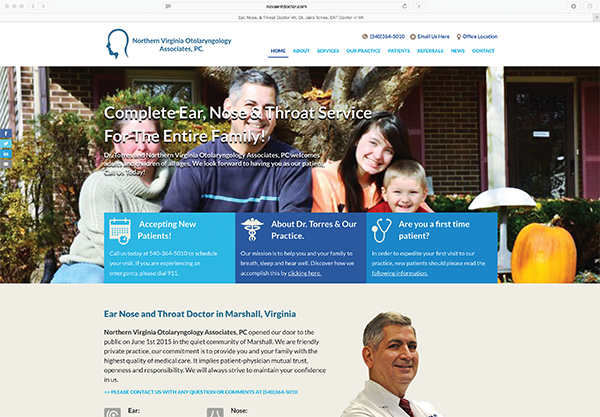
The Northern Virginia Otolaryngology Associates website home page, at novaentdoctor.com, highlights what the patient should know about the practice and offers easy navigation through menu tabs.

The Northern Virginia Otolaryngology Associates website home page, at novaentdoctor.com, highlights what the patient should know about the practice and offers easy navigation through menu tabs.

Developing Content

As you begin to create website content, first list all keywords and phrases that are relevant to your practice, Brouillette said. Content throughout your website should consistently use these keywords. This helps search engines increase the number of visitors to a website by obtaining a high-ranking placement on the search results page—a methodology called search engine optimization.

Above all, messaging needs to address website visitors—their needs, desires, and concerns. “You want visitors to visualize themselves as needing your services and benefiting from them,” said Gainer. “Therefore, don’t infuse messaging with self-aggrandizing content that is irrelevant. If the visitor feels your message is all about you and not about them, then they will likely perceive your website as just transparent marketing.”

Messaging should immediately suggest what is distinctive about a practice. “Just listing services that are common to practices like yours won’t set you apart in a visitor’s mind,” Gainer noted.

Dr. Torres said that he will take the time to explain procedures and educate patients about conditions, which he believes sets him apart from many other practices in his specialty.

The Home Page

The home page—often a visitor’s first view of your website—should include your practice’s logo, its mission statement, and photos that depict what the practice is about. Include a photo of each otolaryngologist and buttons that link to frequently sought-after information.

Try to limit the menu bar to no more than seven categories. A dropdown menu of subpages shows readers the types of information that are provided, Brouillette said, so titles should reflect each page’s content. The key is to make it very user friendly, with contact information and patient portal access readily visible.

Pages: 1 2 3 4 5 | Single Page

Filed Under: Features, Home Slider Tagged With: technology, websiteIssue: May 2016

You Might Also Like:

  • ENTtoday Revamps Its Website
  • Tips for Creating a Dynamic Otolaryngology Workforce
  • Tips for Launching a Solo Otolaryngology Practice
  • Tips for Preventing Missed Appointments at Your Practice

The Triological SocietyENTtoday is a publication of The Triological Society.

Polls

Has experience as a patient influenced your professional development or demeanor?

View Results

Loading ... Loading ...
  • Polls Archive

Top Articles for Residents

  • A Resident’s View of AI in Otolaryngology
  • Call for Resident Bowl Questions
  • Resident Pearls: Pediatric Otolaryngologists Share Tips for Safer, Smarter Tonsillectomies
  • A Letter to My Younger Self: Making Deliberate Changes Can Help Improve the Sense of Belonging
  • ENTtoday Welcomes Resident Editorial Board Members
  • Popular this Week
  • Most Popular
  • Most Recent
    • Growing Use of Tranexamic Acid in Otolaryngology

    • Office Laryngoscopy Is Not Aerosol Generating When Evaluated by Optical Particle Sizer

    • Top 10 LARY and LIO Articles of 2024

    • Empty Nose Syndrome: Physiological, Psychological, or Perhaps a Little of Both?

    • The Dramatic Rise in Tongue Tie and Lip Tie Treatment

    • The Dramatic Rise in Tongue Tie and Lip Tie Treatment

    • Rating Laryngopharyngeal Reflux Severity: How Do Two Common Instruments Compare?

    • Is Middle Ear Pressure Affected by Continuous Positive Airway Pressure Use?

    • Otolaryngologists Are Still Debating the Effectiveness of Tongue Tie Treatment

    • Keeping Watch for Skin Cancers on the Head and Neck

    • Why So Loud? Rethinking the Volume of Our Everyday Experiences
    • How Audiologists and Researchers Are Shaping Military Hearing Health Practices
    • A Case for Endoscopic Surgery: How Personal Experience Influenced Pursuit of a New Skill
    • The Path to Department Chair: Arriving and Thriving
    • Rewriting the Rules of Rhinosinusitis

Follow Us

  • Contact Us
  • About Us
  • Advertise
  • The Triological Society
  • The Laryngoscope
  • Laryngoscope Investigative Otolaryngology
  • Privacy Policy
  • Terms of Use
  • Cookies

Wiley

Copyright © 2026 by John Wiley & Sons, Inc. All rights reserved, including rights for text and data mining and training of artificial technologies or similar technologies. ISSN 1559-4939