In February, the Centers for Medicare and Medicaid Services (CMS) began rolling out its national Recovery Audit Contractor (RAC) program, aimed at ferreting out improper payments and preventing fraud, waste and abuse in the Medicare system. If you bill for Medicare fee-for-service, you are fair game for a RAC audit. A three-year demonstration of the RAC program, which ended in March 2008, heavily targeted bronchoscopy, injectable drugs and IV hydration therapy. But auditors are rapidly expanding the list, and the permanent program will include adenoidectomies, tonsillectomies, thyroidectomies and other otolaryngology-related procedures.

Show Me the Evidence: Comparative effectiveness research could aid treatment decisions
A push at the national level to fund more comparative effectiveness research could mean more information for otolaryngologists about which treatments work best for a given condition and in which patients.

Scarless Surgery: The benefits and drawbacks of robotic thryroidectomy
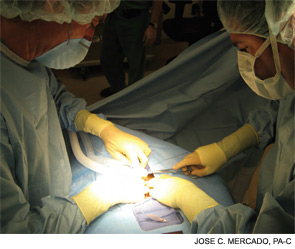
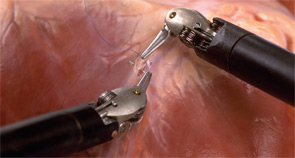
Using robotic arms, surgeons can now remove the thyroid gland through an incision in the axilla, or armpit, thereby avoiding the large scar on the front of the neck caused by traditional thyroid surgery. The procedure offers no other benefits over the traditional approach developed a century ago by Emil Theodor Kocher, MD, according to head and neck surgeons who perform the robotic surgery. In fact, it takes longer to recover from the robotic surgery, they say, with some patients complaining of chest numbness for months afterwards.

A New Game Plan: Otolaryngologists and consultants devise solutions to ride out the recession
Otolaryngologists understand that even their most loyal patients, with finances ravaged by the lingering economic recession, may postpone or forego endoscopic sinus surgery, tonsillectomy or a chemical facial peel in favor of paying the mortgage.

Health Care as a Commodity: Competition should be focus of health reform, lecturer says
Donald Palmisano, Esq., MD, believes the key to curing the health care crisis in the U.S. involves respecting the sacredness of the doctor-patient relationship and capping the size of malpractice awards.

Digital Efficiency: Panel discusses the inevitability of EMRs
Electronic medical records (EMRs) are costly and require significant staff time to implement but have the potential to bring huge benefits to patients and doctors alike, said speakers at the Triological Society’s Combined Sections Meeting held here Feb. 4-7.

Borrowing 101: Minimize risk when taking out a loan for your practice
For better or worse, medical practices are experiencing change. While many physicians are looking to expand their practice, other physicians are seeking a divorce from their current group.

The Future of Genomics Is Now: Dr. Thomas C. Spelsberg discusses the clinical implications
The genome project sequenced all three billion base pairs of human DNA, revealing the instructions cells need to build all the proteins in the body. But that was just a warm-up, according to Thomas C. Spelsberg, PhD, of the Mayo Clinic in Rochester, Minn.

The Female Question: Should more be done to increase the ranks of female otolaryngologists?
Diana C. Ponsky, MD, assistant professor of otolaryngology-facial plastic and reconstructive surgery at Case Medical Center in Cleveland, Ohio, went to medical school wanting to be a pediatrician. She happened upon otolaryngology “by accident, by scrubbing into a very fascinating cancer case. I was hooked,” she now recalls.
Docs Gone Bad: Your top doc just threw a tantrum. Now what?
In the more than ten years that Paul Levine, MD, FACS, has served as chair of otolaryngology and head and neck surgery at the University of Virginia in Charlottesville, he has heard his share of complaints about high-powered surgeons who are difficult to work with.
- « Previous Page
- 1
- …
- 28
- 29
- 30
- 31
- 32
- …
- 50
- Next Page »