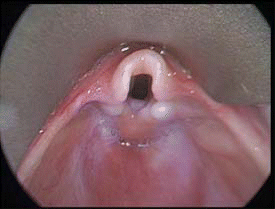
Laryngomalacia is a congenital condition consisting of three anatomical abnormalities: short aryepiglottic folds, suprarythenoid redundant tissue, and an epiglottis that prolapses posteriorly during inspiration.

Every five years I make a list of the ten toughest problems in laryngology, said Jamie Koufman, MD, Director of the Voice Institute of New York.


Snoring is a common complaint of patients (and their spouses) treated by otolaryngologists.

During her presentation at the 2007 Combined Otolaryngology Spring Meeting in San Diego, Dana M. Hartl, MD, PhD, from the Department of Otolaryngology Head and Neck Surgery at the Institut Gustave Roussy in France, described her findings from a retrospective, bi-institutional study designed to review the results of a large series of patients with early glottic squamous cell carcinoma treated with curative intent by transoral laser resection.

We all age, as our bodies unfailingly tell us. Muscles weaken, joints stiffen, hair thins, skin sags-the external signs are evident, albeit somewhat delayed and distorted in the increasing penchant toward masking time through cosmetics.

Non-acidic reflux is a major cause of laryngeal inflammation, and patients with this disorder present with a constellation of symptoms that differ from classic gastroesophageal reflux (GERD).
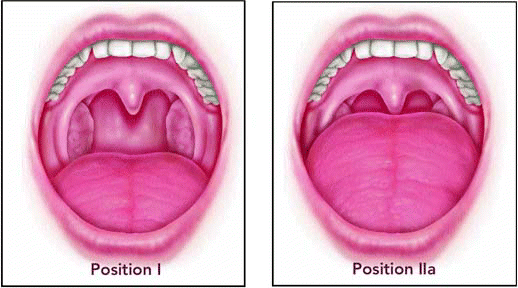
Although otolaryngologic surgeons commonly focus on the palate when treating patients with obstructive sleep apnea (OSA), they also need to look at the tongue.

Until 1980, the primary technique for assessing patients with dysphagia was the modified barium swallow (MBS). It was then that fiberoptic endoscopic evaluation of swallowing was added to the diagnostic armamentarium.

Presenters at several scientific sessions at the Combined Otolaryngology Spring Meeting (COSM) reported on their recent studies involving the use of botulinum toxin type A (Botox® [BTX]; Allergan, Inc., Irvine, CA) injections to treat adductor spasmodic dysphonia (ADSD) and chronic salivary aspiration.