Dr. Johnson gave the presentation at COSM 2011.
TRIO President Discusses the Benefits of U.S. Scientific Research
Dr. Gerald Berke gave his presentation at COSM 2011.
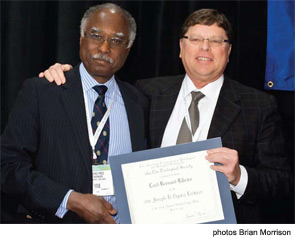
Training Trends: British surgeon offers cautionary tale about limit on trainee duty hours
New limits on doctors in training in the United Kingdom (U.K.) have drastically reduced the amount of training they receive and may put patients in peril, a renowned retired British surgeon told listeners here on April 29 at the Annual Meeting of the Triological Society, held as part of the Combined Otolaryngology Spring Meetings.
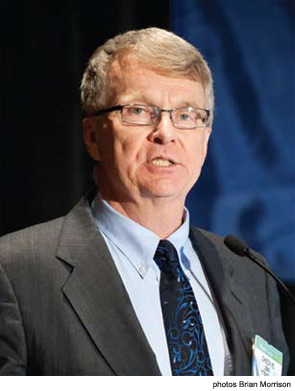
Lecturer Warns Against Overuse of CRT: Says many early-stage laryngeal cancer patients overtreated
Chemoradiation therapy (CRT) for head and neck cancer is overused at some centers in patients with early-stage laryngeal cancer, and more care should be taken not to overtreat patients with therapy that can have toxic effects, said invited lecturer Jonas Johnson, MD, at the Annual Meeting of the Triological Society, held here on April 29 as part of the Combined Otolaryngology Spring Meetings.

Return on Recycling: Reprocessing single-use devices may lower costs, improve efficiency
The idea of reusing single-use devices may bring to mind the recent news of a Las Vegas urologist who was investigated in March for supposedly resuing single-use devices. As the Las Vegas Review-Journal reports, Dr. Michael Kaplan is accussed of reusing, but not not decontaminating, endocavity needle guides. While Dr. Kaplan’s specific case may be unique, the idea of reprocessing single-use devices is not.
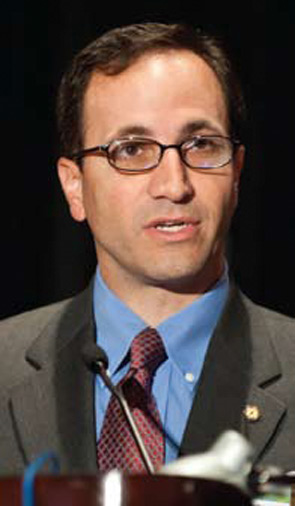
New Tool Could Aid Decisions on Elective Neck Dissection: Fast polymerase chain reaction detects sentinel lymph node positivity
Quantitative real-time polymerase chain reaction (Q-PCR) can be a valuable tool in the operating room to determine whether head and neck cancer patients should go on to elective neck dissection, researchers said here on April 29 at the Annual Meeting of the Triological Society, held as part of the Combined Otolaryngology Spring Meetings.

National Drug Shortage Hits ENT Surgeries: Succinylcholine, propofol and tetracaine in limited supply
When performing certain procedures, many otolaryngologists use succinylcholine, a neuromuscular blocking agent, to help them monitor the facial nerve.

Letter: Another ENT-Hospitalist
Regarding the article, “Otolaryngologist Pioneers New Practice Model: Dr. Russell heralds hospitalist role as others ponder the concept’s staying power”…
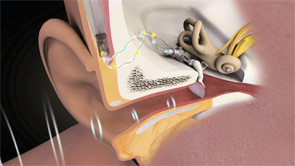
Middle Ear Implants Offer Potential: New breed of devices may stimulate compliance, experts say
For decades, otolaryngologists have been frustrated by the refusal of some patients with hearing loss to use hearing aids. Statistics on noncompliance vary, but there is general agreement that only about 20 percent to 25 percent of Americans with treatable hearing loss use hearing aids. The problem seems to be more acute for people with mild hearing loss: A consumer survey conducted by the nonprofit Better Hearing Institute in 2009 found that fewer than 10 percent of people with mild hearing loss use amplification and that even among people with moderate-to-severe hearing loss, only four in 10 use amplification.

Social Media-cine: Get your practice on board with an Internet policy
An increasing number of physicians are venturing onto the web, and, in particular, into social media. Recently, my client Dr. M was advised by a consultant to update his practice’s website, create a Facebook page for his practice and join Twitter. The marketing consultant cautioned Dr. M that there are legal concerns for health care providers associated with the Internet and social media. While social media can be a beneficial marketing tool, it is important for physicians to have in place a specific media policy that addresses the proper ways to use this outreach both in and outside the workplace.
- « Previous Page
- 1
- …
- 22
- 23
- 24
- 25
- 26
- …
- 51
- Next Page »